 English
 Spanish
 Portuguese
 German
 Italian
 Japanese
 French
 Polish
 Russian
 Netherlands
 Hungarian
 Turkish
 Videos
 Thedink Pickleball


Chris Olson of Pickleball Studio explains the criteria worth prioritizing before you buy your next paddle
Paddle buying guides are a dime a dozen, and usually they're sales promotion in disguise. It bugs me. It should bug you.
This one is not.
The easiest way to choose a pickleball paddle is to decide your three to five dealbreakers before you look at a single model. Dealbreakers are things like shape, handle length, swing weight, power level and durability. Any paddle that misses one is out, no matter how good the reviews are.
That method comes from Chris Olson of Pickleball Studio, one of the most-watched paddle reviewers in the sport. Olson has play-tested well over 500 paddles, and he can get pretty much any paddle he wants. There are still paddles he won’t play with, even when he thinks they perform exceptionally well.
In an interview with The Dink, I asked him a hypothetical:
If you were a billionaire, would you use an incredible paddle that didn’t last very long?“Yeah, I probably wouldn’t use it,” he told me.
Then he pointed out that, when it comes to access to paddles, he essentially already is a billionaire. Durability still matters to him because he doesn’t want his equipment changing mid-tournament, however easily he could replace it.
Every shopper should take the same lesson: decide what a paddle has to do before you get sold on what it can do.
This guide combines that interview with Olson’s recent discussions across his platform, Pickleball Studio. It covers:
- Which factors matter most
- What each spec actually changes
- The paddle-feel vocabulary most players have never heard
- How construction affects durability
- How much to spend, and
- How to demo a paddle so you don’t regret the purchase
One thing we will tell you: once you’ve picked a paddle, don’t pay full price. Check The Dink’s discounts page before you buy. And code THEDINK works across most of our partner brands, even if they're not listed. (The Dink earns a commission on purchases through that page. It doesn’t change anything in this guide.)
How to choose a pickleball paddle in 5 steps
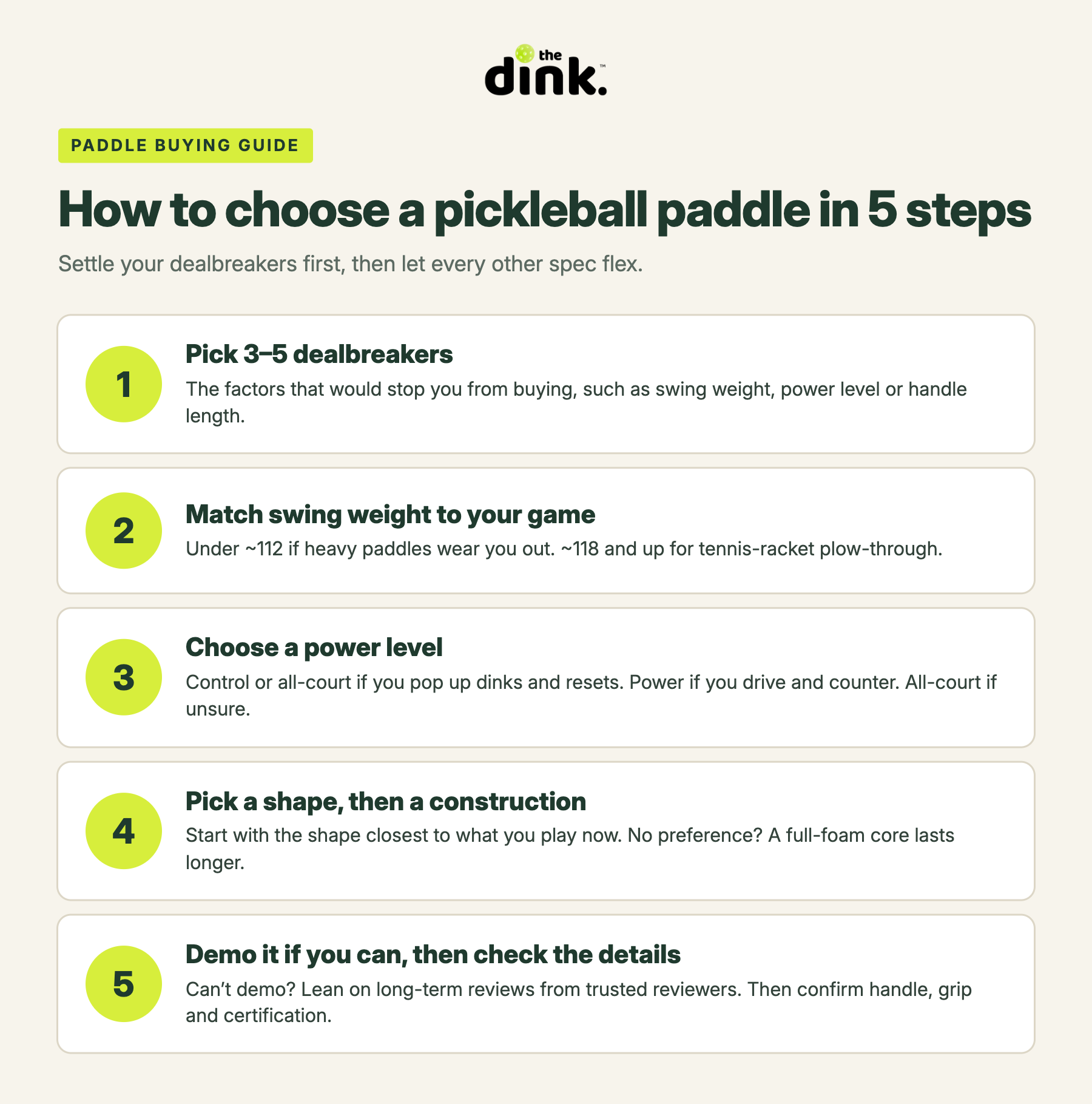
- Pick three to five dealbreakers. These are the factors that would stop you from buying, such as swing weight, power level or handle length.
- Match swing weight to your game. Under about 112 if heavy paddles wear you out. Around 118 and up if you want tennis-racket plow-through.
- Choose a power level. Control or all-court if you pop up dinks and resets. Power if you mostly drive and counter. All-court if you’re not sure.
- Pick a shape, then a construction. Start with the shape closest to what you play now. If you have no preference, a full-foam core is the more durable bet.
- Demo it if you can, then check the details. Demoing is easier said than done. If you can, play your real shots with the paddle. If you can’t, lean on long-term reviews from trusted reviewers like Olson. Either way, confirm the handle and grip fit and that it’s certified for where you play. Then check our discounts page before you check out.
💪
Ready to level up? Get the best discounts from Pickleball Central, automatically applied to your cart.
Start with your dealbreakers
Olson’s approach is simple. Paddles have dozens of attributes you could evaluate. Pick the three to five that would stop you from buying if they weren’t right, and treat everything else as a preference you can weigh against the alternatives.
When we spoke, his own list was swing weight, durability, a manageable level of power, handle length and shape.
“If all of those are taken care of, I can probably get over other attributes if they don’t meet what I would prefer,” he said.
In his Pickleball Studio buying guide video, Olson splits the decision into five primary factors:
- Shape
- Swing weight
- Power level
- Feel
- Durability
Then come secondary factors, the ones most people can live with if the primaries are right: budget, spin, sweet spot, thickness, handle length, grip size and certification. That split is a useful default, but it isn’t fixed. A secondary factor for one player is a dealbreaker for another. If you hit a two-handed backhand, handle length probably belongs at the top of your list.
Settle your list before you compare models. Once you’re reading reviews, it’s too easy to fall for a headline feature that doesn’t fit your game.
Pickleball paddle specs explained
Product pages list a lot of numbers. Here’s what each one measures and what it means for how a paddle plays.
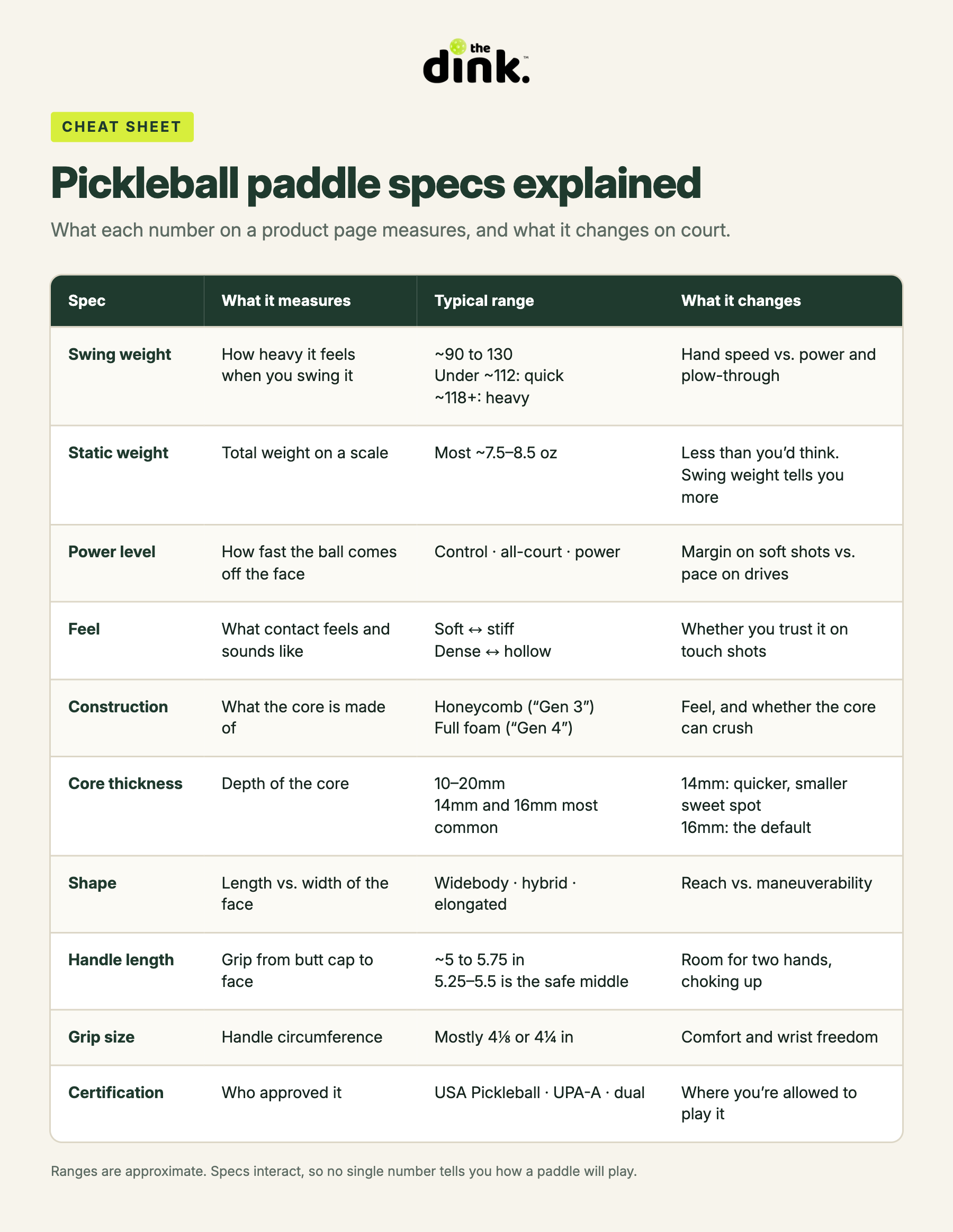
No single spec tells you how a paddle will play. They interact: a 14mm core in a light widebody feels nothing like a 14mm core in a heavy elongated paddle. That’s why the dealbreaker method works. You lock in the few factors that matter most to you and let the others flex.
Swing weight: why ounces aren’t enough
I asked Olson why a shopper should care about swing weight when they already know how many ounces a paddle weighs. His answer: total weight doesn’t tell you where that weight sits.
What is swing weight?
Swing weight measures a paddle’s resistance to rotation, which is how heavy it feels in motion rather than on a scale. Picture two paddles that weigh exactly the same. Move more of the mass toward the tip of one and toward the handle of the other, and they’ll feel very different when you swing them. The tip-heavy one has a higher swing weight. It hits harder and feels more stable on blocks, but it’s slower to get into position.
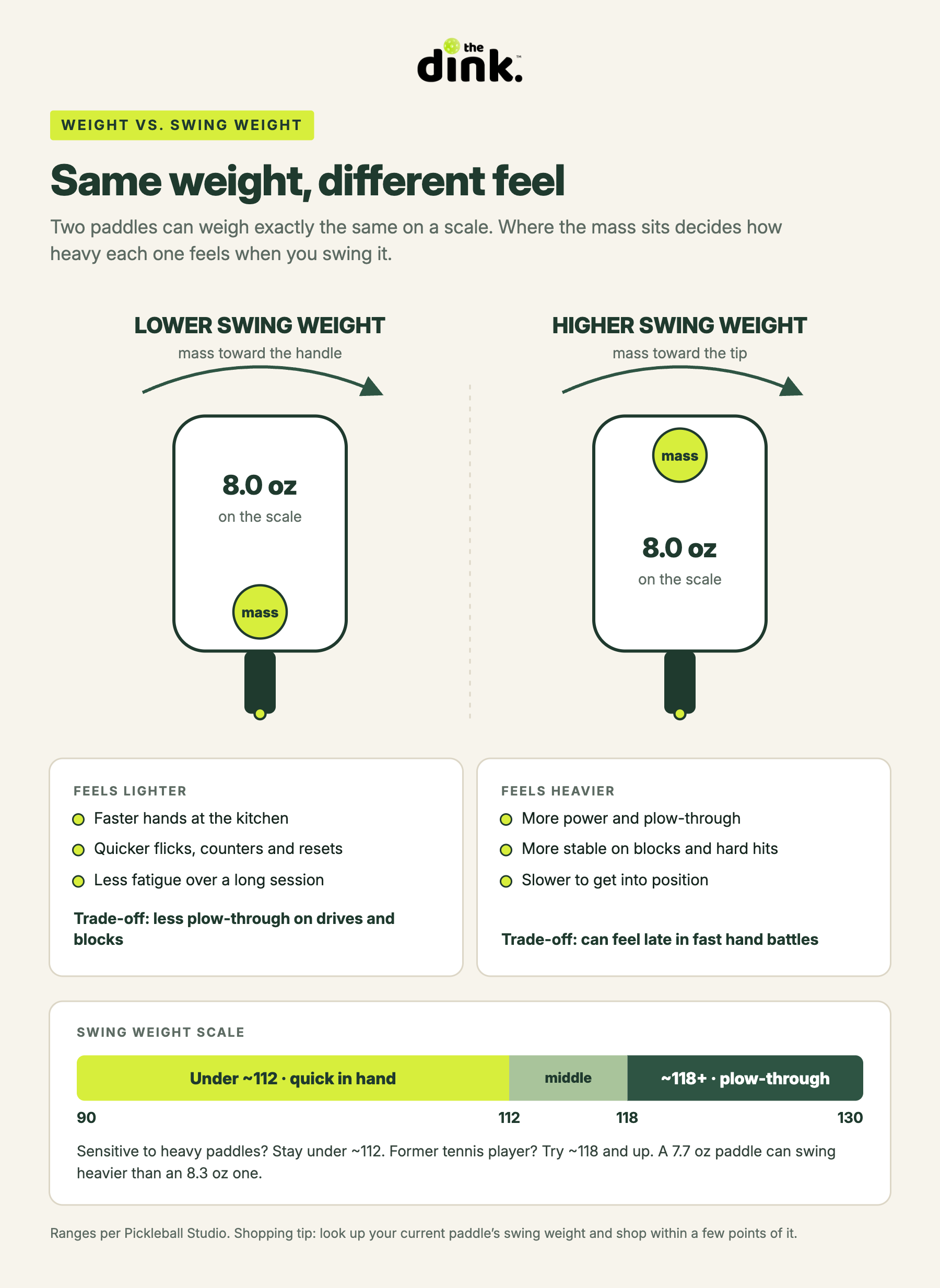
The difference can be big enough to flip what the scale tells you. In his video, Olson notes that a 7.7-ounce paddle can feel heavier to swing than an 8.3-ounce one, depending on how the weight is distributed. That’s why he treats static weight as close to useless for shopping. “It doesn’t matter how good a paddle is if it’s too heavy for you to play an entire session with,” he says.
What swing weight should you buy?
Swing weights for pickleball paddles run from roughly 90 to about 130. Lower numbers are easier to maneuver, and higher numbers are slower in the hand but carry more plow-through. Olson’s rough guide:
- Sensitive to heavy paddles, or want the fastest hands at the kitchen: look for something under about 112.
- Former tennis player: around 118 and above will swing more like a racket and give you more plow-through.
- Not sure: look up the swing weight of a paddle you already like and shop within a few points of it.
Most paddle companies now publish swing weights on their websites. Independent databases, including Pickleball Studio’s, list them for most popular models. A paddle might feel great for a few points and then get hard to maneuver as the session goes on, so pay attention to that during a demo. How does it feel an hour in?
Chris Olson: The Truth Behind His Pickleball Paddle Review
Chris Olson never imagined that a chance game of pickleball would change the course of his life. In 2021, a friend invited him to play the sport that would soon become his obsession, pulling him into the world of paddles, strategy, and YouTube fame.
 The Dink PickleballJason Flamm
What about twist weight?
Twist weight measures how much a paddle resists twisting when you hit off-center. A higher twist weight usually means a more stable, forgiving paddle. Weight added at the edges of the face, as with lead tape at 3 and 9 o’clock, raises it.
Power level: control, all-court or power
Olson specifically prefers a paddle that isn’t overly powerful for him. He wants something he can use across his whole game. The real buying question isn’t how much power a paddle has. It’s whether you can use that power and still keep the control you need.
Reviewers and brands usually sort paddles into three power levels: control, all-court and power. To pick one, look at how you actually lose points:
- You keep popping up dinks and resets: a control or all-court paddle gives you more margin. You can swing through the ball without babying it.
- You have good touch and want to end points faster: a power paddle adds pace on drives and counters.
- You don’t know yet: start with all-court. Olson calls it a very safe place for most people to start.
During a demo, spend as much time on dinks, drops and resets as on drives and put-aways. A paddle that adds pace to your drive and sends every third reset into the net isn’t an upgrade.
Paddle feel: the factor most players have never heard of
Ask a paddle reviewer how a paddle plays and you’ll hear words like “dense,” “hollow,” “plush” and “crisp.” Ask most recreational players, and you’ll hear “it’s good” or “it has a lot of pop.” That gap is one of the most overlooked part of buying a paddle.
Where the feel chart came from
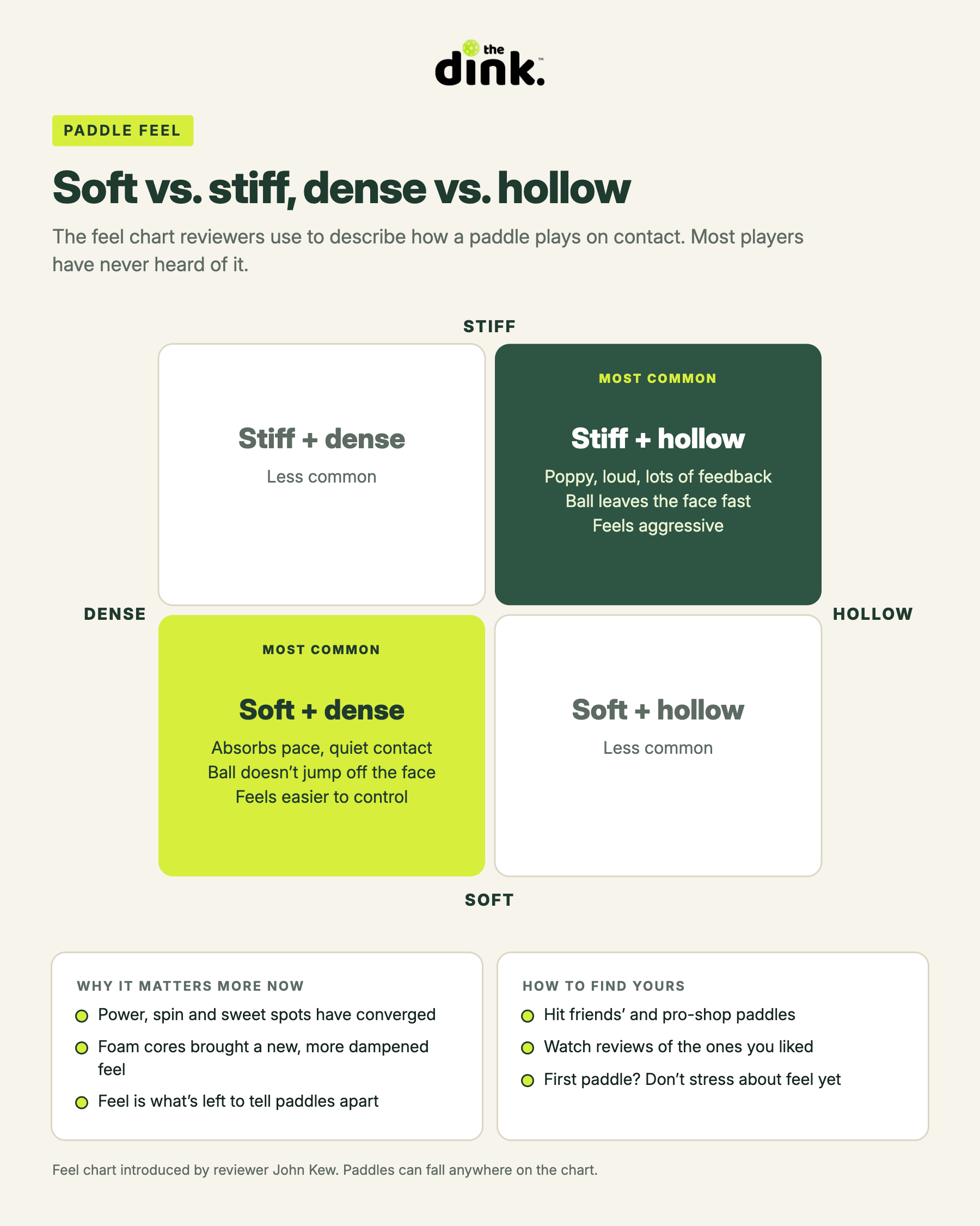
The vocabulary most reviewers now use comes from a simple two-axis chart that created by paddle reviewer John Kew. One axis runs from soft to stiff. The other runs from dense to hollow. Every paddle can be placed somewhere on it.
- Soft and dense paddles feel like they absorb pace. The ball doesn’t jump off the face, contact is quiet, and they usually feel easier to control.
- Stiff and hollow paddles feel poppy and aggressive. They’re louder, give more feedback, and the ball doesn’t sit on the face for long.
- Soft and hollow and stiff and dense paddles exist too, but they’re much less common.
Why feel matters more than it used to
A few years ago, paddles separated themselves on bigger things: power, spin, sweet spot. Those gaps have narrowed. Olson says shapes are now close in power, spin is similar across reputable paddles, and bad sweet spots have become rare. When the measurable specs converge, what’s left to tell paddles apart is how they feel on contact.
Construction is pushing feel forward too. Full-foam cores, covered in the next section, can feel noticeably more dampened than the honeycomb cores many experienced players grew up on. Players needed words to describe that difference, and the feel chart gave them those words.
Why most players don’t think about it
Feel hasn’t broken out of the enthusiast corner of pickleball yet. It lives in long-form review videos, gear podcasts and Discord servers, not on product pages or in pro-shop conversations. Most players buy on brand, price or a pro’s endorsement and never learn they have a feel preference until a paddle annoys them.
That’s a costly way to find out. “If a paddle checks every box for you, but you hate how it feels every time you hit it, you probably aren’t going to use it for very long,” Olson says in his video.
Pickleball’s Best Deals, Powered by The Dink
Gear up for less with The Dink’s top pickleball deals.
 Pickleball’s Best Deals, Powered by The Dink
How to find your feel preference
Hit as many paddles as you can, from friends, a pro shop or demo programs, and note which ones you like. Then watch reviews of those paddles to learn how reviewers describe them. That gives you a baseline for what “stiff,” “hollow,” “dense” and “soft” actually mean in your hand.
If you’ve never bought a paddle before, don’t stress about feel. Olson’s advice is to buy a highly recommended paddle and learn your preferences as you play more. Feel matters most for players on their second or third paddle who already know what they like and dislike.
Durability and construction: honeycomb vs. full-foam cores
For Olson, durability matters even when replacement cost doesn’t.
“If I’m playing in a tournament, if my paddle’s changing in the middle of that, like, that drives me insane,” he said.
That makes durability a performance question as well as a financial one. A paddle that changes with use forces you to adjust how you hit, often without realizing it. The biggest durability question today is what the core is made of.
💪
Ready to level up? Get the best discounts from Pickleball Central, automatically applied to your cart.
Gen 3 vs. Gen 4 paddles
Two types of construction dominate the market, and players refer to them by generation:
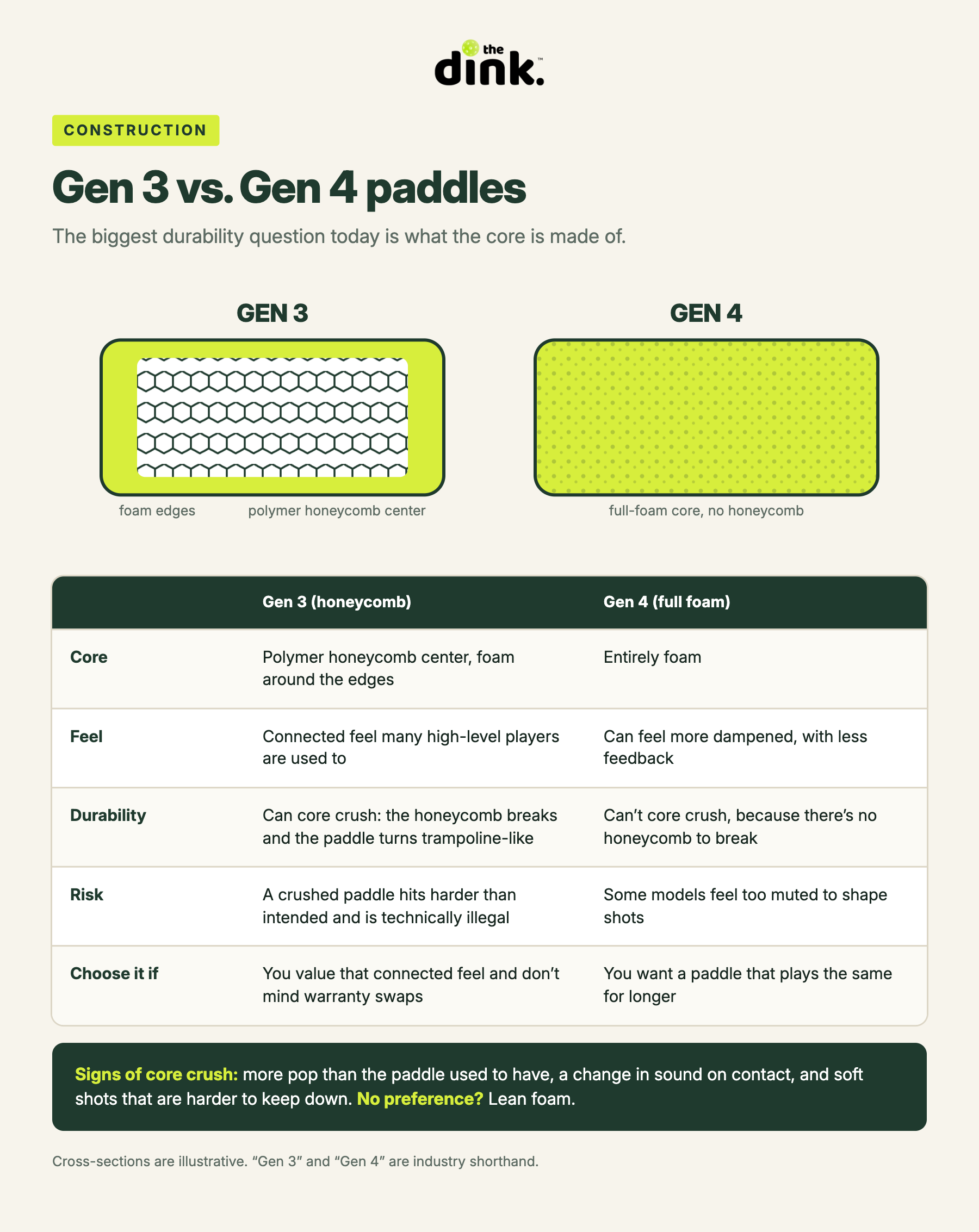
- Gen 3 paddles have a polymer honeycomb core in the center with foam around the edges. Many players love the connected feel they give on contact, and lots of high-level players are used to it.
- Gen 4 paddles have cores made entirely of foam. There’s no plastic honeycomb in the core to break.
What is core crush?
Gen 3 paddles are known to core crush. The honeycomb breaks down and the paddle starts acting more like a trampoline. It hits harder than it was designed to, which can make it play differently from one week to the next. A core-crushed paddle is also technically illegal to play with, because it no longer performs the way it did when it was certified.
Warning signs include a paddle that suddenly has more pop than it used to, a change in sound on contact, and soft shots that are harder to keep down. Some players love Gen 3 feel so much that they accept the cycle of warranty claims and swaps. Others are tired of replacing broken paddles and have moved to full foam.
The trade-off with foam
Full foam isn’t a free upgrade. Some foam models feel too dampened for players who rely on feedback to manipulate the ball, which is why many high-level players haven’t switched. Choosing between Gen 3 and Gen 4 mostly comes down to whether you value that connected feel more than you value a paddle that lasts.
Olson’s default: if you don’t already have a preference, lean toward a foam-core paddle.
Whichever you choose, look for feedback from people who’ve put real hours on the paddle. An initial review tells you how it plays out of the box. Long-term use tells you whether that holds up.
Paddle shape: widebody vs. hybrid vs. elongated
Shape is still a factor. Olson kept it near the top of his list when we spoke, and if you dislike the shape of a paddle, a strong review won’t make it feel right. But shape matters less than it used to, for three reasons.
- The power gap has closed. Elongated paddles used to be the clear power option. Olson says the shapes are now very similar in power.
- Sweet spots have improved across the board, so the narrower face of an elongated paddle costs you less than it once did.
- Most new paddle lines launch in more than one shape, so you rarely have to give up a paddle you like to get the shape you want.
What still differs is reach, maneuverability and weight. USA Pickleball rules cap combined length and width at 24 inches, so a longer paddle is always a narrower one.
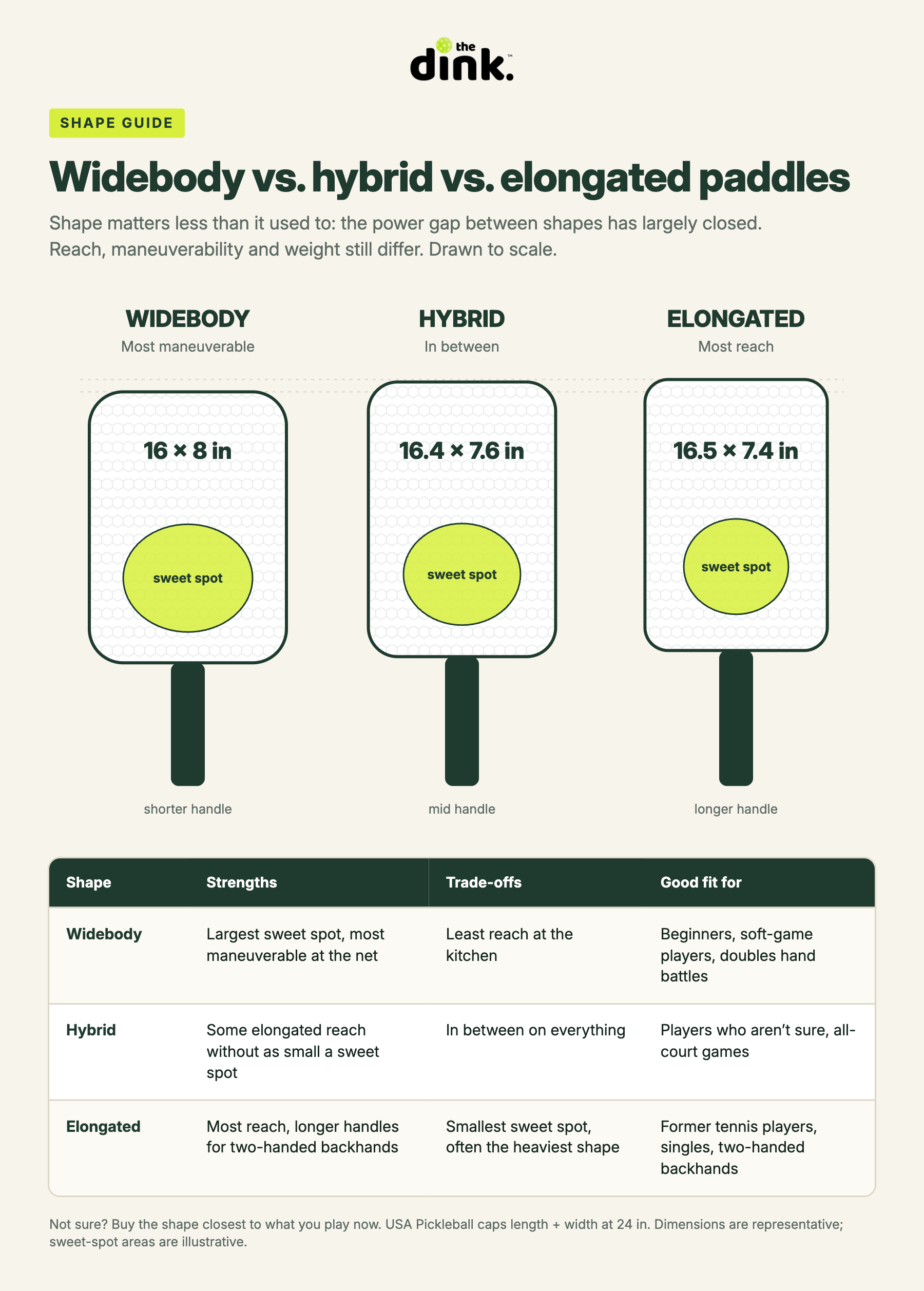
Because elongated paddles are often the heaviest shape, players who prioritize hand speed will find fewer elongated options that fit them. And when you’re choosing between shapes in a new paddle line, Olson’s rule is simple: buy the shape closest to what you already play, unless you want to try something new for fun.
Thinking about switching shapes?
Most people can’t afford to buy three paddles to find out whether a different shape suits them, and plenty of players don’t have access to demos. If you’re a widebody player curious about elongated, a few checks will tell you most of what you need to know:
- Compare swing weights first. Find an elongated paddle within a few points of your current paddle’s swing weight, so you’re only changing one thing.
- Be honest about where you lose points. If you lose hand battles at the kitchen, the extra length will make that harder. If you get beaten by balls just out of reach, or you hit a two-handed backhand, elongated may help.
- Try a hybrid as a stepping stone. It gives you some of the reach while keeping more of the sweet spot.
- Borrow before you buy. A few games with a friend’s paddle in the shape you’re curious about will tell you more than any review. Check the retailer’s return or demo policy before you buy.
Secondary factors: budget, spin, sweet spot, thickness and fit
These aren’t secondary because they don’t matter. They’re secondary because most players will accept a compromise on them if the primary factors are right. Any one of them can still be a dealbreaker for you.
Spin, and how long it lasts
Most reputable paddles produce very similar spin. Governing bodies set limits on surface roughness, so differences out of the box are smaller than marketing suggests. Olson does say those limits aren’t always well enforced, so some paddles are grittier than others.

For spin, 11SIX24 is the name to know. Its proprietary HexGrit surface is built to keep spin going for the entire life of the paddle, helping players shape drives, drops, and passing shots. The Ultré is the best way to get it: a hybrid shape with the most firepower in the Power 2 line.
Use code THEDINK for $10 off at checkout.
The bigger question is how long the spin lasts. Olson told us that surface wear can reduce spin, which pushes players to change their mechanics to compensate, often without noticing. He sees longer-lasting surfaces as a valuable development. So ask two questions: how much spin does the paddle produce when it’s new, and what evidence is there that it keeps that performance? If you play several times a week, surface longevity may belong on your dealbreaker list.
Sweet spot
Sweet spots have gotten so good that you rarely need to worry about a bad one. Olson says almost every paddle that comes through his door now has a more-than-adequate sweet spot. The exceptions are easy to spot: if reviewers consistently complain about a paddle’s sweet spot, skip it.
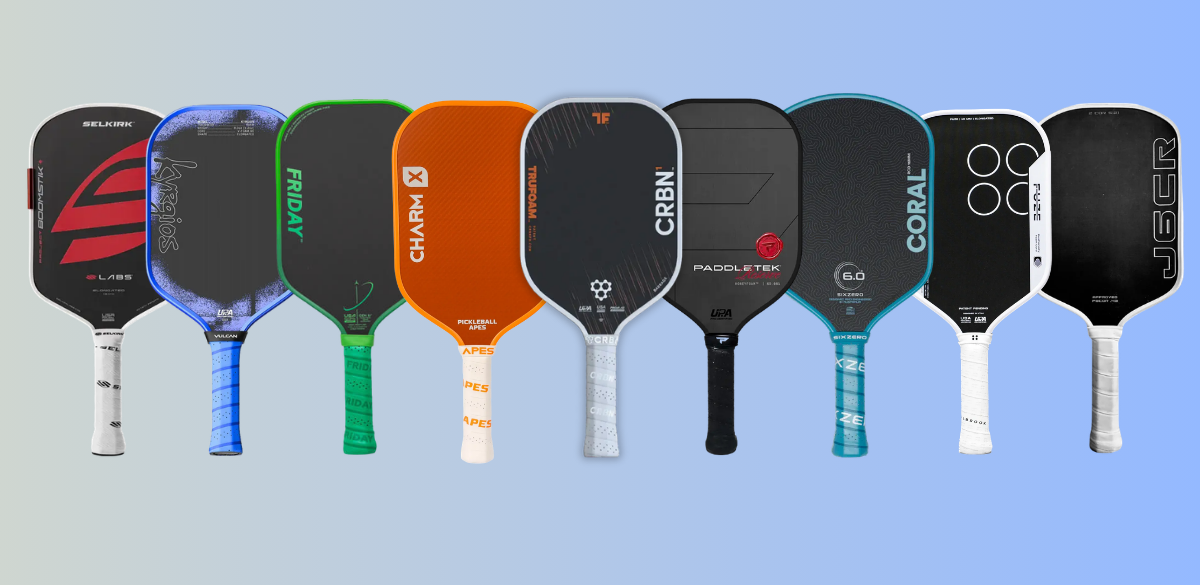
9 Power Paddles that Are Excellent at Dinking
Based on a unique blend of lab-tested power and consistency metrics, these paddles are proven to give you an edge in all three zones of the court.
 The Dink PickleballAlex E. Weaver
Core thickness: 14mm vs. 16mm
Cores range from about 10mm to 20mm, but 14mm and 16mm are by far the most common. The old rule was 16mm for control and 14mm for power. With how paddles are built now, that gap has narrowed a lot, so it’s no longer that simple.
What still holds: 14mm paddles are usually quicker in the hand but have smaller sweet spots. Thinner paddles are generally harder to use and often need added weight to reach their full performance. 16mm is far more popular, and it’s the right default for most players. If you don’t already have a thickness preference, start with 16mm.
Handle length
If you hit a two-handed backhand, look for a handle of at least 5.5 inches so both hands fit without crowding. If you play one-handed and like to choke up, as many former table tennis players do, 5.25 inches or less may be all you need. If you don’t have a preference, anything from 5.25 to 5.5 inches is a safe range. Keep in mind that the longest handles usually come on elongated paddles, so this choice is tied to shape.
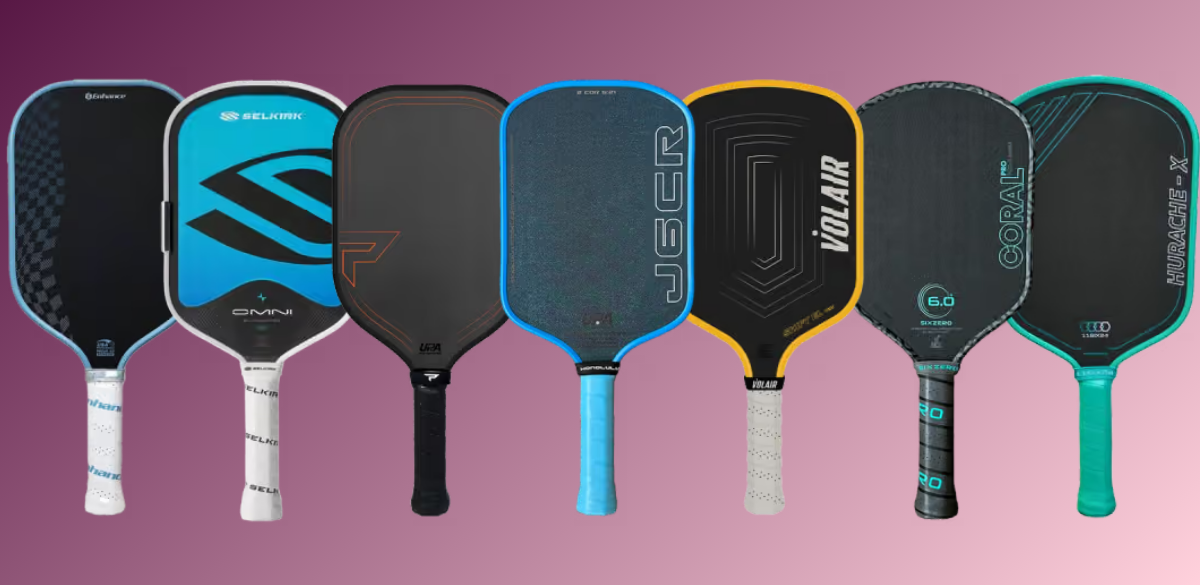
7 Premium Pickleball Paddles with Extra Long Handles
Longer handles can increase a paddle's swing weight and power potential without sacrificing control or sweet spot. Above all, they provide the necessary room to add that all-important second hand when the situation calls for it.
 The Dink PickleballAlex E. Weaver
Grip size
Most paddles come in a 4⅛-inch or 4¼-inch grip. Smaller hands usually want 4⅛, and larger hands may prefer 4¼. Factor in your overgrip. Olson prefers 4⅛ because an overgrip brings it to exactly the size he wants, while the same overgrip on a 4¼ handle feels chunky to him. You can always build a thin grip up, but you can’t make a thick one smaller.
If you can try a paddle before you buy it, hold it with your normal grip and play the shots you rely on. A few impressive drives won’t tell you whether the handle works for your backhand.
Is the paddle approved for tournament play?
Certification only matters if you play sanctioned events, but it’s worth checking before you buy. There are three labels to know:
- USA Pickleball certified: the standard most of the sport uses and accepts. Listed on USA Pickleball’s approved paddle list.
- UPA-A certified: the standard that governs the pro game. More paddles are launching UPA-A-only, because it allows grittier surfaces than USA Pickleball approval does.
- Dual certified: approved by both.
The two don’t always overlap. Some tournaments don’t allow UPA-A-only paddles, and the PPA Tour sometimes doesn’t allow USA Pickleball-only paddles, depending on the division. For amateurs, the answer is simple: buy a USA Pickleball-certified paddle and you’ll be fine in the vast majority of places you play.
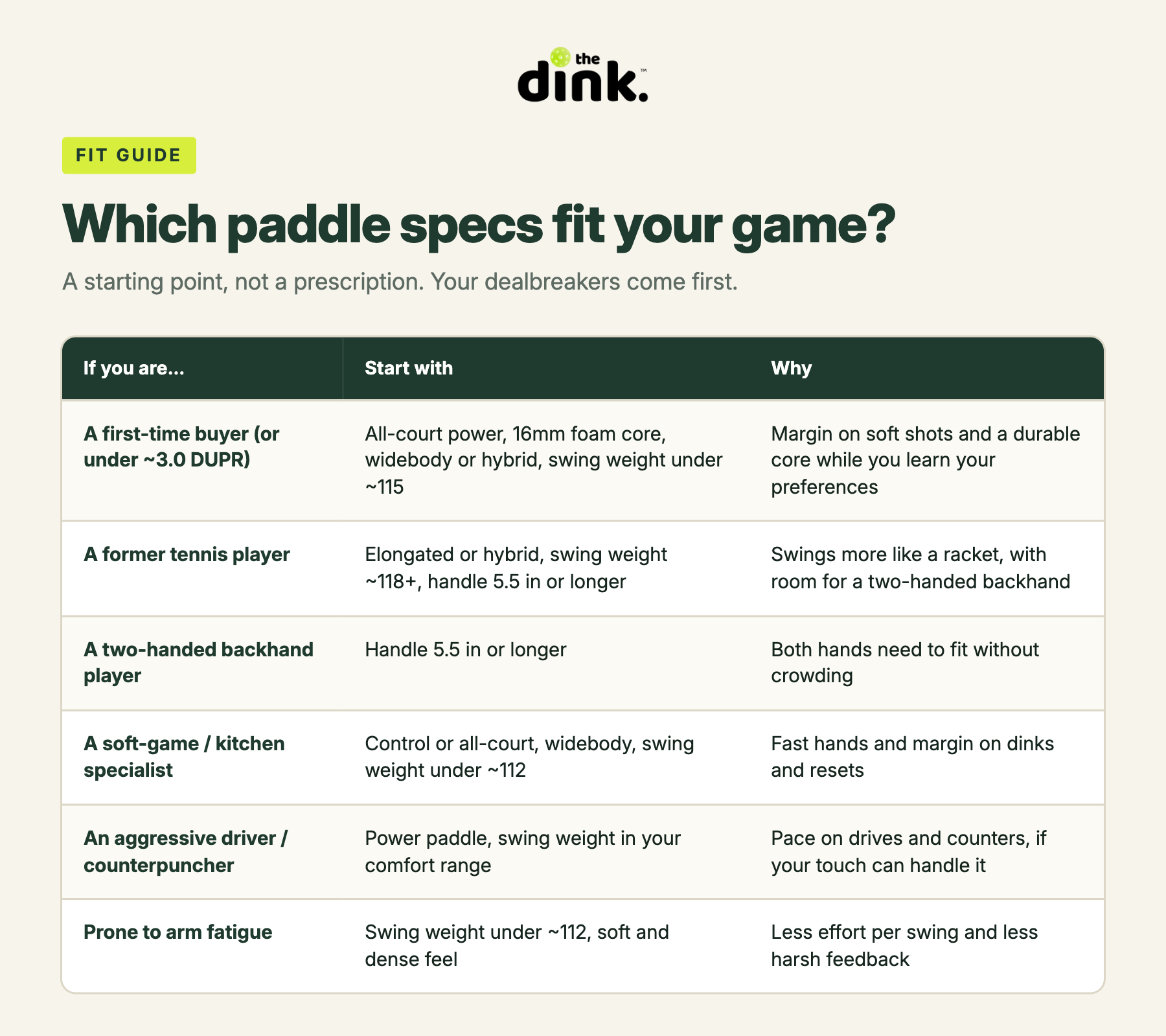
Which paddle specs fit your game?
Use this as a starting point, not a prescription. Your dealbreakers come first.
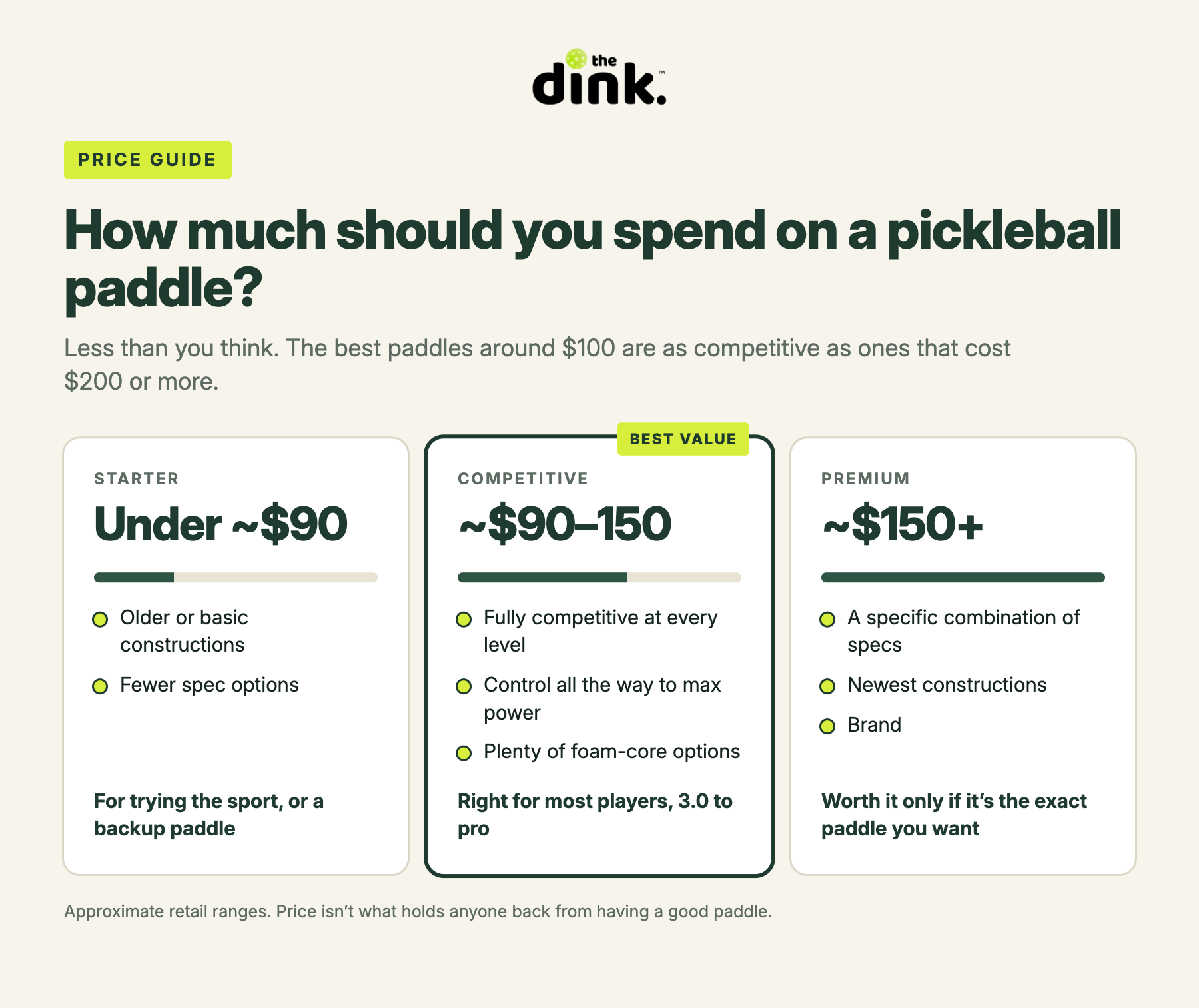
How much should you spend on a pickleball paddle?
While the best-selling Selkirk Boomstik comes in at $333, it's less than you might think. Good paddles run from roughly $90 to more than $300, and the price doesn’t track performance the way most shoppers assume. Olson is blunt about it: the best paddles around $100 are just as competitive as ones that cost $200 or more, and anyone from a 3.0 player to a pro could play with them.
“Anyone who tells you that some of the $100 paddles aren’t competitive with things above 200 is literally just lying to you,” he says in his video.
💡
Before you buy any paddle, check
The Dink’s discounts page. Code THEDINK works at most of our partner brands, which include Selkirk, CRBN, 11six24, Bread & Butter and RPM. Some partners use their own code, and some apply the discount automatically at checkout. (Affiliate links: The Dink earns a commission.)
Spending more isn’t a mistake if a pricier paddle has exactly the combination you want. Just know that price isn’t what holds anyone back from having a good paddle. Set a budget and it’ll cut your shortlist in half. When you’re ready to compare specific models, our best pickleball paddles rankings break them down by shape, swing weight and play style.
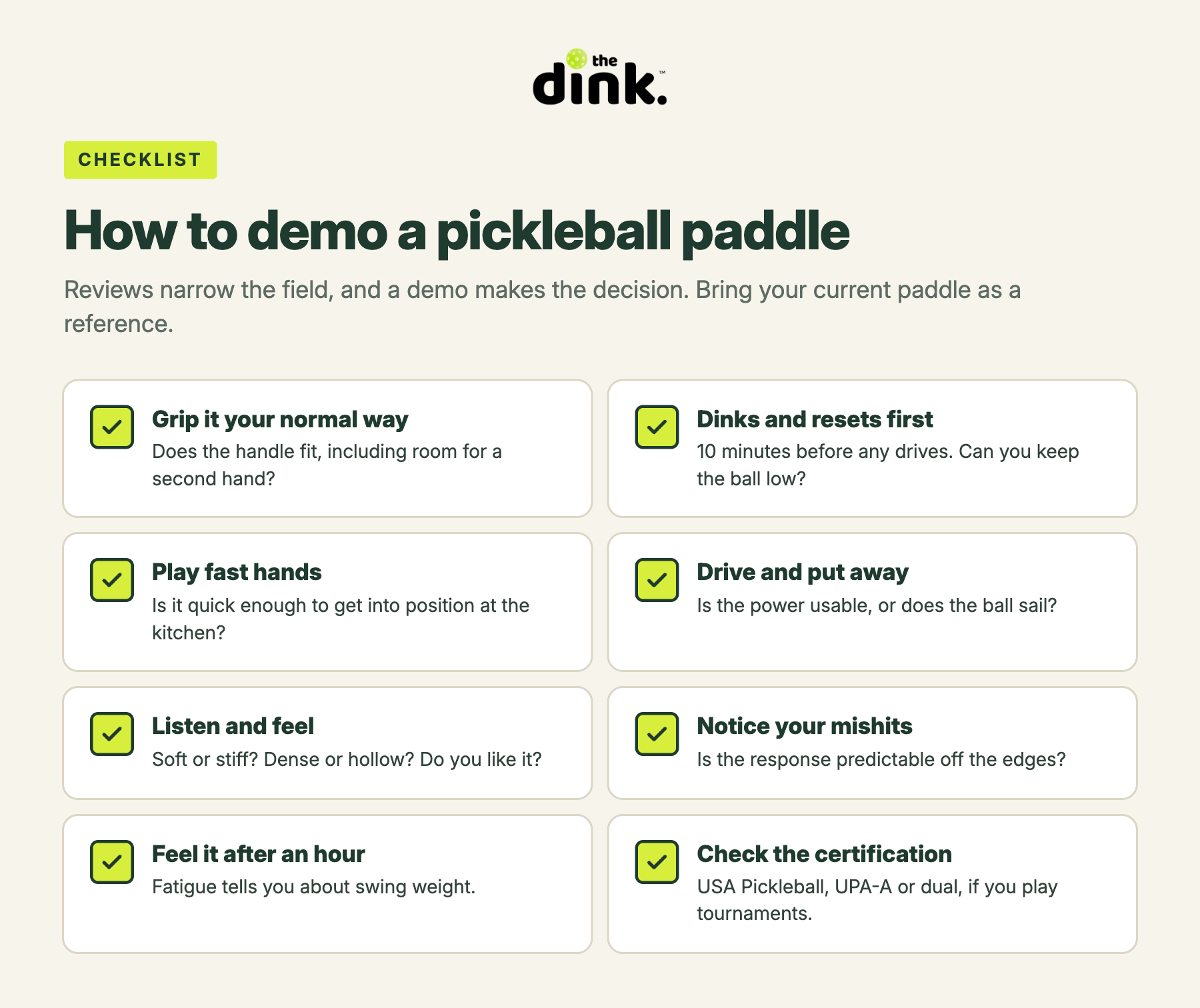
How to demo a pickleball paddle: a checklist
Reviews narrow the field, and a demo makes the decision. Bring your current paddle as a reference and work through this list:
- Grip it your normal way. Does the handle fit, including room for a second hand if you need it?
- Hit 10 minutes of dinks and resets before any drives. Can you keep the ball low and controlled?
- Play fast hands at the kitchen. Is it quick enough to get into position?
- Drive and put away. Is the power usable, or does the ball sail?
- Listen and feel. Is contact soft or stiff, dense or hollow? Do you like it?
- Pay attention to mishits. Is the response predictable off the edges?
- Check how it feels after an hour. Fatigue tells you about swing weight.
- Check the certification if you’ll play tournaments.
Build your shortlist before you shop
Write down your three to five requirements, then use them to narrow the field. For example: a handle that fits your two-handed backhand, a swing weight under 112, and an all-court power level you can control on soft shots.
Once a paddle meets those requirements, weigh the remaining preferences against price and decide which compromises you’re willing to make. Write down why you chose it. Next time you shop, that note becomes your starting reference. And before you pay, check our discounts page for a code.
Olson avoids naming a universal best paddle in his reviews because what works for him may not work for everyone. Bring the same discipline to your buying decision.
💪
Ready to level up? Get the best discounts from Pickleball Central, automatically applied to your cart.
Pickleball paddle buying FAQ
What grip size pickleball paddle do I need?
Most paddles come in a 4⅛-inch or 4¼-inch grip. Smaller hands usually want 4⅛, and larger hands may prefer 4¼. If you use an overgrip, factor in the thickness it adds. When in doubt, go smaller: you can build a thin grip up, but you can’t make a thick one smaller.
Is a heavier or lighter pickleball paddle better?
Neither is better across the board, and static weight is less useful than it looks. A 7.7-ounce paddle can feel heavier to swing than an 8.3-ounce one, depending on where the weight sits. Shop by swing weight instead: under about 112 for fast hands, around 118 and up for plow-through.
What is swing weight on a pickleball paddle?
Swing weight measures how hard a paddle is to rotate, which is how heavy it feels when you swing it. Paddles range from roughly 90 to 130. Lower numbers are quicker in the hand; higher numbers are slower but more stable and powerful. Most brands now publish swing weights on their websites.
What is the difference between Gen 3 and Gen 4 pickleball paddles?
Gen 3 paddles have a polymer honeycomb core with foam around the edges. They give a connected feel but can core crush over time. Gen 4 paddles have an all-foam core with no honeycomb to break, so they don’t core crush, though some feel more dampened. If you have no preference, foam is the more durable choice.
What does soft, stiff, dense or hollow mean for a pickleball paddle?
They describe how a paddle feels on contact. Soft and dense paddles absorb pace, feel quiet and are easier to control. Stiff and hollow paddles feel poppy, loud and aggressive, with more feedback. Most paddles fall somewhere between the two, and feel is a personal preference rather than better or worse.
Should a beginner buy an expensive pickleball paddle?
No. Many paddles around $100 are as competitive as ones costing $200 or more. A first-time buyer should look for an all-court power level, a 16mm foam core, a widebody or hybrid shape and a moderate swing weight, then learn their preferences before spending more. Whatever you buy, check The Dink’s discounts page first.
How long does pickleball paddle grit last?
It depends on how often you play and how the surface is made. Frequent players often notice spin dropping as the texture wears. If your serves and rolls don’t grab the ball the way they did when the paddle was new, the surface has worn. Long-term reviews are the best guide to how well a paddle’s grit holds up.
Should I get an elongated or widebody pickleball paddle?
Choose widebody for the largest sweet spot and the fastest hands at the net. Choose elongated for reach and longer handles, especially if you come from tennis or hit a two-handed backhand. The power gap between shapes has largely closed. If you’re unsure, buy the shape closest to what you play now, or try a hybrid.
Is a 14mm or 16mm pickleball paddle better?
For most players, 16mm. It’s far more popular, more forgiving and easier to use. 14mm paddles are quicker in the hand but have smaller sweet spots and often need added weight to perform their best. The old rule of 16mm for control and 14mm for power matters much less with today’s constructions.
Do I need a USA Pickleball-approved paddle?
Only for sanctioned tournaments. For amateurs, a USA Pickleball-certified paddle is accepted almost everywhere. Some paddles are UPA-A-only, the pro standard, which some amateur tournaments don’t allow. If you plan to compete, check which certification your events require before you buy.
The bottom line
Even the guy with access to almost every paddle on the market has to make tradeoffs. Choose your dealbreakers, match swing weight and power level to your game, decide how much feel and durability matter to you, and demo before you commit.
Then ignore the noise. A new paddle launches almost every week, and that doesn’t make the one you just bought obsolete. As Olson puts it, most new paddles aren’t so much better that you need to get rid of the one you have.
💡
Ready to buy? Don’t pay full price.
Check The Dink’s discounts pagefirst and use code THEDINK at most of our partner brands. (Affiliate links: The Dink earns a commission.)
Anuncie Aqui / Advertise Here
Sua marca para o mundo Pickleball! / Your brand for the Pickleball world!



 English (US) ·
 Portuguese (BR) ·