
 English
  Spanish
  Portuguese
  German
  Italian
  Japanese
  French
  Polish
  Russian
  Netherlands
  Hungarian
  Turkish
  Videos
  Thedink Pickleball

You're at the non-volley zone, the ball comes over the net, and you hit it right back—except it pops up into your opponent's attack zone. Sound familiar?
The problem isn't that you're hitting the ball too high.
According to C.J. Johnson from Better Pickleball, the real culprit behind those dreaded pop-ups is your pickleball backswing.
Love pickleball? Then you'll love our free newsletter. We send the latest news, tips, and highlights for free each week.
What's Really Causing Your Pop-Ups?
Most players blame themselves for hitting the ball too high or misjudging the trajectory. But Johnson explains that the real issue is energy and depth.
When a ball pops up, it's not the height of your shot that's the problem—it's how far the ball travels and how much energy you've put into it.
Think about it this way: if a ball lands in your opponent's strike zone with enough bounce to be attackable, they're going to punish it.
The depth of your shot determines whether that ball sits up for an easy put-away or stays low and unattackable.Johnson identifies three sources of energy that control how far your ball travels. The biggest one?
Your pickleball backswing. That's where most players go wrong.
Why Your Backswing Is Sabotaging You
Here's what most people get wrong about backswings: they think it means taking the paddle way behind your body. Johnson offers a clearer definition.
Your backswing is anything behind the point where your paddle contacts the ball.
If you're hitting a dink at the non-volley zone, your backswing might be tiny.
If you're hitting a ground stroke from the baseline, your backswing needs to be larger to generate the distance you need. The key word here is need.
Pop-ups happen when your backswing is too big for the type of shot you're hitting.
You're generating way more energy than necessary, and that excess energy sends the ball deeper into your opponent's court—right into their attack zone.
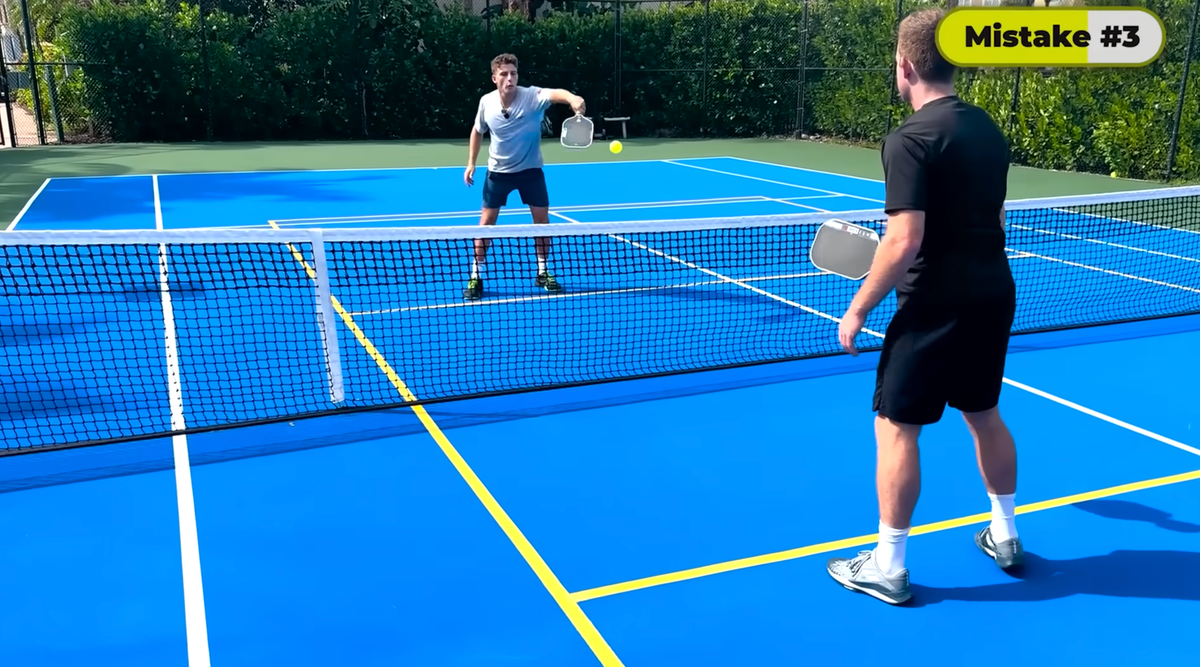
Johnson demonstrates this with his friends Paula and Karen at the non-volley zone.
When he takes a large backswing for a dink shot, the ball travels too far and bounces up high enough to be attackable.
When he shortens his backswing dramatically, the ball stays low and controlled.
💡
Need some new pickleball gear? Get 20% off select paddles, shoes, and more with code THEDINK at
Midwest Racquet SportsUnderstanding Energy Control in Pickleball
Energy in pickleball comes from three places:
- Your backswing.
- Your body rotation.
- Your follow-through.
But the backswing is the heavyweight champion of energy generation.
Johnson uses a simple demonstration: if you hold a ball up and drop it with no additional energy, it bounces below the net.
But add a little wrist snap or body rotation, and suddenly that ball bounces up above the net—now it's attackable.
The goal at the non-volley zone is to keep the ball low and unattackable.You have seven feet on your side and seven feet on their side.
Your ball should land in that seven-foot zone on the other side, staying below net height so it can't be attacked as either a volley or a bounce.
10 Pickleball Tips That Transform Your Game
A 5.0 pickleball player shares 10 game-changing pickleball tips that took years to learn. From grip fundamentals to wrist strength, these insights will transform your game.
 The Dink PickleballThe Dink Media Team

The Common Backswing Mistakes Players Make
Johnson identifies a pattern he sees constantly: players bring the paddle way too far back for the distance they actually want the ball to travel.
They're thinking about power when they should be thinking about control.
At the non-volley zone, you don't need power. You need precision.
Yet most players take a backswing that would be appropriate for a baseline drive, then wonder why their dink pops up.
The mistake compounds because players don't adjust their backswing based on the shot type.
- A dink requires minimal backswing.
- A transition shot requires slightly more.
- A drive requires even more.
But many players use the same large backswing for all three, which explains why their dinks are so inconsistent.
7 Pickleball Mistakes Keeping You From 5.0
These aren’t complicated technical adjustments that require months of practice. They’re fundamental shifts in how you approach the game.
The Dink PickleballThe Dink Media Team
How to Find Your Ideal Pickleball Backswing
So what's the right backswing length? Johnson's answer is refreshingly simple: it varies by shot, and the best way to develop it is through a specific drill.
Come to the non-volley zone and ask yourself: How short can I make my backswing and still get the ball over the net?
That's your ideal backswing length for that particular shot.
This isn't about being timid or tentative. It's about efficiency. You want to take as much backswing as you need to get the job done and no more.
Any excess is just extra energy that's going to cause problems.
Johnson demonstrates this by hitting dinks to both Paula and Karen. His backswing is barely visible.
His forward swing is longer, and his follow-through adjusts based on distance. But that backswing? Minimal.
The result is a ball that travels the exact distance needed, stays low, and remains unattackable. That's control.
Pickleball Shot Placement: Complete Winning Guide
Whether you’re serving, returning, dinking, or driving, knowing where to aim gives you control over the rally and keeps your opponent reacting instead of attacking.
The Dink PickleballThe Dink Media Team

Using Your Follow-Through to Control Distance
Here's something that surprises many players: your follow-through matters more than your backswing for controlling distance at the non-volley zone.
Johnson shows that when hitting to Karen (closer), his follow-through is shorter. When hitting to Paula (further away), his follow-through is longer.
The backswing stays short in both cases, but the follow-through adjusts.
This is the opposite of what most players do. They take a big backswing and then try to "slow down" their follow-through to control distance.
It doesn't work that way. The energy is already in the ball from the backswing.
Instead, keep your backswing short and consistent, then adjust your follow-through based on how far you need the ball to go.
This gives you much better control and consistency.
Offensive vs. Defensive Dinks: How to Control the Kitchen
The difference between an offensive dink and a defensive dink comes down to spin and intent. Master this fundamental skill and you’ll control the kitchen and win more points.
The Dink PickleballThe Dink Media Team

The Drill That Fixes Pop-Ups
Johnson's solution is straightforward: spend time at the non-volley zone working on shortening your backswing.
Here's the drill: start a dink rally and focus exclusively on making your backswing as short as possible while still getting the ball over the net.
How short can you go? Push that boundary. Find the minimum backswing that still allows you to hit a legal shot.
This drill works because it forces you to be intentional about every swing. You can't rely on muscle memory or habits. You have to think about what you're doing.
As you shorten your backswing, you'll notice something magical happens: your pop-ups disappear.
The ball stays lower. Your opponent has fewer attacking opportunities. Your dinks become more consistent.
Johnson emphasizes that this concept applies to every shot on the court, not just dinks.
Transition zone shots, baseline drives, everything benefits from understanding how backswing length affects energy and depth.
7 Pickleball Drills That Work for Every Level
Pro player Michael Loyd shares 7 pickleball drills designed to build real consistency and fix the weaknesses keeping you stuck.
The Dink PickleballThe Dink Media Team

Why This Matters for Your Game
Pop-ups are one of the most frustrating aspects of pickleball because they feel like mistakes when they're actually symptoms of a bigger problem.
You're not hitting the ball wrong—you're generating too much energy for the shot you're trying to hit.
Understanding your pickleball backswing and how it controls energy is foundational to improving your game.
It's not about being more athletic or having better reflexes. It's about being smarter with your mechanics.
Better Pickleball, the channel behind this instruction, focuses on helping players over 50 live their best lives on and off the court.
But this lesson applies to players of all ages and skill levels. Whether you're a 3.0 or a 4.5, controlling your backswing is essential.
The beauty of this fix is that it's immediately applicable. You can go to your local court today and start working on it.
No special equipment needed. No complicated technique to master. Just shorter backswings and better energy control.
💡
Heads up: hundreds of thousands of pickleballers read our free newsletter.
Subscribe herefor cutting edge strategy, insider news, pro analysis, the latest product innovations and more.
Frequently Asked Questions
What exactly is a backswing in pickleball?
Your backswing is anything behind the point where your paddle contacts the ball. It's not about how far back you take the paddle relative to your body—it's about the paddle position relative to the ball at contact. A dink might have a tiny backswing, while a baseline drive has a larger one.
Why do pop-ups happen if it's not about hitting the ball too high?
Pop-ups happen because of excess energy. When your ball bounces too high or sits up as a volley, it's because you've generated more energy than necessary for that particular shot. The ball travels too far and lands in your opponent's attack zone instead of staying low and unattackable.
Can I use the same backswing for all shots?
No. Different shots require different backswing lengths. A dink needs minimal backswing, a transition shot needs slightly more, and a drive needs even more. The key is matching your backswing to the specific shot you're hitting, not using one-size-fits-all mechanics.
How do I know if my backswing is too long?
If your dinks are popping up or traveling too far, your backswing is too long. Use Johnson's drill: shorten your backswing until you find the minimum length needed to get the ball over the net. That's your target.
Does this apply to both forehand and backhand?
Yes. The principle of matching backswing length to shot type applies to every stroke in pickleball, regardless of which side you're hitting from. The mechanics might feel slightly different, but the concept is identical.
Anuncie Aqui / Advertise Here
Sua marca para o mundo Pickleball! / Your brand for the Pickleball world!






 English (US) ·
  Portuguese (BR) ·