
 English
  Spanish
  Portuguese
  German
  Italian
  Japanese
  French
  Polish
  Russian
  Netherlands
  Hungarian
  Turkish
  Videos
  Thedink Pickleball

Recovery position after attack pickleball strategy is what separates players who win one rally from players who win the whole game. Here's exactly how to get back in position after you pull the trigger, stay balanced, and keep the pressure on.
Your recovery position after attack pickleball situations is the shot nobody talks about.
Everyone obsesses over the attack itself, the speed-up, the roll, the punch.
But what happens the moment after you pull the trigger? That's where most points are actually lost.
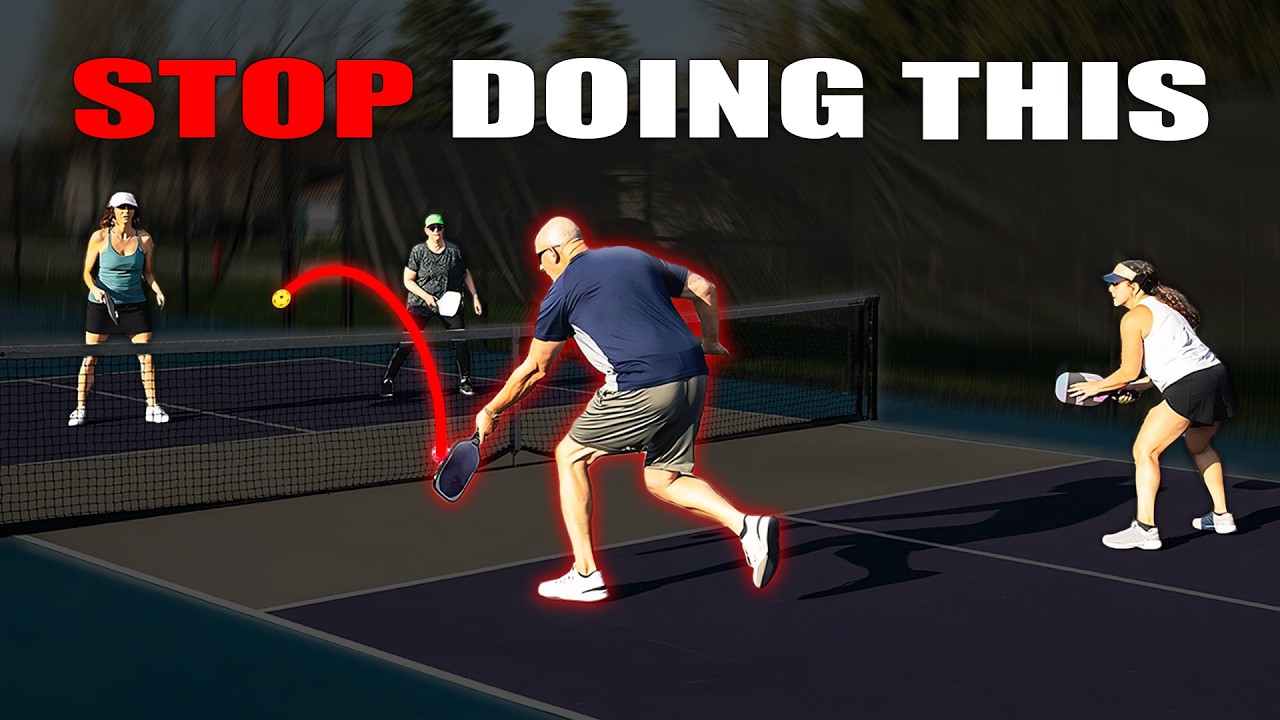
You attack. The ball comes back. You're out of position, your weight is forward, and you eat a counterattack at your hip. Sound familiar?
Fixing this is not complicated. But it does require intention, and it starts before the ball even leaves your paddle.
Love pickleball? Then you'll love our free newsletter. We send the latest news, tips, and highlights for free each week.
Why Recovery Position After Attack Pickleball Matters More Than the Attack Itself
Recovery position after attack pickleball isn't a secondary skill. It is the skill. Here's the thing: most 3.5-to-4.0 players attack reasonably well.
The separation at 4.5 and above is almost entirely about what happens next.
Think about the pro rallies you've watched. When Ben Johns speeds up, his paddle doesn't follow the ball to the net.
It snaps back to a ready position, chest high, weight balanced, eyes already scanning the return. He's built a response plan into the attack itself.
That's attacking strategy at its highest level: intention on the way in and a reset plan on the way out.
The physics are simple. When you attack, your momentum goes forward and downward. Your weight follows your swing.
If your opponent blocks or redirects that attack, especially cross-court, your body is already traveling the wrong direction.
You're chasing the next ball before you've finished the current one.
The fix isn't to attack less. It's to attack smarter and recover faster.
These are the two sides of the same coin, and shot selection always has to account for both.
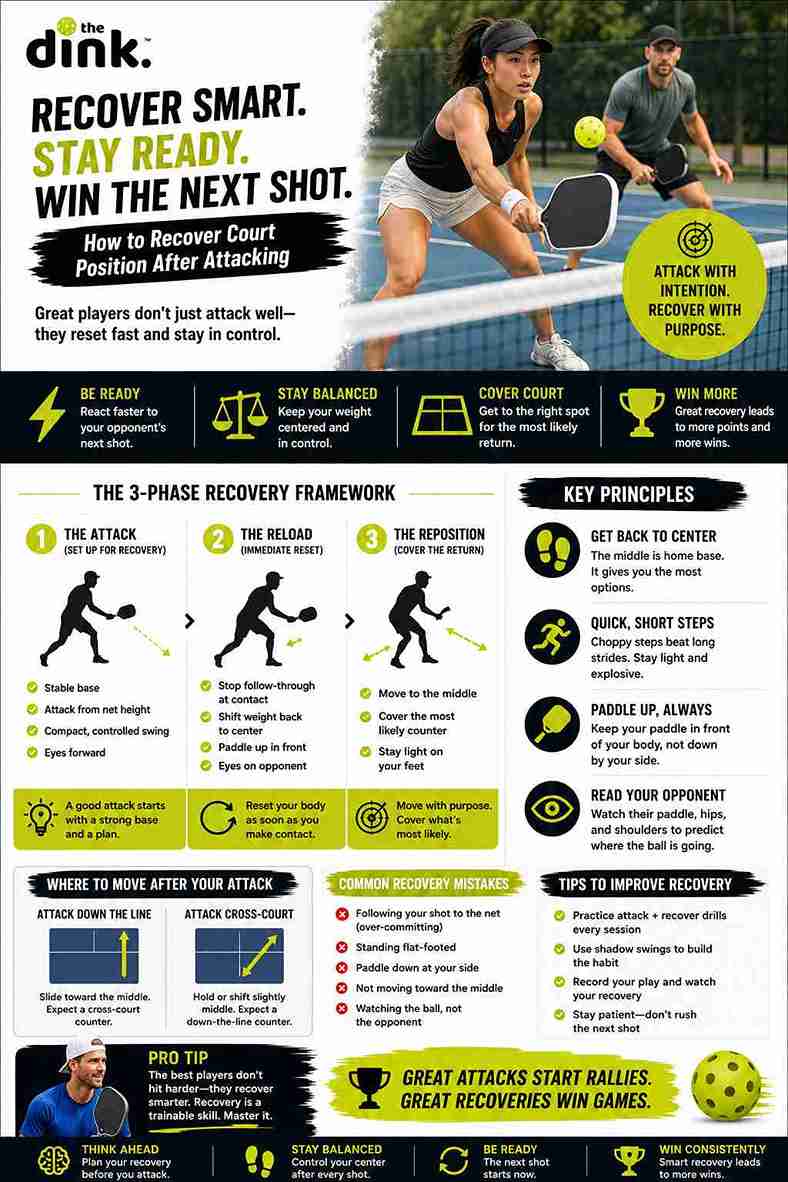
What Does "Recovery Position" Actually Mean?
Before we get into mechanics, let's define the term.
Recovery position in pickleball means returning your body to a neutral, balanced, ready state after executing an aggressive shot.
It is not the same as retreating. You're not backing off, you're re-centering.
The core elements of a proper recovery position:
- Feet shoulder-width apart, staggered slightly if you're moving laterally
- Weight on the balls of your feet, not your heels
- Knees slightly bent, you want to be able to move in any direction within half a second
- Paddle up and in front, roughly chest to shoulder height
- Eyes tracking the ball and your opponent's body language simultaneously
That last one is often ignored. Most players watch only the ball after they attack.
But reading your opponent's shoulder and hip rotation tells you where the counterattack is going before it happens.
Combine that with solid footwork fundamentals and you'll stop chasing balls you should have already been moving to.
💡
Need some new pickleball gear? Get 20% off select paddles, shoes, and more with code THEDINK at
Midwest Racquet SportsHow to Recover Court Position After Attacking in Pickleball: The Three-Phase Framework
Recovery position after attack pickleball breaks down into three phases that happen in roughly two seconds: attack, reload, and reposition.
Most players only think about phase one.
Phase 1: The Attack (and the Setup for Recovery)
Counterintuitively, a cleaner recovery starts with a better attack setup. If you're reaching, off-balance, or swinging from below your waist, your recovery is already compromised before it begins. Quality attacks come from a stable base. That means your split step has already loaded your weight correctly, you're at or above net height for contact, and your paddle path is controlled, not flailing.
Check out how shoulder height on contact affects your entire swing chain. An attack from too low forces your body into a compensation that bleeds straight into your recovery. Getting the right contact point is step one of getting back in position.
Phase 2: The Reload (Immediate Reset After Contact)
This is where the work happens. The instant your paddle makes contact on an attack, stop your swing's follow-through from dragging your whole body forward. Think of it like a boxer who throws a jab, the hand snaps back to guard position. It doesn't follow the fist to the target.
Practically, this means:
- Stop the follow-through at contact. Don't let your arm swing past your body's midline.
- Drive your weight back through your heels briefly to counteract the forward momentum of the swing.
- Get your paddle back to ready position, up in front, not hanging at your side.
This all happens in under half a second. If it feels mechanical at first, that's normal. Build it in drills, and it becomes automatic in matches.
Drills designed around shot creation and recovery are the fastest way to hardwire this habit.
Phase 3: Reposition (Cover the Most Likely Counterattack)
Here's where court strategy intersects with biomechanics. After attacking, your opponent has three realistic options: they can counterattack at your body, redirect cross-court, or reset soft into the kitchen. Your repositioning should account for the most likely of those based on where you attacked and where they're standing.
- If you attacked down the line: Slide slightly toward the middle of your half of the court. A cross-court redirect is now their highest-percentage play.
- If you attacked cross-court: Hold or recover slightly toward the middle. A down-the-line counter is their natural response.
- If you attacked at their body: Stay center. Their return options are limited, so you own the next ball if you're balanced.
How to Stop Lunging in Pickleball: Fix Your Court Position
If you want to stop lunging in pickleball, the real fix isn’t faster hands, it’s better court position before the ball arrives. This guide breaks down exactly why you lunge and how to correct it with footwork adjustments you can apply immediately.
 The Dink PickleballThe Dink Media Team
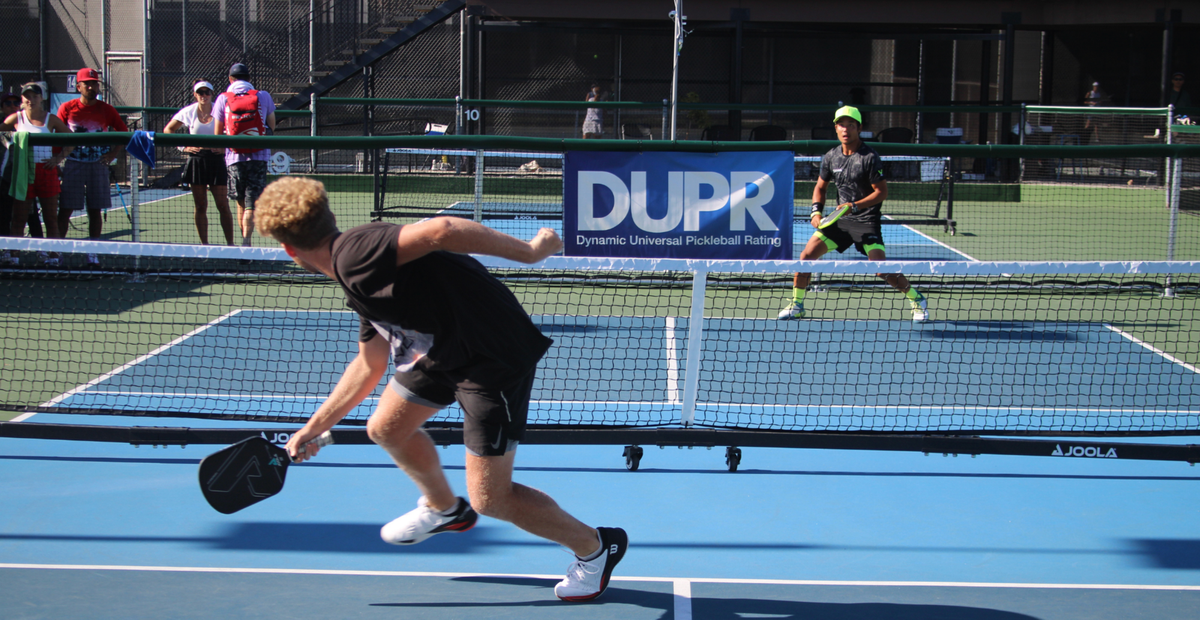
The Transition Zone Problem: Why Your Recovery Gets Complicated
If you're attacking from the transition zone, that no-man's-land between the baseline and the kitchen line, your recovery position after an attack becomes even more critical.
You're not at the net yet. You're not safely back. Every attack you attempt here carries real risk.
This is covered in depth in mid-court pickleball tips, but the short version is: attacking from the transition zone without a recovery plan is one of the most common errors at the 3.5-to-4.0 level.
You attack, you're out of position, and your opponent drops the ball just over the net for an uncontested winner.
The principle that fixes this: your recovery position determines whether you can get to the kitchen.
A compact, controlled attack with fast recovery lets you continue your move forward to the NVZ line.
A sloppy, over-committed attack pins you in no man's land.
Talking transitions is the piece most coaches skip. It's not glamorous. But it's where the game is won and lost at every level above 3.5.
Win the Pickleball Transition Zone: Reset Shot Guide
The pickleball transition zone is where most players struggle, but mastering it separates beginners from competitive players. Learn the reset shot technique that gives you control of the middle court.
The Dink PickleballThe Dink Media Team

How Does Recovery Differ in Singles vs. Doubles?
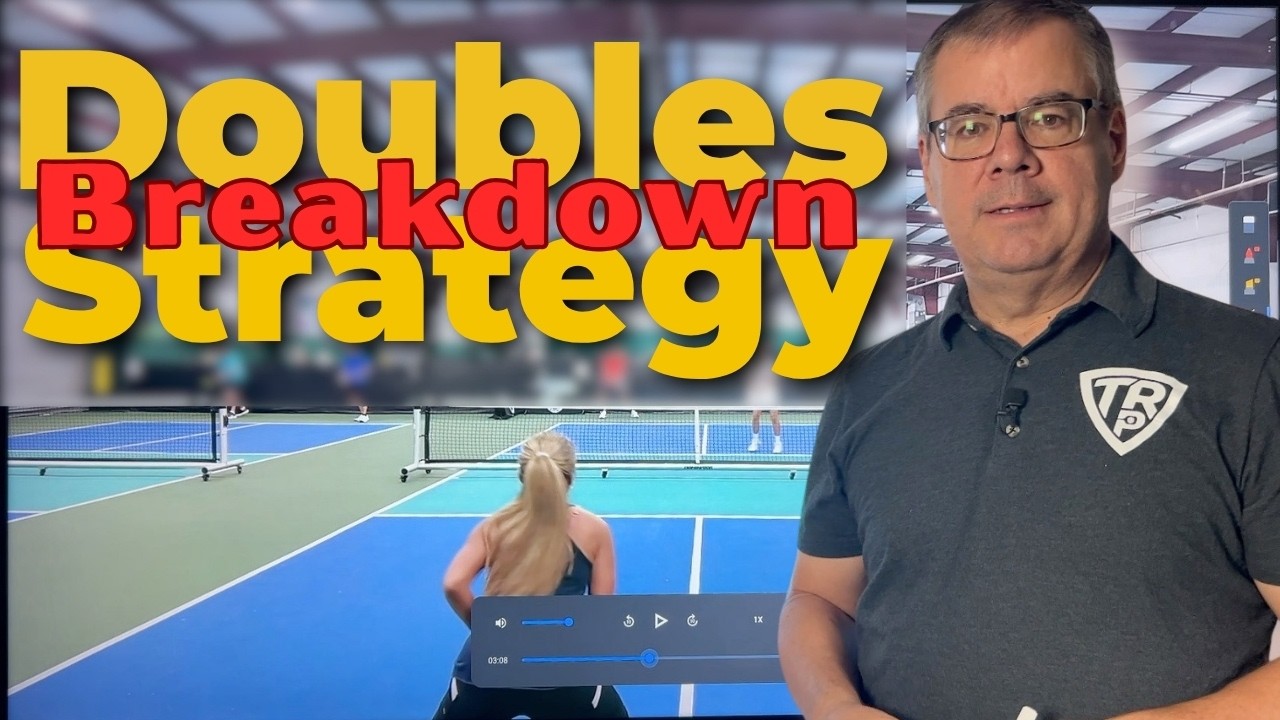
This question comes up constantly, and the answer matters. In doubles, your recovery position after attacking is a team responsibility.
Your partner's positioning affects where you need to be just as much as your own movement does.
If you attack from the left side and your opponent redirects down the right sideline, your partner needs to be covering that lane while you recover center.
In singles, you own the entire court, so recovery positioning is even more demanding. You need to attack and then move, not just reset in place.
The standard principle in singles strategy is to return to roughly the center of the court's baseline after any aggressive shot, then advance as the ball's pace gives you time.
The stagger concept applies directly here in doubles.
You and your partner should be staggered based on ball position, the player closer to where the ball is coming from takes slightly more of the court.
Understand this and your post-attack doubles coverage will look completely different.
Mixed Doubles Strategy: Rachel Rohrabacher’s Guide
Rachel Rohrabacher breaks down the fundamentals of mixed doubles strategy in a masterclass with Kyle Koszuta. From understanding each player’s role to reading your opponent’s movement, this guide covers everything you need to elevate your mixed game.
The Dink PickleballThe Dink Media Team
When Should You Reset Instead of Recovering?
Honestly, sometimes you don't recover at all, you neutralize.
If your attack didn't go exactly where you wanted and you sense a hard counterattack coming, the smartest move is to stop thinking about recovery and start thinking about survival.
That means:
- Drop your center of gravity fast. Get low for the incoming pace.
- Shorten your swing to a block. Don't try to counter a counter with a full swing.
- Use the reset, a soft, absorbing block that drops the ball into the kitchen and restarts the dink rally.
This is the difference between how to become unattackable and just surviving rallies. The best players don't panic after a failed attack.
They have a reset hierarchy: if the counterattack is manageable, re-engage aggressively. If it's fast and well-placed, block or reset and reset the point.
A different kind of reset covers the nuances of blocking under pressure well. The key mindset shift is this: a reset is not failure.
It's a tactical retreat that buys you the next attack on better terms.
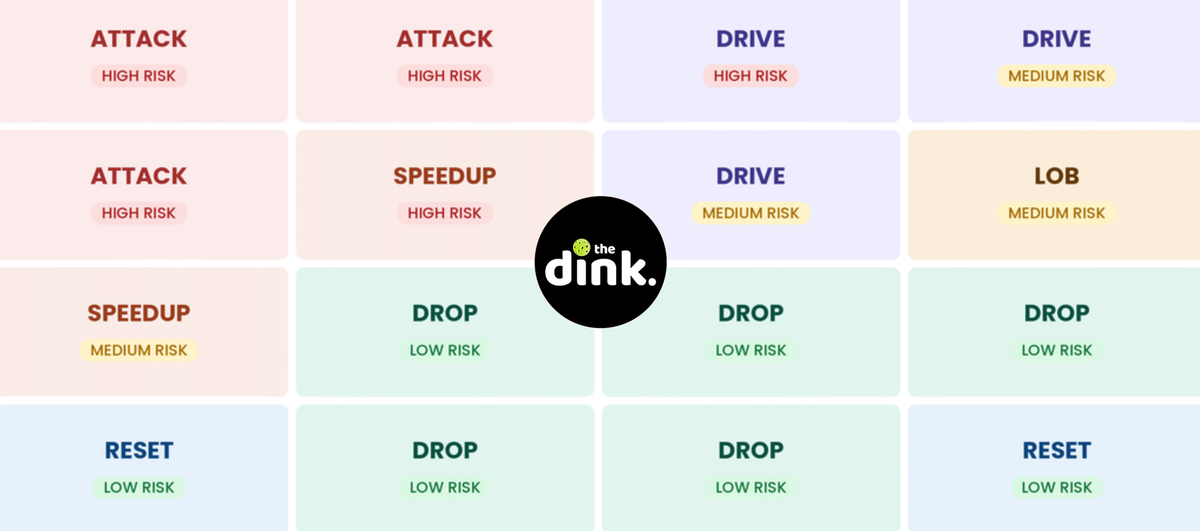
Decision Matrix: When to Attack or Reset in Pickleball
Pickleball is really all about two key factors: your court positioning and the height of the ball. This matrix decodes the game for you.
The Dink PickleballThe Dink Media Team
The Most Common Recovery Mistakes After Attacking
Understanding what not to do locks in the concepts faster. These are the errors showing up at every rec-to-competitive level:
- 1. Standing tall after attacking. Your center of gravity needs to drop after contact, not rise. Standing tall leaves you vulnerable to hard balls at the hip and slow to lateral movement.
- 2. Watching where your ball went instead of watching your opponent. The ball is irrelevant once it's left your paddle. Snap your eyes immediately to your opponent's contact zone.
- 3. Letting the paddle drop below waist height. Post-attack, your paddle drifts down. It should be back up to chest height within a half-second. A low paddle can't protect you from a body-attack counter.
- 4. Over-committing to a follow-through. The same thing that makes your attack look powerful can destroy your recovery. Compact swings recover faster. Full, looping swings are slower to reset.
- 5. Attacking when you're already out of position. The mistake most players don't realize they're making is launching attacks before their feet are set. Attack from a stable base or don't attack at all.
5 Pickleball Mistakes Keeping You Stuck Below 4.0
Intermediate pickleball players often hit a plateau around the 3.0-4.0 level, not because of lack of effort, but because of repeated habits. A new breakdown identifies five specific pickleball mistakes that limit progression and explains exactly how to correct them.
The Dink PickleballThe Dink Media Team
Drills to Build Recovery Position After Attack Pickleball Habits
You can read about this all day, but the body learns movement through repetition. These drills build the recovery habit:
- Attack-and-Recover Drill: Feed yourself a mid-court ball (from a ball machine or a partner). Speed up to your target, then immediately snap back to ready position. Have your partner immediately feed the next ball, forcing you to actually be in recovery position, not just think about it.
- Block the Counter Drill: Your partner initiates a speed-up. You attack back. They immediately block or redirect. Your job is to be in position to handle that second ball. This replicates the real in-game sequence at pace.
- Three-Ball Sequence: Attack, block the counter, reset to the kitchen. Running this sequence until it feels seamless builds the full attack-to-recovery-to-reset chain that wins real points. Connect this to 4th shot court coverage principles in doubles for a complete practice plan.
- Shadow Footwork: No ball. Just practice the attack motion followed immediately by a two-step lateral shuffle back to center position. Pickleball footwork patterns feel awkward until they're automatic. Get 100 reps of the movement before you ask your brain to manage it mid-rally.
5 Pickleball Drills That Will Transform Your Game in 2026
Five simple yet powerful pickleball drills can completely reshape how you play. These mechanics focus on consistency, footwork, and positioning to help you see immediate results on the court.
The Dink PickleballThe Dink Media Team

Key Takeaways
- Recovery position after attack pickleball is the overlooked half of every speed-up sequence.
- A solid attack starts with a stable base, and a bad attack setup leads directly to a bad recovery.
- The three-phase framework: attack (controlled), reload (snap paddle back, check forward momentum), reposition (cover the most likely counterattack lane).
- In the transition zone, every attack must come with a recovery plan, or you're handing points away.
- Resetting is not failure. It's a tactical choice that resets the point on better terms.
- Build recovery into your drilling, not just your match play.
💡
Heads up: hundreds of thousands of pickleballers read our free newsletter.
Subscribe herefor cutting edge strategy, insider news, pro analysis, the latest product innovations and more.
Frequently Asked Questions
What is recovery position in pickleball after attacking?
Recovery position after attacking in pickleball means returning your body to a balanced, ready state immediately after executing an aggressive shot. It involves feet shoulder-width apart, knees bent, weight on the balls of your feet, and your paddle back at chest height, all within a half-second of contact. The goal is to be prepared to react to any counterattack, not to admire your last shot.
Why do I keep getting countered after I speed up in pickleball?
The most common cause is a poor recovery position after the attack. When you speed up, your weight drives forward and your paddle follows through low. If you don't actively reset your base and paddle height, you're exposed to redirects and body shots. Drilling the attack-and-recover sequence specifically, not just the attack, will fix this faster than anything else.
How does recovery position differ in singles vs. doubles pickleball?
In doubles, recovery is a shared responsibility. Your position after attacking should complement your partner's, with one covering the counter and one holding the middle. In singles, you own the full court, so recovery means moving back toward center court after every attack. The urgency is higher in singles because there's no partner to cover your gaps.
Should I reset or attack after my speed-up is blocked?
It depends on the quality of the block. If your opponent's block is soft and uncontrolled, re-engage aggressively. If their block is clean, fast, or well-placed cross-court, switch to a reset, absorb the pace, drop the ball into the kitchen, and restart the dink sequence on neutral terms. Trying to counter-attack from a poor position is one of the most common unforced errors at the 4.0 level.
How do I practice recovery position after attacking in pickleball?
The most effective approach is dedicated two-ball or three-ball drills. Attack, then have your partner immediately feed a second ball, forcing your recovery to be real, not theoretical. Shadow footwork (attack motion followed by lateral shuffle to center) is also underrated. Most players drill the attack in isolation, but it's the pairing of attack and recovery that builds match-ready habits.
Anuncie Aqui / Advertise Here
Sua marca para o mundo Pickleball! / Your brand for the Pickleball world!





 English (US) ·
  Portuguese (BR) ·