
 English
  Spanish
  Portuguese
  German
  Italian
  Japanese
  French
  Polish
  Russian
  Netherlands
  Hungarian
  Turkish
  Videos
  Thedink Pickleball

By maintaining a stable face and letting the path of the paddle create the spin, you widen your margin for error and maximize consistency
If you’ve spent more than five minutes on a pickleball court lately, you’ve probably noticed that the game is getting faster, more aggressive, and—most importantly—spin-heavy.
Gone are the days when a simple, flat dink was enough to keep you safe. Now, if you aren't dipping the ball at your opponent's feet with some serious topspin, you're basically handing them an easy point.
Jordan Briones of Briones Pickleball Academy recently broke down the five most common mistakes players make when trying to master topspin. Straight up: you’re probably making at least three of them.
Love pickleball? Then you'll love our email newsletter. We send the latest news, tips, and highlights for free each week.
1. The Wristy Business
We’ve all seen it. A player tries to "flick" the ball with their wrist to generate spin. It looks fancy, sure, but it’s a recipe for inconsistency (and maybe a trip to the physical therapist). Briones points out that amateurs often use their wrist as the primary engine for topspin, especially on dinks.
But if you watch the pros, their wrists are remarkably stable. The spin comes from the shoulder and a smooth, low-to-high motion. Think of your arm as a pendulum rather than a whip. A stable wrist means a predictable ball.
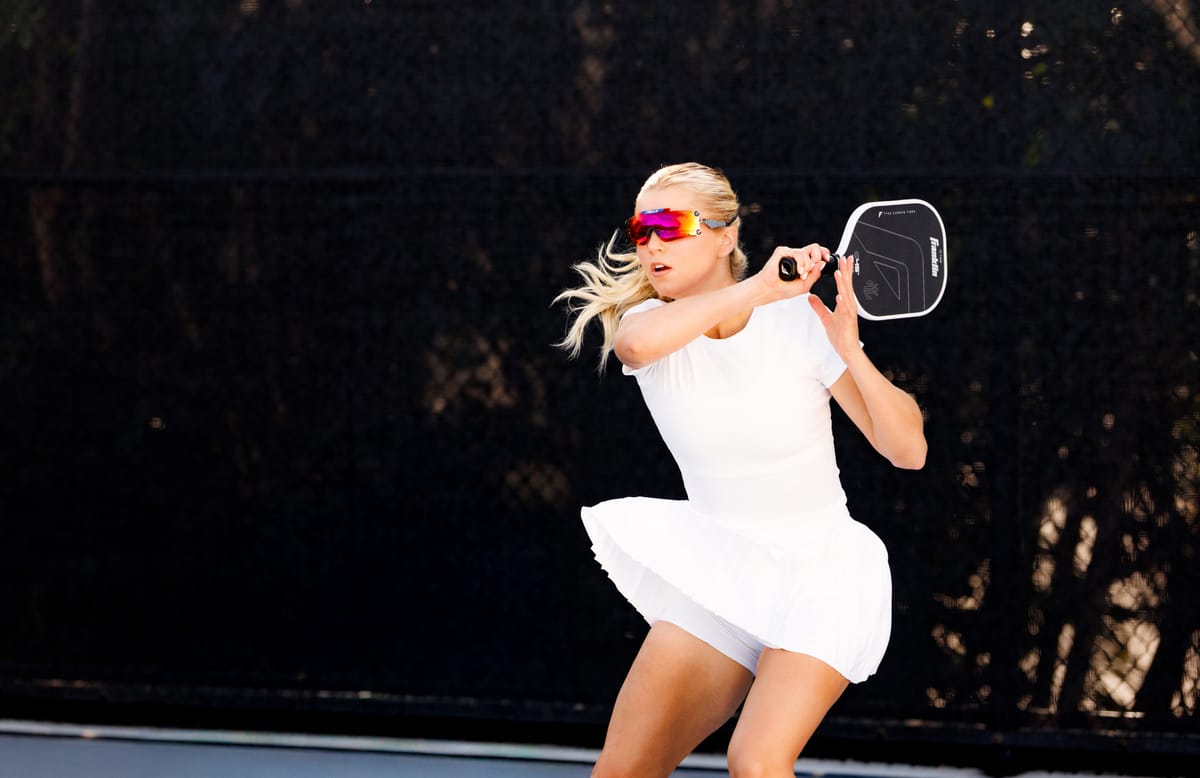
Anna Leigh Waters Signs Longterm Deal with Franklin Pickleball
“I am incredibly proud to begin this next chapter of my career with Franklin Sports,” said Waters.
 The Dink PickleballAlex E. Weaver
2. Stop Pushing, Start Lifting
One of the biggest hurdles for players moving from a 3.5 to a 4.0 level is the "linear" habit. When you’re under pressure, the natural instinct is to push the ball toward the target.
But topspin requires a vertical swing path.Briones notes this is particularly common with the two-handed backhand dink. Players set up well, but then they "push" through the contact zone.
The result? A flat ball that sits up.
To fix this, you have to start the paddle underneath the ball and swing up. It feels counterintuitive to swing vertically when you want the ball to go forward, but that’s the magic of physics—the spin pulls the ball back down into the court.
3. You’re Not Getting Low Enough
You can’t hit a low-to-high shot if you start at the same height as the ball. It sounds obvious, right? Yet, so many players fail to drop their paddle head early enough. Whether it’s a forehand speed-up or a topspin lob, the preparation is everything.
"In order to create topspin, we have to start beneath the ball," Briones says.
If your paddle tip isn't well below the ball before you start your forward motion, you’re just hitting a flat shot with a fancy follow-through.This is why footwork and knee bend are so vital—you have to get your body in a position where that vertical path is even possible.
120/Life Dink Awards 2025 — Pickleball’s Official Fan’s Choice Awards
Dink Awards 2025 — Pickleball’s official fans’ choice awards for the top players, people, and moments from the year.
 120/Life Dink Awards 2025 — Pickleball's Official Fan's Choice Awards

4. The Paddle Angle Rollercoaster
Consistency is the name of the game in pickleball. If your paddle face is changing 180 degrees during your swing, you have to be frame-perfect with your timing.
Briones highlights the backhand flick as a prime example of this mistake. Many players roll their wrist so much that the paddle face flips completely over.
Instead, you want to keep that paddle angle relatively constant through the contact zone. By maintaining a stable face and letting the path of the paddle create the spin, you widen your margin for error. You don't need to be a magician; you just need to be a machine.
Pickleball After 50: Fun Hobby, Meaningful Exercise, or Both?
Understanding Zone 1, 2, and 3 cardio – and the four common scenarios to help you audit your own body and reach peak performance in your senior years
 The Dink PickleballThe Dink Media Team
5. The 'Hero Shot' Syndrome
Finally, there’s the issue of balance. We all want to hit that screaming topspin winner, but you can’t do it while you’re falling backward or reaching out on your tiptoes. Briones emphasizes that aggression requires control.
If your base isn't set, you shouldn't be swinging for the fences.
Topspin is a tool for pressure, but if you use it while off-balance, you’re just as likely to gift your opponent an easy overhead.At the end of the day, topspin isn't about how hard you can snap your wrist. It's about preparation, a vertical swing path, and the discipline to stay balanced. If you can stop "pushing" and start "lifting," you'll find that your balls start dipping exactly where you want them—right at your opponent's shoelaces.
Heads up: hundreds of thousands of pickleballers read our free newsletter. Subscribe here for cutting edge strategy, insider news, pro analysis, the latest product innovations and more.
Anuncie Aqui / Advertise Here
Sua marca para o mundo Pickleball! / Your brand for the Pickleball world!







 English (US) ·
  Portuguese (BR) ·