
 English
  Spanish
  Portuguese
  German
  Italian
  Japanese
  French
  Polish
  Russian
  Netherlands
  Hungarian
  Turkish
  Videos
  Thedink Pickleball

The pickleball boom isn’t dead. But bad leases, oversized facilities and flawed business models are exposing the brutal economics behind a growing wave of club closures.
You've seen the headlines. Clubs are going dark. The pickleball "boom" has gone bust. Corporate and personal bankruptcies all around.
The personal ones should keep you up at night, because behind every one is a decent person who signed their name to a lease and bet everything on a game they loved.
What you haven't seen is the money. Franchisors mostly can't talk about it, because their lawyers won't let them. Independents won't talk about it, because they're too embarrassed by their failures.
So you get the ribbon cuttings and the grand-opening photos. You never get the P&L.I don't run a franchise, and nobody's lawyer gets a vote on what I say. But I do help design, build, consult and operate pickleball facilities all over the globe, and I've been doing it since March of 2023.
So let's talk about money, shall we?
2023: The gold rush
In March of 2023, when I started work on my first club, there were ZERO franchise pickleball facilities. Essentially, the entire industry could fit in a van together.
I opened our doors on August 1, 2023, five months later. By then there were three franchise brands and hundreds of franchise locations sold, most of them not yet built.
According to new data from FRANdata, 18% of franchise business concepts reach 100 locations, and the average time to get there is more than 10 years.Suffice it to say that the race to build in pickleball outpaced the experience in most other industries. The problem was that most of those brands had never operated outside their home market. Pickleball is a stubbornly local sport. What works in Naples may not work in Dallas, and what works in Dallas may not work in Chicago. Every market needs a different club.
After the Gold Rush: How Pickleball Facilities Thrive Now
In an over-built market, pickleball courts are a commodity. Community is the moat. You can pour concrete in ninety days; you cannot pour belonging.
 The Dink PickleballBen Borton
Furthermore, everybody went after the same buildings. After COVID, national retailers like Nordstrom Rack and Barnes & Noble moved into smaller stores of 20,000 to 40,000 square feet, which is exactly the size a pickleball club needs. Only so many of those buildings have 30-foot column spacing and 18-foot ceilings.
I watched five pickleball groups chase the same lease like seagulls on a french fry. Rents went up before a single ball was hit.To understand why that mattered, you need one real estate finance concept: the cap rate.
A cap rate is a building's yearly rental income divided by what the building sells for. If a building brings in $600,000 a year and sells for $10 million, that's a 6 percent cap rate. Investors use it to price risk. The safer the tenant, the lower the cap rate, and the more the building is worth.
Now run the math.
- Take a $50,000-a-month lease, which is $600,000 a year
- If Chick-fil-A is paying it, investors price the building at a cap rate between 4.2 and 4.5 percent, because nobody doubts Chick-fil-A will pay its rent
- That makes the building worth about $14 million
If a first-year pickleball club is paying the same rent, an investor should want 8 to 10 percent for the risk. That makes the building worth $6 million to $7.5 million. Same rent, half the value.
So a startup pickleball club should have paid less rent than a national retailer for the same box, not more.It went the other way. To beat a retailer with a credit rating and four other pickleball groups, an unproven operator had to offer more.
And many of the people signing those leases had been sold a dream: build a club, hire a general manager, collect checks. But there was nobody to hire. No coaching base, no bench of professional GMs, no pickleball veterans. The business was about fifteen minutes old.
Pickleball Facilities Are for Sale and Getting Cheaper, Fast
If your club isn’t producing strong, steady profit, you’ll struggle to find a buyer. And the one you find will likely offer less than you put into the walls, courts and lighting.
 The Dink PickleballDavid Johnson
2026: The reality
So what does a court actually make? Johns Design & Consulting-compiled industry performance data covering hundreds of facilities offers a clearer look. This data spans indoor and outdoor, staffed and autonomous operations. Each figure represents the average monthly pickleball revenue per court over a 12-month period, excluding food, beverage, and separate secondary revenue streams.
- Small facilities (10 courts or fewer): ~$8,000
- Large facilities (more than 10 courts): ~$5,600
- All facilities: ~$6,400
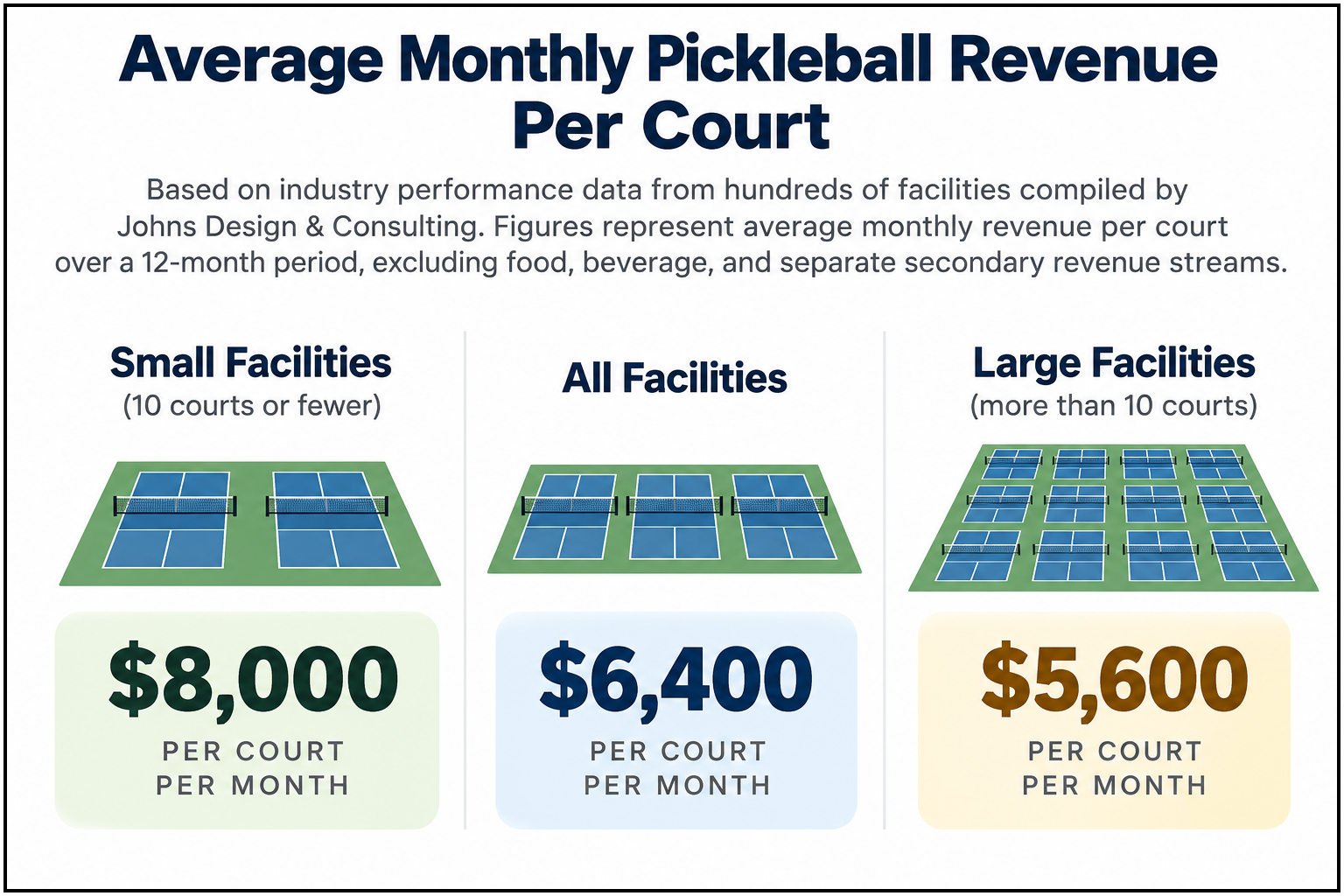
Two key trends stand out from the figures.
- First, a court at a smaller facility earns roughly 43 percent more than a court at a larger one, primarily because many big venues were built expecting to be the sole provider in their area.
- Second, these figures have remained relatively consistent for the past year, showing that player demand remains strong and isn't the underlying issue for struggling locations.
The range is wide. We have three-court rural clients doing $12,000 to $14,000 per court per month, and urban clients doing more than $30,000.
Location decides most of that. The lease decides the rest.
At McDonald's, the cost of goods is food. At a pickleball club, the cost of goods is rent, and rent is fixed.Sign a bad lease and you're stuck with it for years. Most 10-court clubs sign leases between $30,000 and $50,000 a month.
We push every client toward the low end, but most of the clubs going under are at the high end. Heck, I've heard of people signing $100,000-a-month leases.
Here's the reality most failing clubs are facing right now, on a $50,000 lease.
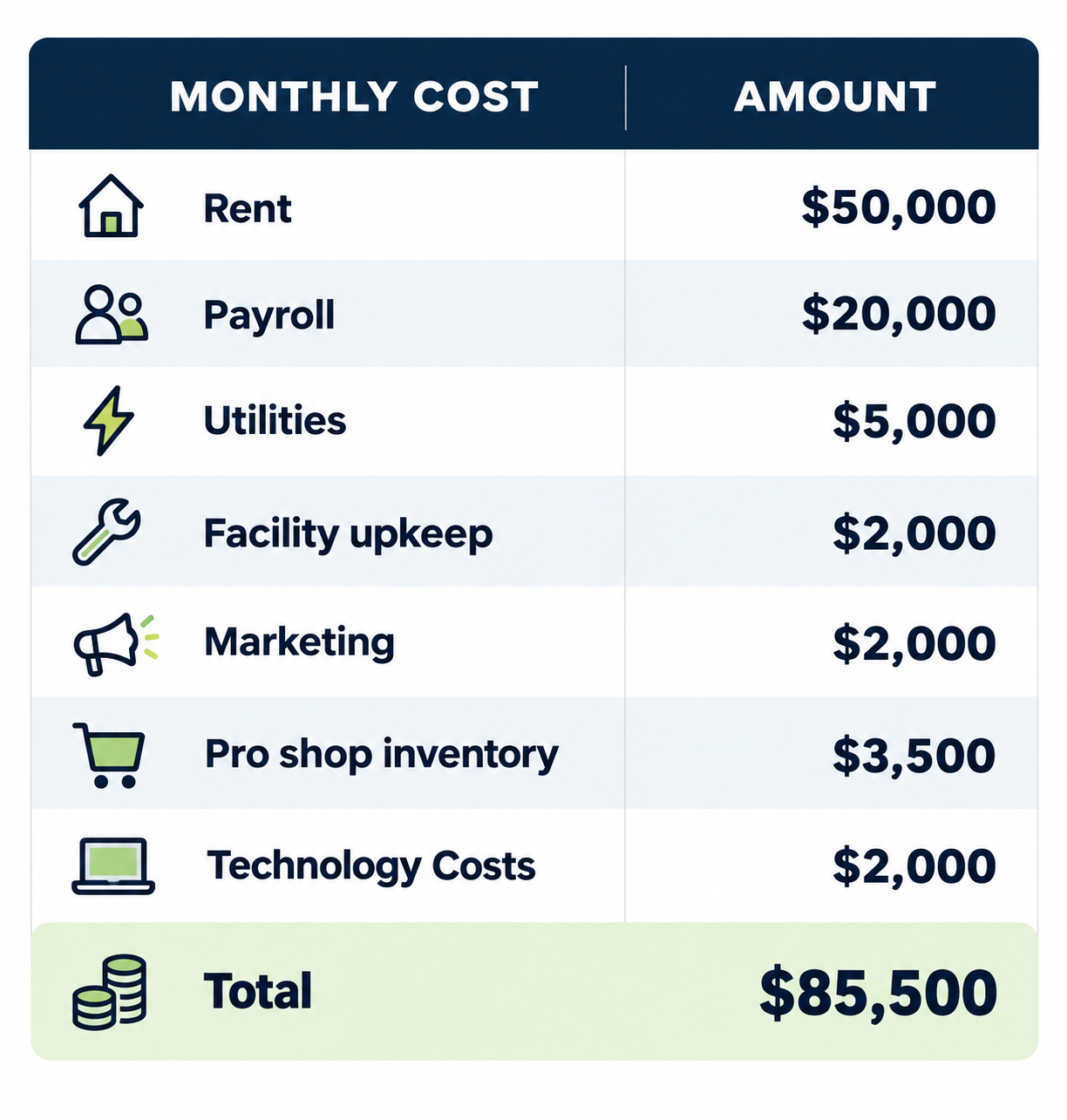
That's over $1 million a year just to break even, and I'm being generous on payroll. Plenty of clubs spend $25,000 to $30,000.
Now compare that with industry-wide numbers. A 10-court club at the small-facility average brings in about $960,000 a year in pickleball revenue. And I'm being nice there too, because that's the best of the three numbers. At the all-facilities average, it's about $768,000. Either way, the club is underwater on pickleball alone.
And you can't fix it with memberships.
- Say you sell a $50-a-month membership that gets half-off court time, and your court rate is $40 an hour
- To bring in a million dollars at full price, you need to sell 25,000 court hours a year
- That's every court booked almost seven hours a day, every day, Christmas included
And members only pay half, so the real number is higher.
Or say you sell unlimited play at $119 a month. A million dollars takes 700 members, or 70 per court. I don't think a club can hold more than 50 per court, which caps you around $714,000.
Everybody wants to play from 5 to 9 pm, and 10 courts only give you 40 court hours a night.
A gym makes money on members who never show up. Pickleball members show up every couple of days. The club fills up at peak, new members can't get a court, and growth stalls right around break-even.
💡
Love pickleball? Then you'll love our free newsletter. We send the latest news, tips, and highlights for free each week.
The aftermath
So here's what really happened.
Two things killed these clubs:
- Bad leases
- Owners who were sold a passive investment in a business that needs an owner in the building
What comes next is predictable. Clubs will try to renegotiate their leases. Some will close. The ones worth saving need somebody to look under the hood.
That's most of what we do at Johns Design & Consulting now. We're building fewer facilities and spending more time inside open ones. We call it a facility audit. It sounds polite. It isn't.
We go through the lease, payroll, revenue, programming, marketing, offers, staff training and coaches until we find where the money is leaking. It's usually the same few places.First, nearly every facility I walk into is overstaffed. Second, the programming is just there to check a box. Sure, there's an "Intro to Pickleball" class. But what happens after that class? Where does that player go next? Usually nobody has thought it through.
Weak programming breaks the marketing, because programming drives everything that comes after it: what you sell, how you sell it, and what you spend ad dollars on. If there's no path for a player to follow, you have nothing to offer them. If you have nothing to offer, a performance ad campaign has nothing to point to. That's why we started StackEleven Marketing.
Most of that can be fixed. A bad lease can't, at least not from the inside. That takes a lawyer and a negotiation, and I hope to God you didn't sign a personal guarantee.
The Pickleball Facility Boom Is Here, But a Shakeout Looms
First movers have rushed in to secure prime locations, sign leases, and build out clubs. But speed can come at a cost.
 The Dink PickleballAlex E. Weaver
What's next
Is pickleball dead? Hell no. If it is, I've made a spectacularly bad career choice, betting everything I have on one sport. What's dead is the fantasy that one club model works in every market and runs itself while the owner is on a boat somewhere.
When the boom hit, nobody was designing clubs for their market, nobody was training pros to run them, and nobody knew how to market them. So we built that.
- Johns Design & Consulting right-sizes the club for its market.
- RacketPro Organization develops the pros who run it.
- StackEleven fills it.
Design it, staff it, fill it. And we're not the only ones. Companies across the industry are building the same kind of support.
If I'm a betting man, the next wave of openings will be autonomous or semi-autonomous clubs with three to six courts: smaller, smarter builds with an active owner-operator and a real community behind them.
Remember the three-court rural clubs doing $12,000 to $14,000 a court every month? That's the model. I'm a huge believer in what PodPlay has made possible here, and we push nearly every new lead in that direction.
Why This Pickleball Club Gives Content Creators Free Memberships
The community gets built on the court. More and more, it gets found on the feed.
 The Dink PickleballBen Borton
A semi-autonomous club also lets you keep your day job. You don't need to be there from 9 to 5, because those are slow hours anyway.
But can you be there from 7 to 9 in the morning and 5 to 9 at night? Can you learn your members' names? If so, you've got a real shot.The game was never the problem. Walk into any good club at six o'clock on a weeknight and listen: forty paddles popping, people laughing, somebody arguing a line call like it's the Supreme Court. People love this sport. They just need a club that can afford to stay open.
Know your market. Size the club to fit it. Sign a lease the business can carry. And show up. It's a smaller dream than the one they were selling in 2023, but this one works.
Heads up: hundreds of thousands of pickleballers read our free newsletter. Subscribe here for cutting edge strategy, insider news, pro analysis, the latest product innovations and more.
Anuncie Aqui / Advertise Here
Sua marca para o mundo Pickleball! / Your brand for the Pickleball world!





 English (US) ·
  Portuguese (BR) ·