
 English
  Spanish
  Portuguese
  German
  Italian
  Japanese
  French
  Polish
  Russian
  Netherlands
  Hungarian
  Turkish
  Videos
  Thedink Pickleball

Most players separate fitness work from pickleball practice, and that is exactly why they plateau. These 5 pickleball drills build cardiovascular conditioning and sharpen your actual game at the same time.
Most players think fitness and pickleball practice are two separate things. You either go to the gym, or you go play rec games.
That split is costing you progress on both fronts.
The truth is you can build real cardiovascular conditioning, improve your footwork, and groove your most important shots all at once.
You just need the right drills that force your body and your game to work together under fatigue.These five drills come from PlayPickleball.com on YouTube, developed with coach Connor (That Pickleball Trainer) on a real court with real players who got genuinely winded working through them.
Love pickleball? Then you'll love our free newsletter. We send the latest news, tips, and highlights for free each week.
Drill 1: Shuffle Dinks
Shuffle dinks are the best single drill for building lateral quickness and grooving a consistent slice dink at the same time.
You are hitting a real shot while your legs are burning. That combination is exactly what you need.
Here is how it works. One player feeds a steady, low-pace ball to the worker.
The worker hits a straight line dink, then immediately shuffles to tap the center line with their right foot, shuffles back, and resets for the next ball.The goal is 20 consecutive reps before switching sides. Do two to three rounds total.
The most common mistake is going too fast and losing your base. Stay low throughout the entire movement.
Sit into your hips on every shuffle step. If you are standing upright between dinks, you are doing it wrong and you are also making the drill easier than it needs to be.
The feeder's job is critical here. You want a consistent, relatively dead ball with minimal pace. The worker needs to get into a groove, not fight a bad feed.Check out these dink fixes if your slice keeps floating on you.
Drill 2: Cooperative Cat and Mouse
Cat and mouse is a fitness drill disguised as a dinking game. One player stays in a single box. The other has to cover the entire kitchen.
The stationary player moves the ball around the full kitchen, including lobs if they want.The moving player's only job is to not miss and get every ball back into that one box. The goal is 20 consecutive shots without an error.
This drill is also great if you have a habit of overcomplicating your shots.When you are tired and scrambling, you stop trying to hit heroes and just make the ball. That mindset reset alone is worth the drill.
The secondary benefit here is lob retrieval.
When the stationary player throws a lob, the worker has to turn, run it down, chip it back in, and then work their way back to the kitchen.
That is a movement pattern that shows up in real games constantly.
If you want to sharpen your overall pickleball footwork, this drill will expose every gap in your lateral movement and recovery speed.
Offensive vs. Defensive Dinks: How to Control the Kitchen
The difference between an offensive dink and a defensive dink comes down to spin and intent. Master this fundamental skill and you’ll control the kitchen and win more points.
 The Dink PickleballThe Dink Media Team
What Makes These Different From Just Playing Rec Games?
Rec games are inconsistent. Some points are fast, some are slow, and you end up standing still for long stretches without realizing it.
These drills force continuous movement with no breaks built in. Your heart rate stays elevated because you are never waiting for a rally to develop.
Every rep demands both a physical and technical response.
That is a completely different training stimulus than casual play.How to Fix an Inconsistent Pickleball Serve Fast
If you want to know how to fix inconsistent pickleball serve mechanics, the fix usually lives in your toss, your contact point, and your follow through, not your talent. One focused practice session and three targeted drills can turn a shaky serve into your most reliable shot.
 The Dink PickleballThe Dink Media Team
Drill 3: 30 Before 30
30 before 30 is the pickleball drill that will make you take your drops seriously.
Your goal is to make 30 successful drops before accumulating 30 push-ups.
Every missed drop costs you five push-ups.
The feeder is not cooperative here. They are actively trying to make you miss with difficult ball placement, pace variation, and awkward feeds.
You can only hit drops. No drives. No resets.Drops only.
Here is why this works so well. As the push-ups accumulate, your upper body fatigues and your drops get worse.
You are forced to find technique that holds up under physical stress, which is exactly what happens in a real match when you are tired at 10-9 in the third game.
This is also a great pickleball drill for players who struggle with third shot drop consistency under pressure.
The consequences here are immediate and physical, which sharpens focus fast.
Pro tip: do your push-ups quickly and get back into position. The longer you take, the harder it becomes to find your rhythm again.5 Pickleball Drills That Turn Weak Shots Into Weapons
Pros Zane Navratil and John Cincola built five pickleball drills that attack the exact shots most players avoid. Steal all five and turn your weak spots into weapons.
 The Dink PickleballThe Dink Media Team
Drill 4: Two to One
Two to one trains your drive and drop combination from the baseline under continuous movement pressure. The worker covers the full baseline.
The feeder has one target box to aim at.
The sequence is simple:
- Feeder sends a fluttery ball to the worker's forehand side.
- Worker fires a 70% drive back (not a full rip, a compact, controlled swing).
- Feeder blocks it back softly.
- Worker hits a backhand or forehand drop into the kitchen.
- Repeat for 10 reps, then switch to the other side for 10 more.
The goal is 20 total consecutive reps without a miss. That sounds easy until you are 12 reps in and breathing hard.
The drive needs to be compact and purposeful, not a full swing. Think 70% effort with good contact, not a hero ball.
If you keep flying your drives long, these forehand drive fixes will help you find the right contact point.The immediate transition from drive to drop is what makes this pickleball drill valuable. In real games, you often need to attack and then reset quickly.
This drill builds that two-shot muscle memory automatically.
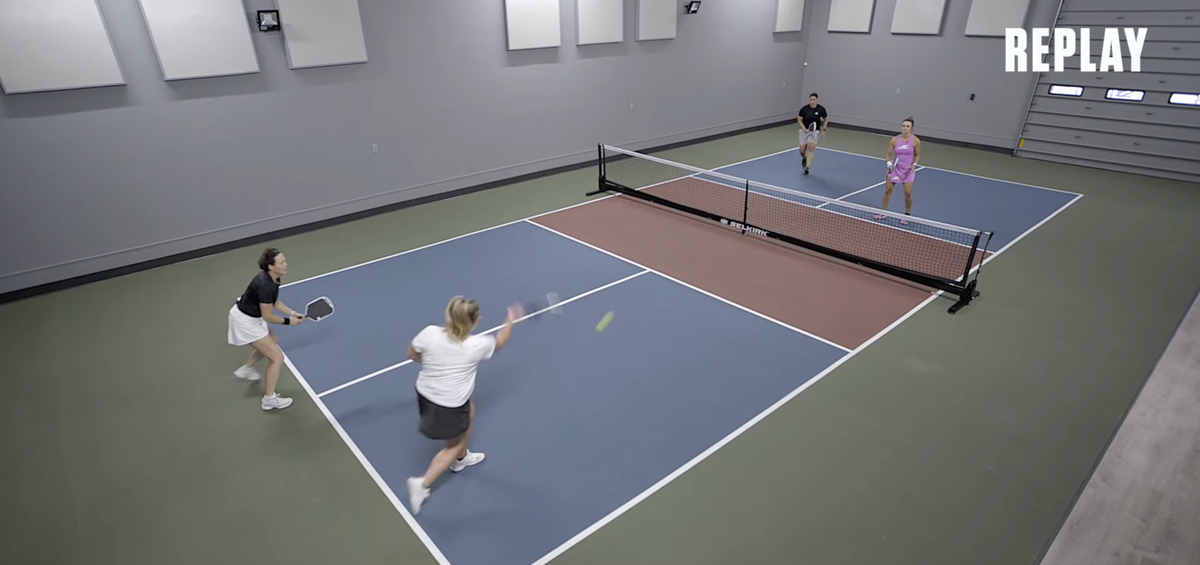
How and When to Hit the Drive-Drop Combo Shot in Pickleball
Most players think in binary terms. Drive or drop. Aggressive or defensive. But the reality of modern pickleball is more nuanced. Enter: The Drip.
 The Dink PickleballThe Dink Media Team
Is There a Right Way to Set Up the Feed for Two to One?
Yes, and most people get it wrong. The feed should be fluttery and slow, not a hard drive at the worker.
You want a ball that sits up just enough for the worker to generate their own pace on the drive.
A fast, low feed forces the worker to just block the ball back rather than actually executing a drive. That defeats the purpose entirely.Slow and soft from the feeder, explosive and controlled from the worker.
Erne Pickleball: Setup, Jump & Legal Landing Explained
The Erne pickleball shot is one of the most disruptive weapons at the net, letting you volley the ball outside the kitchen line while your opponent has nowhere to go. Here’s exactly how to set it up, execute the jump, and land legally every time.
 The Dink PickleballThe Dink Media Team
Drill 5: Dink Dink Lob
Dink dink lob is the movement pickleball drill that will expose how poorly most players recover from a lob.
The pattern is exactly what it sounds like.
Here is the full sequence:
- Both players dink once each from the kitchen.
- The feeder throws a lob up the line on the third ball.
- The worker does NOT take it out of the air. They run it down, chip it back into the kitchen, and work their way back up to the line.
- The feeder resets the point and the pattern repeats.
Goal is five consecutive reps without a miss.
The physical demand here is real. You are sprinting back, chopping a ball under pressure, then recovering forward to the kitchen.
Do that five times in a row and your legs will know about it.The skill piece is the chip back into the kitchen while running. Most players either pop it up or go wide because they are trying to do too much.
Simplify it.
Open your hips to the ball, chip it soft, and get moving forward immediately.If your lob recovery has always been a weakness, this drill fixes it with repetition rather than theory.
The lob itself is a real weapon in this pattern too, so understanding how to use it from the other side helps.Strong kitchen recovery is the foundation of good doubles play.
Players like Tyra Black make lob retrieval and reset look effortless, but it is built on exactly this kind of repetitive movement training.
5 Pickleball Dink Drills to Instantly Improve Your Game
Learn how to stop unforced errors, master the ready position, and dominate the non-volley zone to win more matches.
 The Dink PickleballThe Dink Media Team
How to Put These Five Drills Together in One Session
You do not need to run all five in a single session. Two or three done well will give you more than five done sloppily.
A solid 45-minute pickleball workout could look like this:
- Shuffle dinks: 3 rounds of 20 reps each side (10 minutes)
- Cat and mouse: 3 rounds of 20 each player (10 minutes)
- 30 before 30: 1 full round each player (15 minutes)
- Dink dink lob: 5 consecutive reps each player, 2 rounds (10 minutes)
That is a full workout that also makes you better at the actual shots that determine most points in your matches.
Compare that to running on a treadmill and then hitting a bucket of serves and the difference in transfer to your game is not even close.
If you want to build a smarter overall pickleball training week, this practice week guide gives you a structure that keeps you improving without burning out.
5 Pickleball Drills That Will Transform Your Game in 2026
Five simple yet powerful pickleball drills can completely reshape how you play. These mechanics focus on consistency, footwork, and positioning to help you see immediate results on the court.
 The Dink PickleballThe Dink Media Team
Why Fatigue Is the Point, Not a Side Effect
Every drill in this set gets harder as you get more tired. That is intentional, not accidental.
The best players in your local games are not the ones who look great in warm-ups. They are the ones who execute under fatigue in game five of a session.Practicing while tired builds that specific ability.
If your drops are falling apart when you are winded, you need more reps under fatigue, not more reps when you are fresh.These drills give you exactly that. And if you want to complement this court work with off-court strength, pickleball strength training basics is a solid starting point.
The goal is not just to get fit. The goal is to get fit in a way that makes your pickleball measurably better. These five drills do both at once.
💡
Heads up: hundreds of thousands of pickleballers read our free newsletter.
Subscribe herefor cutting edge strategy, insider news, pro analysis, the latest product innovations and more.
Frequently Asked Questions
How many times per week should I do these pickleball drills?
Two to three sessions per week is enough to see real improvement in both fitness and shot quality. Doing them every single day without rest will slow your recovery and reduce the quality of each session. Consistency over a few weeks beats daily grinding for one week.
Can beginners do the 30 before 30 drill?
Yes, but beginners should start with 10 before 10 to keep the volume manageable. The push-up penalty can also be modified to five knee push-ups instead of full push-ups. The goal is to keep the drill moving, not to get stuck doing push-ups for five minutes straight.
What does it mean to hit a "chip" during lob recovery?
A chip is a short, compact punch shot that gets the ball back into the kitchen with backspin or minimal pace. You are not trying to drive the ball from the baseline. You are just making a controlled return that gives you time to recover forward to the kitchen line.
Why should I not take a lob out of the air in the dink dink lob drill?
The entire point of the drill is to practice the full movement pattern: running back, recovering the ball, chipping it in, and transitioning back to the kitchen. Taking it out of the air skips all of that. Let it bounce and do the work.
What is the best pickleball drill for pure fitness without a partner?
Shadow footwork drills where you simulate the shuffle dink movement without a ball are a strong option when solo. You can also practice drop feeds into a net from the baseline to work on your drop mechanics and footwork together. The two to one drill can be adapted with a ball machine if you have access to one.
Anuncie Aqui / Advertise Here
Sua marca para o mundo Pickleball! / Your brand for the Pickleball world!






 English (US) ·
  Portuguese (BR) ·