
 English
  Spanish
  Portuguese
  German
  Italian
  Japanese
  French
  Polish
  Russian
  Netherlands
  Hungarian
  Turkish
  Videos
  Thedink Pickleball

New testing from Pickleball Effect suggests paddle manufacturers are finding ways to squeeze more power out of their equipment without breaking the rules. And the numbers are pretty eye-opening.
Remember when USA Pickleball introduced PBCoR testing to rein in increasingly powerful paddles?
Well, apparently nobody told the paddle manufacturers to slow their roll.
A new investigation from Pickleball Effect suggests that pickleball paddles are still getting more powerful, even as equipment regulations have become stricter.
And the data makes a pretty compelling case.
The Paddle That Started It All
Pickleball Effect founder Braydon Unsicker revisited the infamous Ronbus Ripple Beta, one of the first paddles to fail under the new PBCoR standard in early 2025.
He compared it against the Mark UnMarked 2026, one of today's hardest-hitting approved paddles.
The results? Surprisingly close.
- Ronbus Ripple Beta: 57.2 mph power, 37.9 mph pop
- Mark UnMarked 2026: 57.8 mph power, 37.4 mph pop
What's more, 19 approved paddles in Pickleball Effect's database now match or exceed the Ripple Beta's measured power. But only two approved paddles match or exceed its pop.
In other words, today's legal paddles can hit just as hard, or harder, than a paddle that helped spark the original controversy.
That's interesting.
💡
Need some new pickleball gear? Get up to 15% off select paddles, shoes, and more with code THEDINK at
Midwest Racquet Sports.
The Numbers Don't Lie
Looking at Pickleball Effect's testing database, the trend becomes even clearer:
Average measured paddle power
- 2022: 53.5 mph
- 2026: 56.7 mph
That's a roughly 6% increase in average measured power over four years.
The median has climbed, too, meaning this isn't just a few ridiculous paddles skewing the numbers.
As the Pickleball Effect report, written by Matt Reny, explains:
"That's engineering to a standard, not breaking it."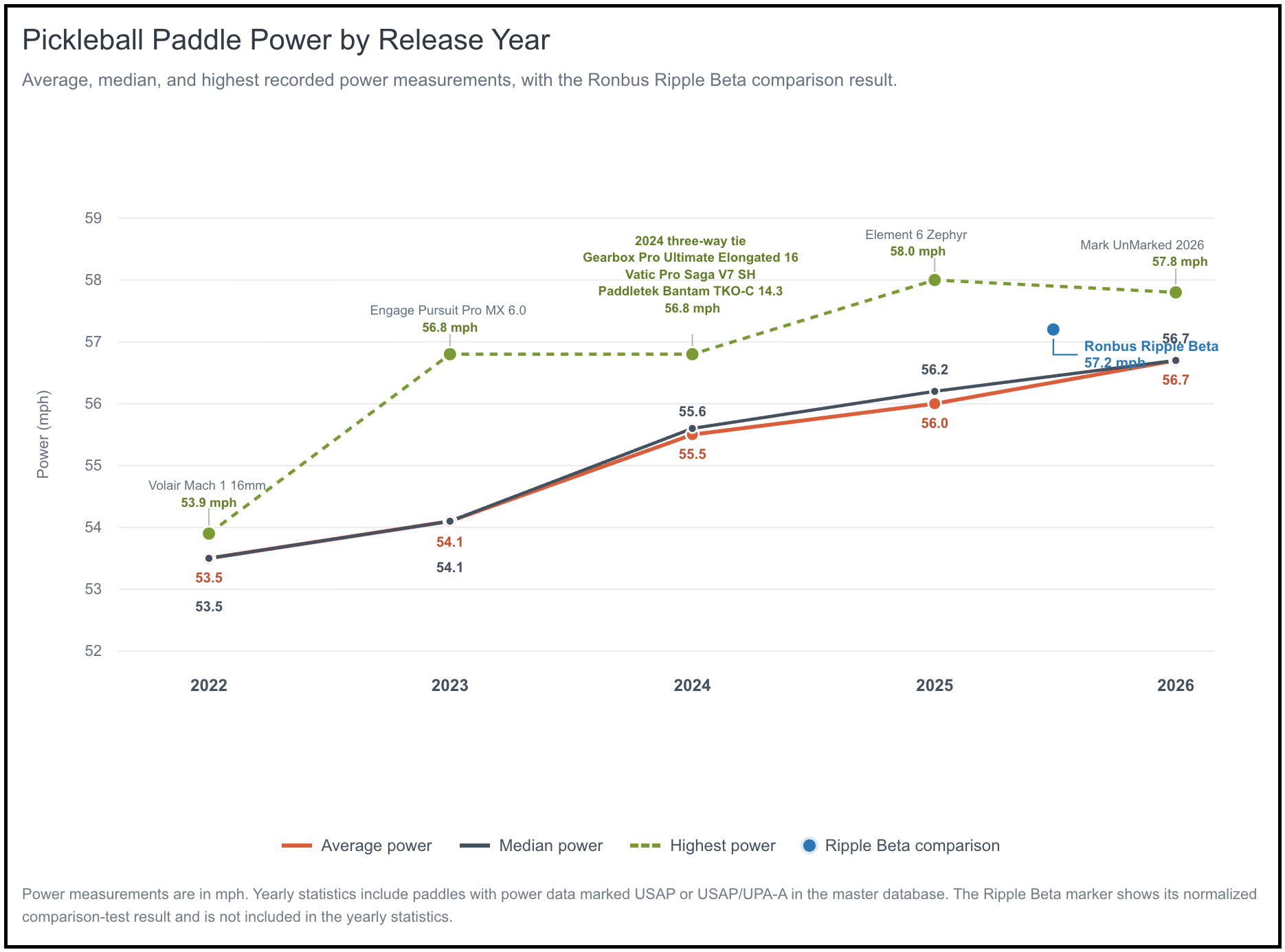 Graph and data via Pickleball Effect
So Is PBCoR Actually Working?
Here's where things get interesting.
PBCoR measures how a ball rebounds off a paddle under controlled conditions. It doesn't directly measure how hard someone can crush a full-swing drive.
And some manufacturers are getting pretty good at potentially exploiting that distinction.
By adjusting construction, stiffness, weight distribution and other variables, brands can generate more full-swing power while remaining within legal limits.That doesn't mean anyone is cheating or acting nefariously, necessarily. It means paddle technology is evolving faster than a single testing metric can fully capture.
And there's another wrinkle: newer balls can also contribute to faster play.
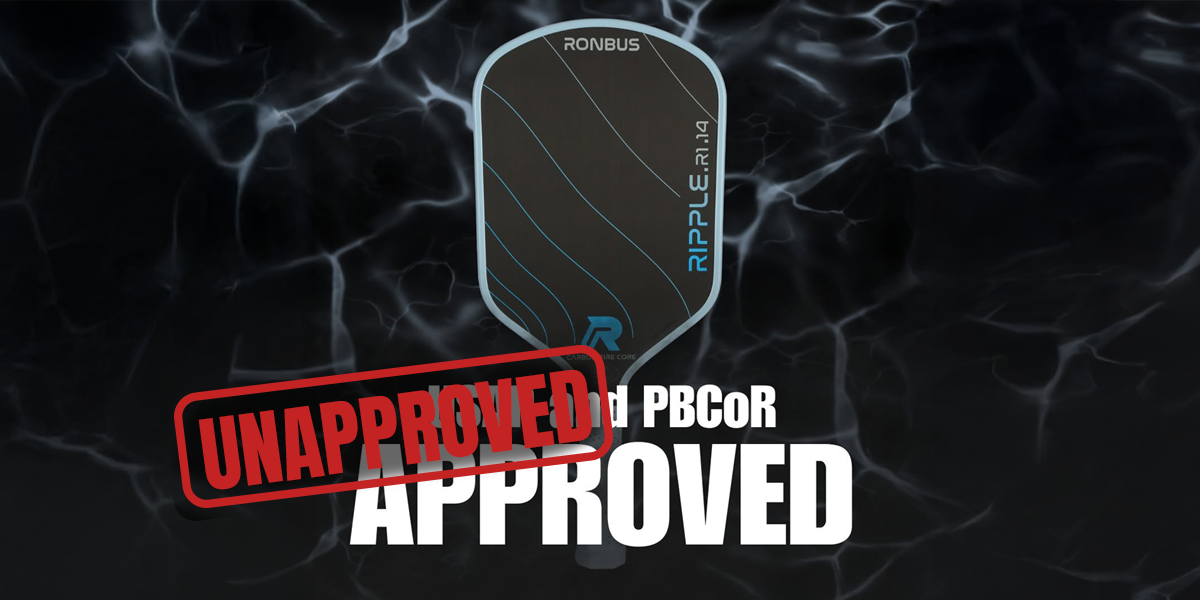
Popular Paddle Release Stalled Causing Confusion
The Ronbus Ripple R1.14 paddle launch is halted after failing USA Pickleball testing, sparking debate over paddle technology and rules.
 The Dink PickleballThomas Shields
The Big Takeaway
Pickleball Effect acknowledges its database isn't a perfect scientific sample of every paddle on the market. But the trend is difficult to ignore.
The report closes with an important observation:
"The pursuit of more power hasn't been stopped."So perhaps the real question isn't whether paddle regulations are working.
It's whether they're measuring everything that matters.
Because if the goal was to stop pickleball from becoming an arms race, the arms dealers apparently didn't get the memo.
💡
Need some new pickleball gear? Get up to 15% off select paddles, shoes, and more with code THEDINK at
Midwest Racquet Sports.
For more on this topic from the Pickleball Effect guys, check out their podcast below:
Heads up: hundreds of thousands of pickleballers read our free newsletter. Subscribe here for cutting edge strategy, insider news, pro analysis, the latest product innovations and more.
Anuncie Aqui / Advertise Here
Sua marca para o mundo Pickleball! / Your brand for the Pickleball world!






 English (US) ·
  Portuguese (BR) ·