
 English
  Spanish
  Portuguese
  German
  Italian
  Japanese
  French
  Polish
  Russian
  Netherlands
  Hungarian
  Turkish
  Videos
  Thedink Pickleball

Breaking the 4.0 ceiling in pickleball is the sport's most common plateau, most players hit it and never figure out why. Here's what's actually holding you back and how to move past it for good.
If you want to break the 4.0 ceiling in pickleball, the answer probably isn't your forehand. It's not your serve.
It's not even your third shot drop, even if everyone at the courts has told you that's the problem. The real issue is almost always tactical, not technical.
You've built the strokes. What you haven't built is the decision-making, the patience, and the pattern recognition that separates a 3.5 grinder from a legitimate 4.0.
Love pickleball? Then you'll love our free newsletter. We send the latest news, tips, and highlights for free each week.
Why Is the 4.0 Ceiling in Pickleball So Hard to Break?
The 4.0 rating is the sport's most stubborn plateau.
USA Pickleball's official skill rating descriptions define 4.0 as the point where players demonstrate "above average" consistency and strategy, and DUPR data shows the overwhelming majority of competitive recreational players cluster between 3.0 and 4.0.
Getting into that range is achievable. Breaking out of it is where progress stalls for most people, often for months, sometimes for years.
Here's the thing: the jump from 3.0 to 3.5 rewards good mechanics. You learn the third shot drop, you stop popping balls up, you stop hitting out of bounds.
Progress is clear. Incremental. You can feel yourself getting better.
The jump from 3.5 to 4.0 is different. It rewards pattern recognition. It rewards consistency under pressure.
It rewards knowing when not to attack, which is, frankly, a skill most players never fully develop.
The players who successfully break the 4.0 ceiling in pickleball aren't always hitting better shots than you.
They're making better decisions, more often, in the moments that actually matter.
What's Actually Holding You Back at 3.5
Most players assume their ceiling is physical. Wrong. The three things that actually keep players stuck below 4.0 are:
- Unforced errors in transition
The no-man's land between the baseline and the kitchen is where ratings are lost. Players who struggle to break the 4.0 ceiling in pickleball tend to attack from transition when they should be resetting. Mid-court pickleball is its own discipline, and most 3.5 players haven't studied it seriously.
- Predictable shot patterns
If your opponent knows what's coming, your ball speed doesn't matter. Better players read tendencies fast. Within a few points, they know your go-to dink direction, whether you prefer cross-court or down-the-line drives, and how you respond to pace. Pickleball deception isn't just for pros.
- Emotional inconsistency
This one's uncomfortable but true. Players at 3.5 often play their best pickleball in practice and their worst in competitive games. Tight moments produce tight swings. Tight swings produce errors. Errors snowball. Sports psychology research on "choking under pressure" confirms that anxiety disrupts motor performance in ways that are measurable and predictable, the mental side of rating improvement is drastically underrated in pickleball.
10 Pickleball Mistakes Holding You Back
From forcing points too early to avoiding your backhand, here’s exactly what to fix to get to the next level.
 The Dink PickleballThe Dink Media Team

How to Break the 4.0 Ceiling in Pickleball: The Third Shot Drop Isn't the Problem
You've heard it a thousand times: "Work on your third shot drop." And yes, a reliable third shot drop is essential.
But here's the truth most coaches won't say directly, most 3.5 players have a serviceable third shot drop already.
The problem isn't the shot itself. It's the fifth shot. And the seventh. And the reset after that.
The 4.0 game is about sustaining neutral. It's about executing the right shot five, six, seven times in a row until an attackable ball finally shows up.
Players who crack the ceiling understand that patience is a weapon. They don't rush. They don't force. They wait.
This is where solo pickleball drills become invaluable. You can't drill patience in a casual game.
You have to build it deliberately, resetting balls into the kitchen from mid-court, over and over, until the instinct to attack gets replaced by the instinct to wait for the right opportunity.
💡
Need some new pickleball gear? Get 20% off select paddles, shoes, and more with code THEDINK at
Midwest Racquet SportsDo You Actually Know Your Own Tendencies?
This is the question most players dodge. Honestly, most 3.5-level players have never seriously analyzed their own game.
Film yourself. It's uncomfortable. Do it anyway.
Video self-modeling has been shown in sports science research to be one of the most effective tools for skill refinement, athletes who review their own footage consistently outperform those who rely on coach feedback alone.
The dink you swear is reliable? It's going wide 30% of the time. The forehand roll you think is your weapon? You're telegraphing it from the backswing.
Pickleball self-filming is one of the highest-leverage things a developing player can do, and almost nobody below 4.0 bothers.
To break the 4.0 ceiling in pickleball, you have to be honest about what you're actually doing versus what you think you're doing.
Those two things are almost never the same.
How to Get From 3.5 to 4.5 in Pickleball
Cliff Pickleball reveals that the jump from 3.5 to 4.5 is driven by discipline, consistency, and better decision-making
The Dink PickleballThe Dink Media Team

How to Break the 4.0 Ceiling in Pickleball With Smarter Practice
Playing more isn't the answer. Playing better is.
There's a big difference, and research on deliberate practice consistently shows that the quality and intentionality of practice matters far more than raw volume.
It's why some players improve steadily while others stay stuck.
Here's what smarter practice actually looks like:
- Drill with purpose. Random rallying builds comfort, not skill. Target specific weaknesses, backhand volleys, resets from transition, return of serve positioning. Make the most of your return of serve before obsessing over the third shot.
- Play up. The single fastest way to accelerate improvement is to play against people who are better than you. Get comfortable being uncomfortable. Losing 11-3 against a 4.5 teaches you more than beating a 3.0 eleven times.
- Play tournaments. Zane Navratil has talked publicly about why recreational players should compete. The pressure of real match play exposes weaknesses that casual games never surface. Your third shot drop that works in open play will fall apart when you're down 9-8 in a tournament game. That's the moment you find out what you actually own.
Below a 4.0 in Pickleball? Focus on These 2 Shots Instead of the Third Shot Drop
You’re spending practice time on a shot that accounts for only 13 to 30% of points, while neglecting the fundamentals that actually win matches
The Dink PickleballThe Dink Media Team

What Does 4.0 Pickleball Actually Look Like?
Let's define it clearly.
According to USA Pickleball's official skill rating descriptions, a 4.0 player executes third shot drops consistently from both wings, sustains dink rallies without forcing, attacks with purpose rather than panic, and covers the court well in doubles.
They read the game two or three shots ahead. They're not perfect, but they're disciplined.
USA Pickleball also notes that pickleball is now the fastest-growing sport in America for the third consecutive year, which means more players than ever are chasing that 4.0 number.
The gap between 3.5 and 4.0 isn't a gap in athletic ability. It's a gap in strategic maturity. The good news is that strategic maturity is learnable.
Changing how you think about doubles pickleball, treating it as a chess match rather than a rally contest, is often the shift that finally breaks the plateau.
How to Go From a 4.0 to 4.5 Pickleball Rating
If you are looking for more specific things to work on to take your pickleball game to the next level, here are three keys to help you progress from a 4.0 to a 4.5 player.
The Dink PickleballEric Roddy
How to Position Yourself at the Kitchen (And Why Most Players Get It Wrong)
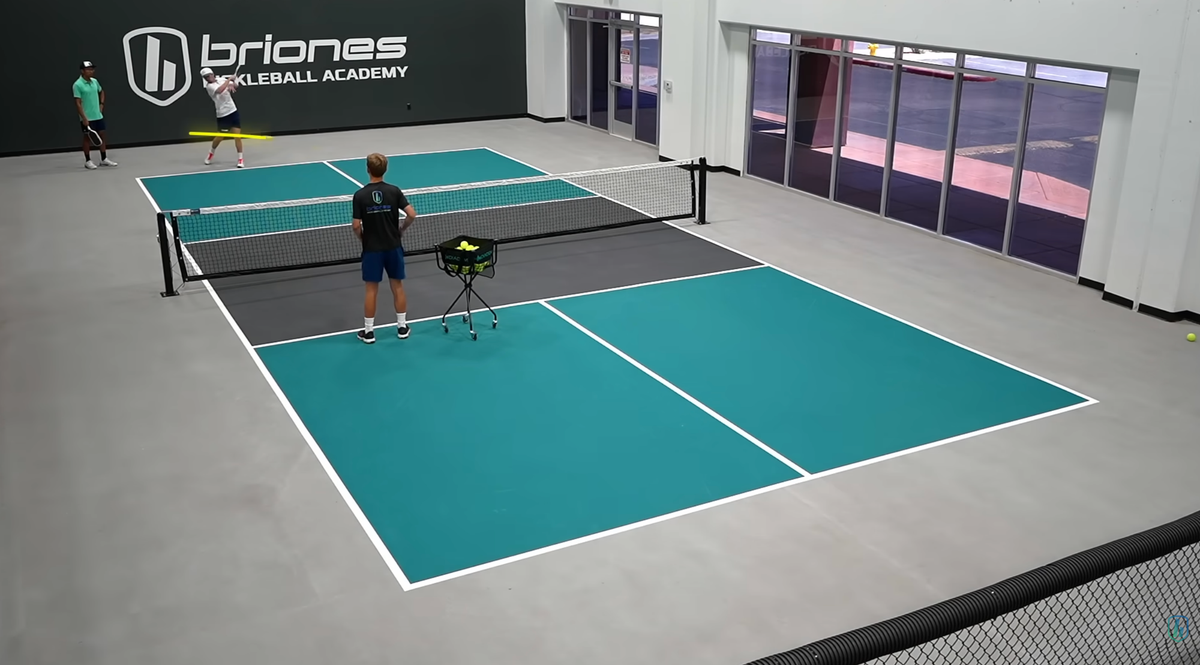
Here's a subtle thing that separates 4.0 players from 3.5: kitchen positioning. Most developing players stand too close to the kitchen line.
That sounds counterintuitive, but being jammed by a fast ball at your feet is one of the most common error sources in the 3.5 game.
Proper kitchen positioning gives you half a second more to read and react, and at this level, half a second is everything.
The other positioning mistake is lateral. Players crowd their partner in doubles, leaving gaps on the strong side and failing to cover poach opportunities.
Simple. Fixable. Almost universally overlooked.
Advanced Pickleball Attacking Strategy at the Kitchen Line
There are only three ways to attack at the kitchen line in pickleball. From speed ups off the bounce to reaching in for air attacks, here’s what separates the winners from the rest.
The Dink PickleballThe Dink Media Team

The Drive vs. Drop Question Nobody Answers Directly
Should you drive or drop on the third shot?
The drive-vs-drop debate is real, and the answer depends on your skill level, your opponent's return tendencies, and the score.
But here's the honest take for players trying to break the 4.0 ceiling in pickleball: default to the drop until your drive is truly a weapon.
A drive that gets reset and used against you is worse than no drive at all. At 4.0+, players handle pace.
What they struggle with is soft, well-placed balls that force them to generate their own power.
Learn to respond to the perfect drop, and then learn to throw that exact shot yourself.
Hit a Devastating Forehand Drive With Hip Rotation
As the game evolves and players get more skilled at dinking and net play, the ability to put away a ball with pace and control separates the good players from the great ones.
The Dink PickleballThe Dink Media Team
Key Takeaways
- Breaking the 4.0 ceiling in pickleball is primarily a tactical and mental challenge, not a physical one
- Unforced errors in transition, predictable shot patterns, and emotional inconsistency are the three biggest culprits
- Sustained neutrality, executing the right shot repeatedly until an attack opportunity arrives, is the defining 4.0 skill
- Film your games, play up, enter tournaments, and drill with intention rather than just rallying
- Kitchen positioning and drive-vs-drop decision-making are often the technical levers that move the rating needle
💡
Heads up: hundreds of thousands of pickleballers read our free newsletter.
Subscribe herefor cutting edge strategy, insider news, pro analysis, the latest product innovations and more.
Frequently Asked Questions
What does it take to break the 4.0 ceiling in pickleball?
Breaking the 4.0 ceiling in pickleball requires shifting from mechanical improvement to strategic maturity. You need consistent third shot drops, disciplined dinking, and the ability to sustain neutral rallies until a genuine attack opportunity appears. Most players already have the strokes, what they lack is the patience and pattern recognition that 4.0 play demands.
How long does it take to go from 3.5 to 4.0 in pickleball?
It varies widely and depends almost entirely on how you practice, not how often. Players who train intentionally, drilling specific weaknesses, playing up, and entering competitive tournaments, tend to progress measurably faster than those grinding casual open play. USA Pickleball's rating criteria makes clear that moving from 3.5 to 4.0 represents a significant jump in consistency and strategic execution, and recreational games rarely create the pressure conditions needed to build those skills.
What is DUPR and does it matter for measuring my rating progress?
DUPR (Dynamic Universal Pickleball Rating) is the most widely used rating system in competitive pickleball. It's calculated based on actual match results across all formats and skill levels, which makes it more accurate than self-assessment or traditional USA Pickleball skill ratings. You can read how the DUPR algorithm works directly on their site. If you're serious about tracking your progress toward 4.0, registering and playing rated matches is the clearest benchmark available, more on that at The Dink's DUPR breakdown.
Should I focus on singles or doubles to improve my pickleball rating faster?
Both help, but in different ways. Singles builds athleticism, court coverage, and shot consistency under pressure, because there's no partner to cover your mistakes. Doubles builds the tactical communication and positioning skills that define 4.0 play. Most players will improve faster in doubles if that's where they compete, but adding singles sessions accelerates the process significantly.
What are the most common mistakes 3.5 players make that prevent them from reaching 4.0?
The three biggest are attacking from transition too early, being predictable with shot selection, and emotionally unraveling in tight games. Most 3.5 players know what they should do in theory, the rating jump happens when they can execute it consistently under pressure, not just in practice.
Anuncie Aqui / Advertise Here
Sua marca para o mundo Pickleball! / Your brand for the Pickleball world!







 English (US) ·
  Portuguese (BR) ·