
 English
  Spanish
  Portuguese
  German
  Italian
  Japanese
  French
  Polish
  Russian
  Netherlands
  Hungarian
  Turkish
  Videos
  Thedink Pickleball

Knowing how to target the weaker player in pickleball doubles is one of the fastest ways to win more matches. This guide breaks down how to identify, exploit, and maintain pressure on the weaker opponent without giving their partner easy angles.
Knowing how to target the weaker player in pickleball doubles is, honestly, one of the most underrated skills in the game.
Everyone talks about shot mechanics, paddle tech, and third shot drops.
But the team that controls where the ball goes, and who it goes to, usually controls the outcome.This is not a dirty tactic. It is how pickleball is actually played at every level, from Thursday night rec sessions to the PPA Tour.
The goal of this article is to show you exactly how to do it, when to ease off, and why the pros make it look so effortless.
Love pickleball? Then you'll love our free newsletter. We send the latest news, tips, and highlights for free each week.
How Do You Identify the Weaker Player in Pickleball Doubles?
The most reliable way to identify the weaker player is to watch the first three to four rallies, not the scoreboard.
Ratings give you a baseline, but real-time errors tell you where the actual vulnerability is sitting right now, in this match, on this day.
Here is what you are looking for:
- Unforced errors on the backhand side. The backhand dink is the most commonly broken-down shot in recreational doubles. A player who floats backhand dinks high and wide is inviting you to come back there all night.
- Poor transition zone movement. If one player is consistently caught in no-man's-land (the area between the baseline and the kitchen line) while their partner reaches the non-volley zone, that is a free target. Balls hit at their feet in transition are brutally difficult to handle.
- Hesitation on speed-ups. Watch for the player who flinches when you attack. If they are blocking with a stiff arm or backing off the line, they are telegraphing discomfort.
- Serve return errors. A player who mishits or balloons their return of serve early is giving you a blueprint. Go back to that serve location.
USA Pickleball Quietly Delists Several Paddle Models
Hundreds of paddles receive USAP certification every year. What you don’t hear about is the ones that don’t make the cut.
 The Dink PickleballAlex E. Weaver
What is DUPR, and why should you check it? DUPR (Dynamic Universal Pickleball Rating) is the most widely used rating system in the sport, backed by Major League Pickleball. Ratings range from 2.0 to 8.0.
A half-point gap between opponents at the 4.0-to-5.0 level is significant. If you can confirm one player is rated meaningfully lower, that is your starting point.
But always trust what you see on the court over what the app says. Ratings are backward-looking; errors are live data.
Targeting the weaker player also pairs directly with smart doubles strategy around T and sideline placement, since shot direction and target selection work together.
Where Should You Direct the Ball to Keep Pressure On?
Direct the ball cross-court to the backhand, low to the feet in transition, and at the body on speed-up opportunities.
Those three zones produce the highest error rates against most recreational and intermediate players.
Cross-Court Dinks to the Backhand
This is the bread and butter of targeting in pickleball doubles. A cross-court dink travels over the lowest part of the net, has a longer landing zone, and arrives at the most uncomfortable angle for most right-handed players. If the weaker player is on your right, you are already set up perfectly from the left-side kitchen corner.
The goal is not to hit a winner. The goal is to force a short, floatable return that sets up your next ball. Keep it low and in the kitchen, and let cumulative pressure do the work.
💡
Need some new pickleball gear? Get 20% off select paddles, shoes, and more with code THEDINK at
Midwest Racquet SportsTargeting the Transition Zone
One of the most effective (and criminally underused) tactics is hitting at an opponent's feet while they are transitioning toward the kitchen. A ball that lands between their knees and their toes while they are mid-step forces a defensive scoop almost every time. Drive at the weaker player's hip or shoe tops the moment you see them moving forward.
This is especially effective off the return of serve. A deep, aggressive return aimed at the weaker player's body keeps them pinned back and neutralizes any drop they were planning to hit.
Body Shots and Speed-Ups
When you are at the kitchen and a soft ball comes back high enough, the body speed-up is lethal against players who are not comfortable at the line. Aim directly at the hip or shoulder of the weaker opponent. Pressure zone targeting at the body removes their ability to swing freely and forces a pop-up.
Competitive Doubles Strategy 4.0 Pickleball: Patterns That Win
Competitive doubles strategy 4.0 pickleball is less about hitting harder and more about controlling patterns, court positioning, and forcing opponents into losing situations.
 The Dink PickleballThe Dink Media Team
How Do You Target the Weaker Player in Pickleball Doubles Without Getting Burned?
The answer is simple: you cannot ignore the stronger player entirely.
The biggest mistake recreational players make when they correctly identify the weaker opponent is that they become predictable.
Every shot goes one direction. The stronger player figures it out in about four rallies, starts cheating that way, and starts poaching.
Here is how to stay unpredictable while still exploiting the mismatch:
- Play to the weaker player roughly 60-to-70% of the time. Not 100%. Keep the stronger player honest with occasional balls to their feet or a well-placed drive down the line.
- Set up the weaker player with the stronger one. Hit a firm ball to the stronger player's backhand, get a weak return, then redirect to the weaker player's open court. Use the strong player as a set-up, not a target.
- Vary speed and spin. Do not just hit the same soft cross-court dink to the same spot on repeat. Mix in a topspin dink, a short angle, and the occasional speed-up to the body. Variation keeps them guessing.
- Watch the poach. If the stronger player is visibly cheating toward their partner's side, that is actually great news. It opens the line. One well-placed return down the sideline or a sharp angle to their vacated side will stop the poaching cold.
There is an entire tactical layer here about when it actually makes sense to target your opponent's strength, and it is worth reading if you tend to over-commit to one pattern.
The #1 Doubles Strategy New Pickleball Players Must Know
The proof is in real statistics from professional pickleball: When the serving team fails to reach the kitchen line, they lose 65% of the time
 The Dink PickleballThe Dink Media Team
What Do the Pros Actually Do (and What Do Rec Players Miss)?
At the pro level, targeting the weaker player in doubles is baked into every serve, every return, and every dink sequence.
It is not a reaction. It is a pre-planned structure.
A few things pros do that most recreational players do not:
- Serve placement is intentional. Pro teams consistently serve to the player they have identified as the weaker return threat. This means fewer quality third shots to deal with and a higher chance of a floated or short return. Advanced serve placement near the kitchen is a genuine weapon, not an afterthought.
- Stacking is a tool, not a gimmick. Stacking in pickleball allows teams to control which player is on which side of the court. If one partner has a stronger backhand cross-court dink, stacking ensures they are always positioned to attack the weaker opponent's backhand. It is targeting made structural.
- Third shot targeting is deliberate. According to analysis published in sports performance coaching literature, the best doubles teams direct their third shot drops toward the player who gives them the softest or most predictable fourth shot. That is not random. It is a calculated read.
- Resets go to the weaker player too. When a team is under pressure and needs a reset, elite pairs reset the ball toward the opponent least likely to attack effectively. Even a defensive shot can have a target.
The idea of changing how you think about doubles pickleball entirely comes down to this: every ball you hit is a decision, and the decision should almost always involve who the ball is going to, not just where.
How to Be a Better Doubles Partner in Pickleball
Becoming a better doubles partner in pickleball starts with two things: clear communication and smart court coverage. This guide breaks down the tactics, habits, and positioning strategies that separate good doubles teams from great ones.
 The Dink PickleballThe Dink Media Team
Is Targeting the Weaker Player Legal and Ethical in Pickleball?
Yes. Completely, unambiguously legal. The official USA Pickleball rulebook contains no provision against directing shots at a specific opponent.
Shot selection is entirely at the discretion of the player.
From a sportsmanship perspective, it is also fully accepted. P
ickleball is a competitive sport. Identifying and exploiting a mismatch is the same strategy used in tennis, volleyball, and virtually every net sport on the planet.
Experienced players expect and respect it.
The nuance comes at the recreational level. If you are playing in a casual round-robin with beginners, there is a social contract in place.
Mercilessly hammering the weakest player in a fun-first setting is poor form, even if it is legal. Read the room.
In competitive play? There is no such contract. Exploit the mismatch.
That is how you become unattackable yourself by winning efficiently and not giving your opponents the oxygen to settle in.
A useful mindset: targeting is not about disrespecting your opponent. It is about respecting the game. Play to win with strategy, not just athleticism.
The 4 Essential Pickleball Return Targets to Play Like a Pro
By mastering these targets, you’ll improve your return consistency, put pressure on your opponents, and ultimately win more points.
 The Dink PickleballThe Dink Media Team
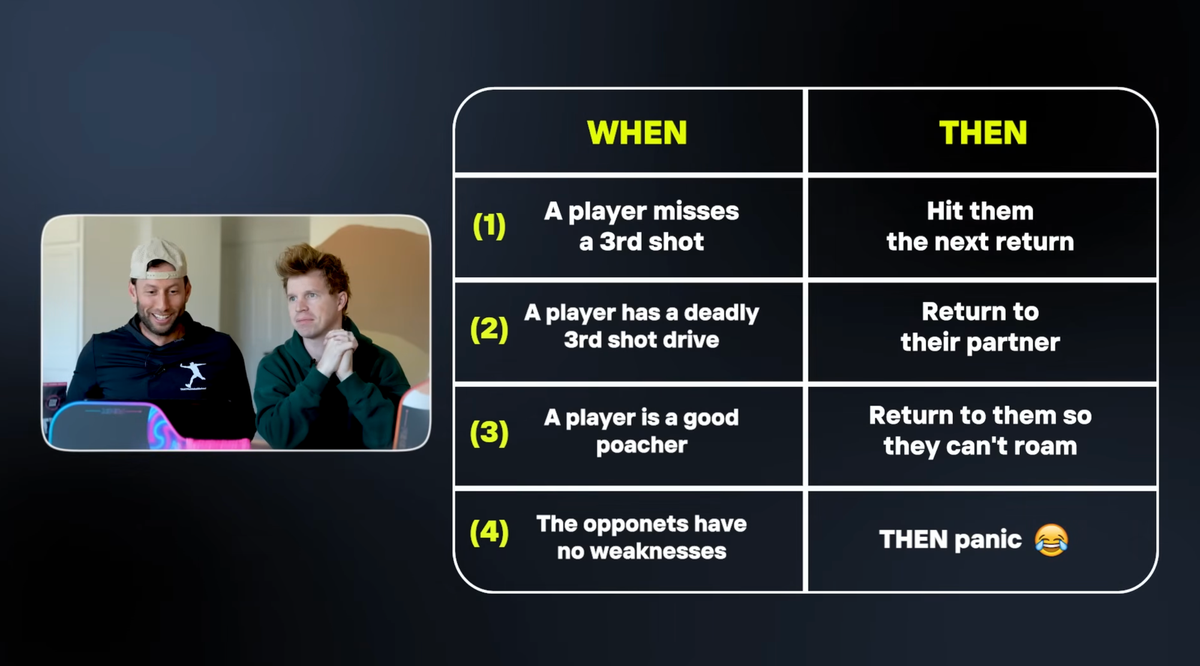
Key Takeaways
- The weaker player is not always the one with the lower DUPR rating. Watch for the player making more unforced errors in this match.
- Cross-court dinks to the backhand, returns aimed at the body, and serve placement are the three highest-percentage ways to apply consistent pressure.
- Over-targeting backfires. If you ignore the stronger player completely, their partner will poach and punish you.
- Targeting an opponent is fully legal under USA Pickleball rules. There is no sportsmanship violation in directing shots strategically.
- The best teams cycle between targets to keep both opponents off-balance, not just one.
💡
Heads up: hundreds of thousands of pickleballers read our free newsletter.
Subscribe herefor cutting edge strategy, insider news, pro analysis, the latest product innovations and more.
Frequently Asked Questions
Is it legal to target the weaker player in pickleball doubles?
Yes. Targeting any specific opponent is completely legal under the official USA Pickleball rules. Shot direction is always the hitter's choice. There is no rule requiring you to distribute shots evenly between opponents, and no sportsmanship clause prohibits strategic targeting in competitive play.
How do you identify the weaker player in pickleball doubles quickly?
Watch the first few rallies and look for repeated errors on the backhand side, poor kitchen positioning, or difficulty handling balls at the feet during transition. A player's DUPR rating from mydupr.com gives you a starting point, but in-match error patterns are always the better real-time signal.
What shot should you use when targeting the weaker player in pickleball doubles?
Cross-court dinks to the backhand, hard drives aimed at the body, and return-of-serve placements aimed deep at the hip are the highest-percentage options. The goal is not to hit outright winners. You want to force weak, hittable returns and capitalize on the next ball, not overhit trying to end it in one shot.
How do you avoid telegraphing your target when playing doubles?
Stay unpredictable by mixing your targets. Hit to the weaker player roughly 60-to-70% of the time, but keep the stronger opponent honest with occasional line drives and body shots. Consistent targeting patterns get read fast, especially by experienced players who will poach and cover for their partner once they recognize the pattern.
Does stacking help you target the weaker player more effectively?
Yes. Stacking in pickleball lets your team control court positioning so your stronger player is always aligned to attack the weaker opponent's vulnerable side, usually their backhand. It turns targeting from a reactive decision into a proactive structural advantage built into how you line up before every point.
Anuncie Aqui / Advertise Here
Sua marca para o mundo Pickleball! / Your brand for the Pickleball world!





 English (US) ·
  Portuguese (BR) ·