
 English
  Spanish
  Portuguese
  German
  Italian
  Japanese
  French
  Polish
  Russian
  Netherlands
  Hungarian
  Turkish
  Videos
  Thedink Pickleball

A hand speed drill isn't just about moving your paddle faster—it's about training your entire body to react with precision at the net. Coach Austin Hardy breaks down the exact hand speed drill system he uses to win 99% of hands battles, complete with three progressive drills and five game-changing tips.
If your hands feel slow at the net, a hand speed drill might be the missing piece in your training.
Most players assume that hand speed is something you're born with, but Coach Austin Hardy, a 5.0+ rated player and founder of the Pickleball Drills App, has spent years proving that's not true.
Through deliberate practice and the right hand speed drill system, you can transform your reaction time and net game in just a few months.
If you want to understand what separates rec players from competitors, the 12 drills you need to play your best pickleball in 2026 is a great place to start.
Love pickleball? Then you'll love our free newsletter. We send the latest news, tips, and highlights for free each week.
The Three Hand Speed Drills That Actually Work
The foundation of any effective hand speed drill system starts with progression.
You don't jump into competitive rallies;
- You build control first
- Then speed
- Then pressure
Hardy's three-drill framework does exactly that.
To see how this fits into a broader improvement framework, a simple 4-step system to win more pickleball games in 2026 outlines the bigger picture context around net-game training.
1. Double Hit Volleys: The First Hand Speed Drill
The first hand speed drill is deceptively simple but brutally effective.
You and a partner stand at the net and hit volleys back and forth, but here's the catch: each player taps the ball up on their paddle before hitting it back.
This creates a rhythm that forces you to think about your target while maintaining control.
"If you do this as a warm-up for just one minute before any drilling session with your partner, you're gonna have wicked fast hands," Hardy explains.The beauty of this drill is that it teaches you to hit your sweet spot consistently, which is the foundation for everything else.
Once you've mastered the basic version, progress to alternating sides. Hit cross-court, your partner hits down the line, then you go up the line while they go cross.
This pattern trains your brain to react faster because you're constantly adjusting your target.
By the time you remove the double tap and hit volleys directly, your hands will feel noticeably quicker.
This mirrors what pickleball's hardest dinking drill teaches about building hand control before adding pressure.
2. Romanian Volleys: Building Footwork Into Your Hand Speed Training
The second hand speed drill adds footwork into the equation. You and your partner shuffle across the kitchen line while hitting volleys back and forth.
The key is maintaining an open base (feet just outside your shoulders) and keeping your knees bent throughout the movement.
This drill teaches you something crucial:
In pickleball, you're not turning sideways like in tennis. You're staying square to the net and moving laterally.As you progress, you speed up the pace, which forces your hands to work faster while your feet stay coordinated.
The real magic happens when you focus on your spin.
Hardy emphasizes brushing up on the ball every single time to create topspin, which is what brings the ball back down at your opponent's feet.
This is the opposite of tennis, where underspin dominates.
In pickleball, topspin wins hands battles.Understanding why professional pickleball players abandoned the slice shot in 2025 explains exactly why this topspin-first mindset is now the pro standard.
💡
Need some new pickleball gear? Get 20% off select paddles, shoes, and more with code THEDINK at
Midwest Racquet Sports3. Heels Up Volleys: The Competitive Hand Speed Drill
The third hand speed drill is where things get competitive. You start about two feet inside the kitchen line and hit volleys at a much faster pace.
The ball comes back nearly twice as fast as normal, forcing your reaction time to sharpen dramatically.
As you improve, you step back and give yourself more reaction time.
This progression mimics what happens in a real match: you start aggressive, then adjust based on your opponent's speed.
Eventually, you turn it into a full hands battle where you're playing to 11 points, starting at 50% intensity and ramping up as the rally continues.
Pairing this with the figure-8 drill gives you a full volley conditioning circuit that covers both control and explosive speed.
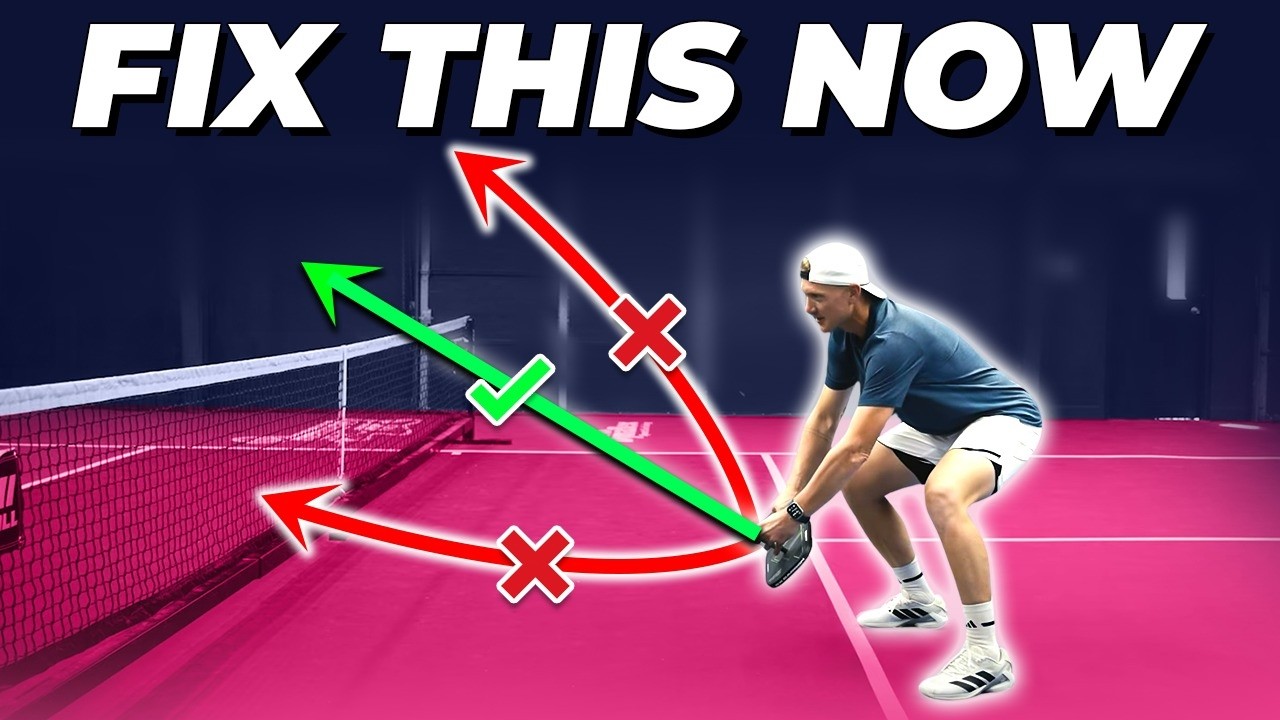
Understand Pickleball Volley Control: Physics & Technique
Pickleball volley control isn’t about luck or natural talent—it’s about understanding two fundamental principles: paddle angle and energy.
 The Dink PickleballThe Dink Media Team
Why Your Drilling Schedule Matters More Than You Think
Here's where most players fail: they do one intense drilling session and then disappear for a week. That's not how muscle memory works.
Hardy recommends drilling three days a week for one hour per session, spread evenly across the week (Monday, Wednesday, Friday is ideal).
The reason is simple:
Consistency beats intensity.If you drill all three hours in one day and then take a week off, your body doesn't build the neural pathways needed for automatic reactions.
But if you spread those three hours across the week, your nervous system has time to consolidate what you've learned between sessions.
Inside the Pickleball Drills App, there's a schedule feature that automatically organizes your drills based on what you want to work on.
If you tell it you want to improve hand speed, it generates a mix of volley drills and speed-up drills tailored to your goals.
The app then syncs with your Apple or Google calendar, so you're not guessing what to practice.
Hardy's own story proves this works. A few years ago, he played in a 4.0 tournament and finished second to last.
Three months later, after committing to this exact drilling schedule, he won a 5.0 tournament.
The difference wasn't talent; it was repetition.You can find a complete breakdown of how structured repetition builds competitive results in this pickleball training plan for competitive players.
Pro Pickleball Drilling Routine: Train Like a 6.0 DUPR
This advanced pickleball drilling routine focuses on building consistency, cleaner attacks, and faster hands under pressure.
The Dink PickleballThe Dink Media Team

Five Tips to Instantly Boost Your Hand Speed at the Kitchen Line
Even if you can't commit to a full drilling schedule right now, these five tips will improve your hand speed and reaction time immediately.
They're the small adjustments that separate pros from amateurs.
Tip 1: Find Your Hand Speed Ready Position
Not every pro uses the same ready position, and that's okay. J.W. Johnson, one of the fastest-handed players in pickleball, keeps his paddle down low, almost below his waist.
This relaxed position lets him react faster because there's less tension in his arm.
Ben Johns and Hayden Patriquin, the world's best players, use a different approach.
They point their paddle tip directly at their opponent at about waist level.
This position automatically sets them up to cut low balls (which resets the point) or hit topspin on high balls (which attacks).
If you have a two-handed backhand, Anna Leigh Waters's ready position might work better for you.
She keeps her paddle tip pointing upward, which gives her the advantage of hitting topspin on any ball, even low ones.
The key is finding what feels natural and what increases your hand speed the most. Experiment with all three, then commit to one.
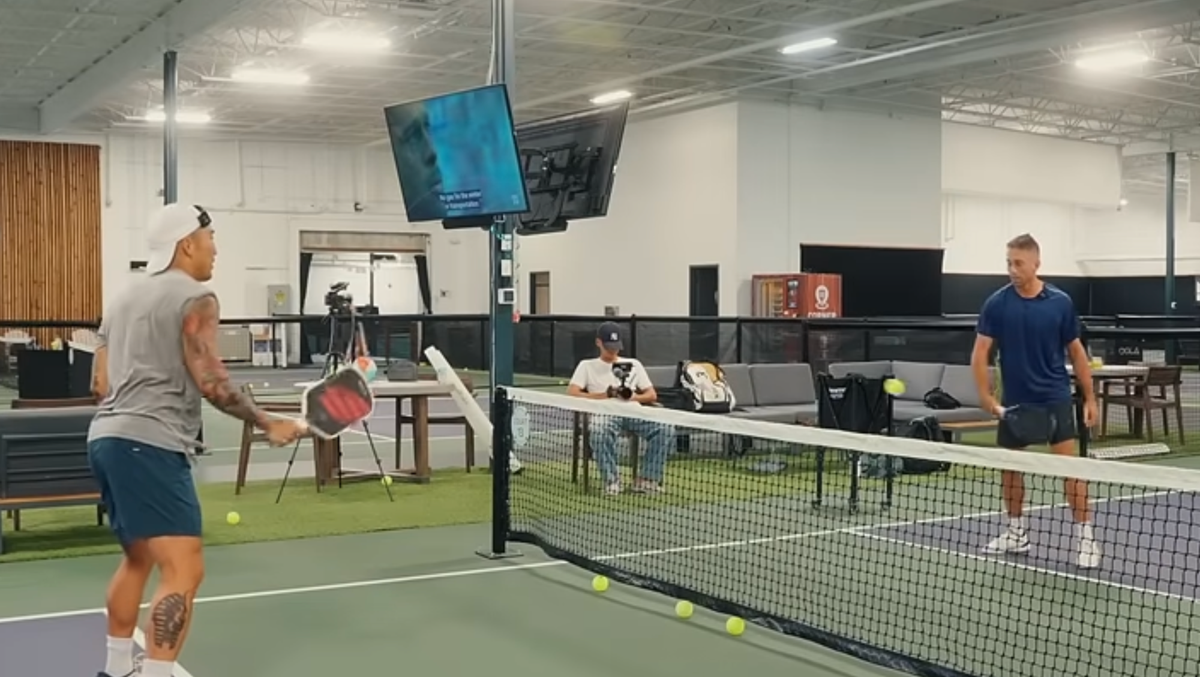
Stop Popping the Ball Up: Modern Pickleball Hand Speed and Paddle Positioning
Winning the kitchen today isn’t about swinging harder—it’s about creating space with your coil and controlling contact with smarter paddle positioning
The Dink PickleballThe Dink Media Team
Tip 2: Get Low and Stay Wide
Your base is everything. Top pros keep their feet just outside their shoulders at all times, and their knees stay bent.
This isn't optional; it's the foundation of fast hands.
When your knees are bent and your base is wide, you're already in position to react. You don't have to bend down to reach low balls; you're already there.
This saves milliseconds, which is the difference between winning and losing a hands battle.
The biggest mistake Hardy sees is players standing straight up with their knees locked.
If you hit them a low ball, they have zero chance of getting it back because they're too late bending down.
They're also unstable, which means they can't set up for the next shot.
Getting this base right is one of 6 essential pickleball shots to master for 2026 — the footwork and positioning fundamentals apply to every shot at the net.
The Return Plus One: Mastering the Transition from Baseline to Kitchen Line
The return and fourth shots aren’t glamorous; they’re the shots that determine whether you’re winning matches or wondering why you keep losing to players you think you should beat.
The Dink PickleballThe Dink Media Team
Tip 3: Elbows Out, Shoulders Forward
This one feels weird at first, but it works. Keep your elbows out in front of your body at a relaxed angle, angled slightly outward.
When you do this, your shoulders naturally tilt forward, which automatically tilts your paddle face down when you make contact.
Gabe Tardio, who has one of the best backhand counters in pickleball, uses this technique constantly.
His elbows are always out, and his shoulders are always forward. This positioning lets him hit the ball down more consistently and with better control.
If your elbows are tucked in, you have to bring them out to make contact, which costs you time. Keep them out and you're already in the right position.
Gabe Tardio's pro tips on the snake shot show this same elbow-forward principle applied to one of the most aggressive shots in the game.
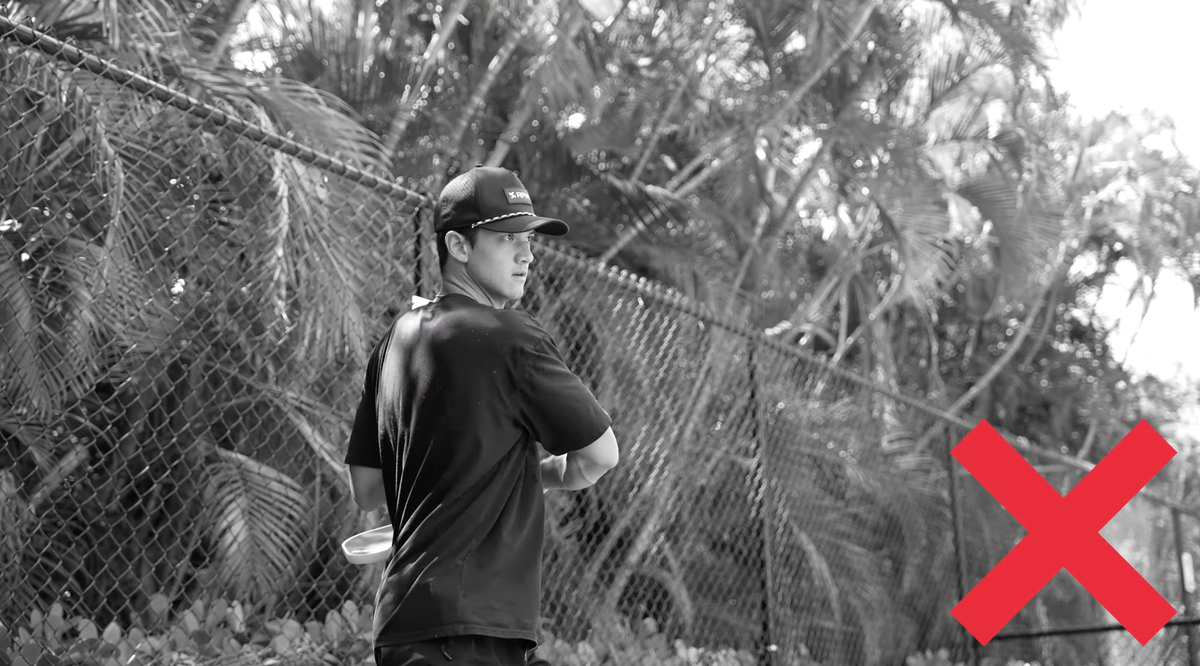
Off-Ball Positioning in Pickleball: Stop Ball Watching
Most pickleball players think the point is decided by whoever hits the ball, but at higher levels, off-ball positioning is what actually controls the court. Master this skill and you’ll transform how you play at the net.
The Dink PickleballThe Dink Media Team

Tip 4: Give Yourself Space and Time
You don't always have to be at the kitchen line. Pros take a step back all the time, especially when they anticipate a speed-up.
If your partner is dinking with the opponent directly in front of you and you notice the dink is a little high, take a step back and get ready.
This simple adjustment gives you more reaction time and a major advantage. If your opponent speeds up the ball, you're already prepared.
If they don't, you can move forward and attack.
Knowing when to hold your ground versus drop back is exactly what the decision matrix on when to attack or reset in pickleball is built around.
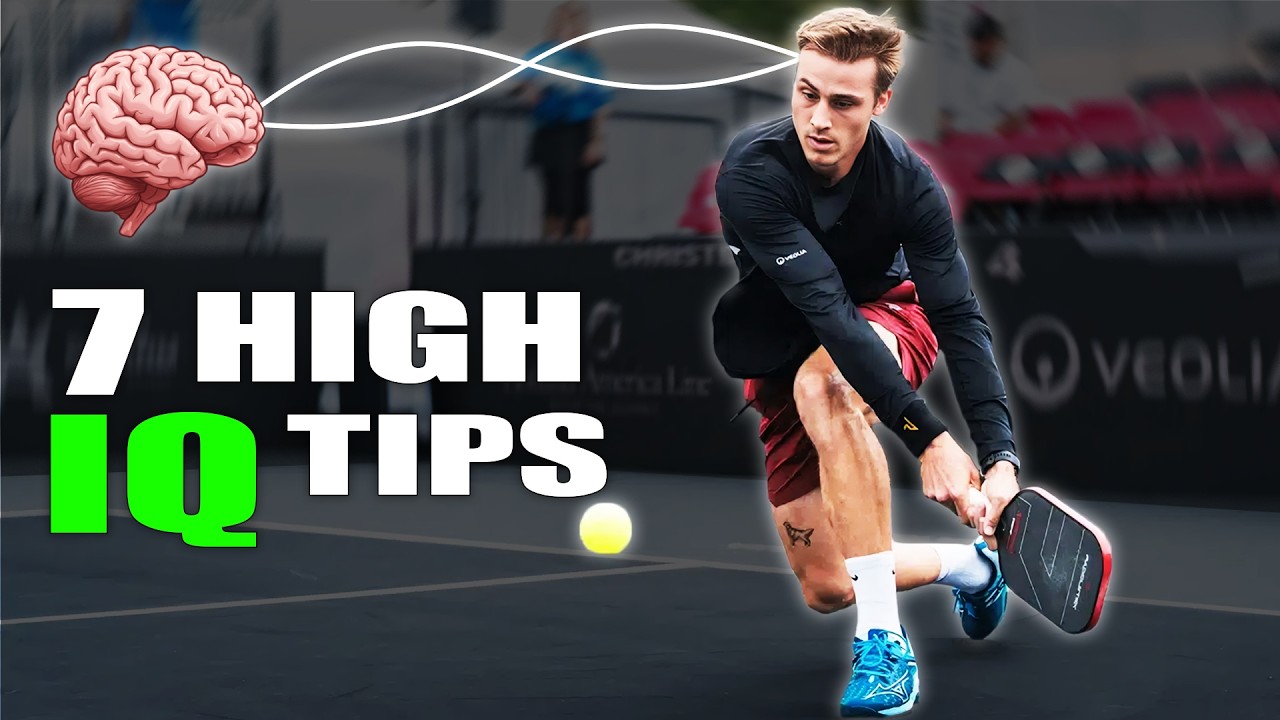
7 High-IQ Adjustments to Stop Playing Reactive Pickleball
When you combine smart decision-making with solid fundamentals, you’ll see immediate improvements in your win rate.
The Dink PickleballThe Dink Media Team
Tip 5: Choke Up on Your Paddle to Improve Hand Speed
This is optional, but it's a game-changer. When you get to the kitchen line, move your grip up the paddle handle slightly.
You're not going full penhold grip (that's too extreme), just choking up a bit so the paddle feels lighter in your hand.
Gabe Tardio, Ben Johns, Christian Alshon, and Hayden Patriquin all do this. The lighter paddle lets your hands move faster and maneuver more quickly.
You lose a tiny bit of reach, but the speed gain is worth it.
Pair this with the right equipment and you can get up to speed fast by reviewing how to break 5.0 with the shots you must master.
Why Pro Players Choke Up on Their Pickleball Grip
Pro pickleball players aren’t just gripping their paddles differently for show. Choking up on your pickleball grip lowers swing weight, increases hand speed, and improves control at the kitchen. Here’s what you need to know.
The Dink PickleballThe Dink Media Team

The Real Secret to Faster Hands: Reps Over Talent
Here's the thing that separates good players from great ones: volume.
- When you play a casual game, you might hit five drop shots in two hours.
- When you drill, you hit 500 drop shots in two hours.
That's the difference between improving slowly and improving fast.
This is why drilling is the foundation of consistency. If you want to play well in tournaments, you have to drill. There's no shortcut.
Research from sports performance science confirms that reaction time training improves with deliberate, structured repetition more than any other method.
But the good news is that the system Hardy outlines is simple enough that anyone can follow it.
The three hand speed drill progressions take you from basic control to competitive pressure. The schedule keeps you consistent.
The five tips fine-tune your mechanics. Together, they create a comprehensive net-game training system that works.
According to NBC Sports' coverage of pickleball's fastest pro players, the top athletes in the game attribute their net dominance to years of targeted drilling rather than natural athletic ability.
This is the same conclusion Hardy reached after modern pickleball's four key strategies to winning in 2026 confirms: the net game is now the battleground, and hand speed is the weapon.
Combine this system with a fridge and toaster drill session and you've got a complete court-time routine built around speed and placement.
💡
Heads up: hundreds of thousands of pickleballers read our free newsletter.
Subscribe herefor cutting edge strategy, insider news, pro analysis, the latest product innovations and more.
Frequently Asked Questions
What is a hand speed drill and how does it differ from just playing matches?
A hand speed drill is a structured exercise that isolates and develops fast reaction volleys at the kitchen line. In a match, you might hit a few fast-paced volleys; in a dedicated hand speed drill session, you hit dozens with specific focus on technique and progression. Drills isolate the skill you're trying to improve, while matches mix everything together.
How long does it take to see results from a hand speed drill routine?
Most players notice measurable improvement within two to three weeks of consistent hand speed drill practice. Real transformation takes about three months of drilling three days a week, which mirrors Hardy's own journey from finishing last in a 4.0 tournament to winning a 5.0 event in exactly that timeframe.
Can I do a hand speed drill session alone, without a partner?
No, most hand speed drills require a partner to return the ball consistently. Without someone feeding the ball back, you can't build the back-and-forth rhythm that trains your reaction time and volley control. If you don't have a regular partner, consider joining a local pickleball club or connecting through a pickleball app.
What if I don't have time for three one-hour hand speed drill sessions per week?
Even one focused session per week is better than none. If you can only commit to one session, make it count by progressing through all three drills, from double hit volleys to heels-up volleys, in a single hour. Quality and progression beat duration every time.
Do I need special equipment to run a hand speed drill?
No special equipment is required, just a paddle, a ball, and a partner. Some players use the Pickleball Drills App to auto-generate and schedule their sessions, but the core system works with nothing more than a court and a willing training partner.
Anuncie Aqui / Advertise Here
Sua marca para o mundo Pickleball! / Your brand for the Pickleball world!





 English (US) ·
  Portuguese (BR) ·