
 English
  Spanish
  Portuguese
  German
  Italian
  Japanese
  French
  Polish
  Russian
  Netherlands
  Hungarian
  Turkish
  Videos
  Thedink Pickleball

By mastering this simple footwork move, you'll stop your forward momentum and give your brain the split second it needs to read your opponent's paddle.
You've probably heard it before: "You just need faster hands to win at the kitchen."
But here's the thing—that advice is only half the story. According to C.J. Johnson of Better Pickleball, the real secret to reacting faster in pickleball isn't about hand speed at all.
It's about mastering the split step pickleball technique, a footwork move that stops your forward momentum and gives your brain the split second it needs to read your opponent's paddle and anticipate the ball.
Love pickleball? Then you'll love our free newsletter. We send the latest news, tips, and highlights for free each week.
Why Hand Speed Isn't Your Real Problem
Let's start with the uncomfortable truth: most players blame their hands when the real culprit is their feet.
When you're moving forward while your opponent hits the ball, you're already committed to a direction. Your brain doesn't have time to process what's happening. You're essentially playing blind.
The momentum stopper is the core concept here. If you're still moving when your opponent strikes the ball, you've lost the ability to react. Your body is already in motion, your weight is already shifting, and by the time your brain registers the paddle angle, it's too late. You're reaching, lunging, or completely out of position.
This is where the split step pickleball technique changes everything. Instead of continuing to move forward, you stop. You plant your feet. You create a moment of stillness that allows your nervous system to process information and respond.
What Exactly Is a Split Step?
The split step is a small, explosive hop that lands you in a neutral, ready position. Think of it as a reset button for your footwork. You're not jumping high or moving far—you're just creating a brief moment where both feet leave the ground simultaneously, then land in a balanced stance.
Here's why this matters: when both feet are off the ground at the same time, you're in a state of dynamic equilibrium. You're not committed to moving left or right. You're not still moving forward. You're ready to explode in any direction based on what you see.
The timing is critical. You execute your split step right as your opponent is about to hit the ball. This gives you the maximum amount of time to read their paddle angle and anticipate where the ball is going.
3 Pickleball Drill Alternatives to Level Up Your Game
Hate drilling? A top pickleball coach just revealed 3 pickleball drill alternatives that work better than traditional practice. These methods focus on intent, extended warm-ups, and court positioning to accelerate your improvement.
 The Dink PickleballThe Dink Media Team
How Stopping Momentum Creates Time
This is the counterintuitive part that most players miss: stopping creates time.
It sounds backwards, but it's physics. If you're moving forward at five miles per hour and your opponent hits the ball, your brain has to process not only where the ball is going but also adjust for your own forward momentum. That's two calculations happening simultaneously.
When you execute a split step and come to a complete stop, your brain only has to do one calculation: where is the ball going?
Suddenly, you have more processing power available.
- You can read the paddle angle more clearly.
- You can anticipate spin.
- You can see whether your opponent is setting up for a hard hit or a soft touch.
C.J. Johnson explains that this split second of stillness is the difference between feeling slow and feeling fast. It's not about your hands at all. It's about giving your nervous system the information it needs to make the right decision.
Paddle Customization Guide: Lead Tape, Twist Weight and More
James Ignatowich breaks down the science behind paddle customization and performance in a way that’ll change how you think about your equipment.
 The Dink PickleballThe Dink Media Team
The Hop vs. The Step Out: Which One Is Right for You?
There are two primary ways to execute a split step, and the right choice depends on your joints and your game. Understanding the difference is crucial because one might work better for your body than the other.
The Hop is the traditional split step.
Both feet leave the ground simultaneously, and you land with your feet shoulder-width apart. It's explosive, it's athletic, and it's what you see most professional players doing. The hop creates maximum readiness because you're literally bouncing into position.
However, the hop can be tough on your knees and ankles, especially if you're playing pickleball over 50 or dealing with any joint sensitivity. The impact of landing can add stress to your lower body over the course of a long match or tournament.
The Step Out is a gentler alternative.
Instead of hopping, you take a small step forward with one foot while simultaneously stepping back with the other. Your feet never leave the ground at the same time. It's less explosive, but it's also less jarring on your joints.
The step out still accomplishes the goal of stopping your forward momentum and creating a moment of readiness. It's a legitimate technique that works especially well for players who need to protect their knees or ankles.
💡
Need some new pickleball gear? Get 20% off select paddles, shoes, and more with code THEDINK at Midwest Racquet Sports
The Triangle Over Triangle Stance: Your Foundation for Balance
Once you've executed your split step, you need to be in the right position to move explosively in any direction. This is where the triangle over triangle stance comes in. It's a specific body alignment that keeps you balanced and ready to spring.
Here's how it works: your feet form one triangle (your base), and your shoulders form another triangle (your upper body). These two triangles should be aligned vertically. Your shoulders should be directly above your feet, not leaning forward or back.
Heads up: hundreds of thousands of pickleballers read our free newsletter. Subscribe here for cutting edge strategy, insider news, pro analysis, the latest product innovations and more.
This alignment is critical because it allows you to move equally well in any direction. If your shoulders are ahead of your feet, you're already committed to moving forward. If your shoulders are behind your feet, you're off-balance. The triangle over triangle keeps you in the sweet spot.
Your knees should be slightly bent, your paddle should be up in front of your body, and your weight should be on the balls of your feet. You're not flat-footed. You're not on your heels. You're in a position where you can explode left, right, forward, or backward with equal ease.
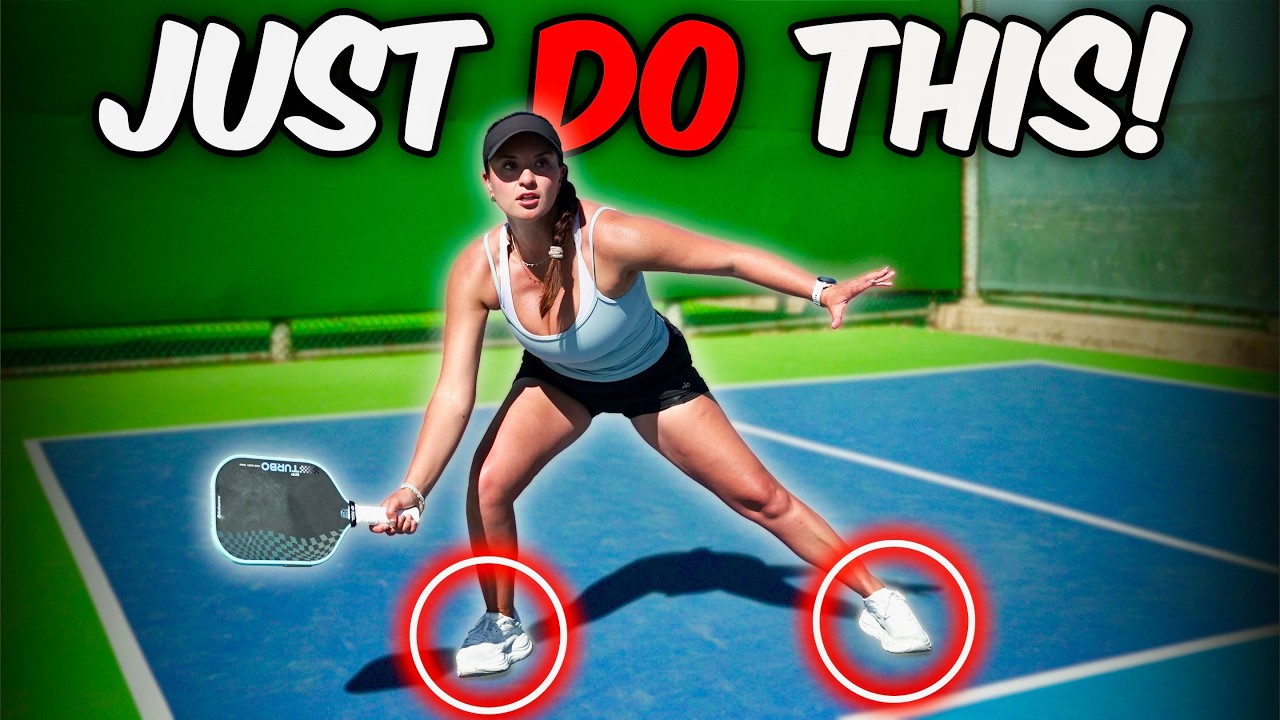
The 4 Pillars of Pickleball Improvement Explained
Pickleball improvement doesn’t have to take forever. By mastering four core pillars—fundamental drills, footwork, eliminating weaknesses, and gear optimization—you can accelerate your progress and compete at a higher level.
 The Dink PickleballThe Dink Media Team
Reading the Paddle Angle: The Pro Tip That Changes Everything
Once you've stopped your momentum with a split step and positioned yourself in the triangle over triangle stance, the real magic happens: you can actually read what your opponent is about to do.
Reading the paddle angle is the skill that separates good players from great ones.
When your opponent is about to hit the ball, the angle of their paddle tells you almost everything you need to know about where the ball is going.- If their paddle is open (facing upward), they're likely hitting a soft shot or a lob.
- If their paddle is closed (facing downward), they might be hitting a hard shot or a drive.
- If their paddle is angled to the right, the ball is probably going to your left.
- If it's angled to the left, the ball is probably coming to your right.
The key is that you can only read these subtle cues if you've stopped moving. If you're still drifting forward, your eyes are bouncing, your brain is processing your own movement, and you miss the information. But if you've executed a split step and you're standing still, you can watch their paddle like a hawk.
This is why split step pickleball technique is so powerful. It's not about being faster. It's about being smarter. You're gathering information that your opponent thinks you can't see.
7 Pickleball Tips That Will Actually Change Your Game
Here’s a little knowledge nugget: just because you know how to hit an ATP doesn’t mean you should go for one every wide dink you get
 The Dink PickleballThe Dink Media Team
How to Spot a Hard-Hitter by Their Body Position
One specific application of reading your opponent is learning to spot the "banger"—the player who loves to hit hard shots. These players have a distinctive body position that telegraphs their intentions.
When a hard-hitter is about to strike, their shoulders rotate more aggressively. Their weight shifts more dramatically. Their paddle comes back further. Their entire body is coiled like a spring, ready to explode through the ball.
If you can spot these signs early, you can adjust your positioning. You might back up slightly. You might widen your stance. You might prepare to block rather than attack. You're no longer reacting to the ball after it's been hit; you're anticipating it before it leaves their paddle.
This is where the split step becomes even more valuable. By stopping your momentum, you give yourself the visual clarity to read these body cues. You're not just reacting to the ball; you're reading the player.
How to Beat a Banger Strategy in Picklebal
Power hitters can be frustrating, but a solid banger strategy doesn’t have to derail your game. Pro player Ava Ignatowich breaks down five tactical approaches to neutralize aggressive opponents and take control of the court.
 The Dink PickleballThomas Shields
Timing Your Split Step in Transition
The split step isn't just for the kitchen line. It's equally important during transition—that moment when you're moving from the baseline toward the net. In fact, timing your split step correctly during transition is one of the most important skills you can develop.
Here's the scenario: you've hit a third shot drop, and now you're moving forward to get to the net. Your opponent is about to hit the ball. This is when you need to execute your split step. You want to land in your ready position right as they're about to strike.
The timing is everything. If you split step too early, you'll have to wait in your ready position, and your muscles will tense up. If you split step too late, you won't have time to process the information. You want to land right in that sweet spot where your opponent is committed to hitting the ball.
This takes practice. You need to develop a feel for the rhythm of the game. But once you get it, it becomes automatic. You'll find yourself naturally stopping at the right moment, and suddenly, you'll feel like you have all the time in the world to react.
Putting It All Together: From Baseline to the Net
Let's walk through the complete sequence from baseline to the net, incorporating everything we've discussed.
You're at the baseline. Your opponent hits a hard shot. You recognize it's coming to your forehand, so you move to your right to get in position. As you're moving, you're thinking about your next shot. You want to hit a third shot drop to move forward.
You hit your drop shot. Now you're moving forward toward the net. As you're moving, you're watching your opponent. You can see they're about to hit the ball. This is when you execute your split step. You hop or step out, landing in your triangle over triangle stance with your feet shoulder-width apart, your knees bent, and your paddle up.
You land right as they're striking the ball. Now you can read their paddle angle. You can see whether they're hitting hard or soft. You can anticipate where the ball is going. You move explosively in the right direction, and suddenly, you're in perfect position to hit an offensive shot.
This entire sequence—from baseline to net, with a perfectly timed split step—is what separates 3.5 players from 4.0 players. It's not about being faster. It's about being smarter and more efficient with your movement.
A Brief History of Every PPA Tour #1 Men’s Singles Player
In 320 total weeks, only four players have basked in the glory of being the best men’s singles player on the PPA Tour.
 The Dink PickleballEthan Silipo

Frequently Asked Questions
What's the difference between a split step and a regular hop?
A split step is a specific footwork technique designed to stop your momentum and create readiness. A regular hop is just jumping up and down. The split step is timed to coincide with your opponent's strike, and it lands you in a specific ready position. A regular hop doesn't serve the same strategic purpose.
Can I use the step out instead of the hop if I have bad knees?
Absolutely. The step out is a legitimate alternative that accomplishes the same goal with less impact on your joints. Both techniques stop your momentum and create a moment of readiness. Choose the one that feels better for your body.
How long does it take to master the split step?
Most players can understand the concept in a few minutes, but it takes weeks or months of practice to make it automatic. The key is practicing it during drills and matches until it becomes a habit. Eventually, you'll execute it without thinking.
Does the split step work for all positions on the court?
Yes. Whether you're at the baseline, in transition, or at the net, the split step is valuable. The timing and positioning might vary slightly depending on where you are, but the fundamental principle remains the same: stop your momentum to create readiness.
What if my opponent hits the ball before I can execute my split step?
This happens, especially early in your learning process. The key is to practice your timing so that you're executing your split step right as your opponent is about to strike. As you get better, your timing will improve, and you'll find yourself in the right position more consistently.
100s of thousands of pickleballers read The Dink Newsletter, including pros, business owners, beginners & (probably) your grandma. Click here to subscribe, it's free.
Anuncie Aqui / Advertise Here
Sua marca para o mundo Pickleball! / Your brand for the Pickleball world!







 English (US) ·
  Portuguese (BR) ·