
 English
  Spanish
  Portuguese
  German
  Italian
  Japanese
  French
  Polish
  Russian
  Netherlands
  Hungarian
  Turkish
  Videos
  Thedink Pickleball

The experience advantage for senior pickleball players comes from pattern recognition, not raw athleticism. Here's how to turn years on court into better shot selection, calmer hands, and more won points.
The experience advantage for senior pickleball players shows up about a half second before the ball does. You already know where the lob is going.
You saw the paddle face open, you saw the shoulder drop, and you were drifting back before your 30-year-old opponent even finished his backswing.
That is not luck. That is a few thousand points of stored pattern recognition doing its job, the same thing that makes watching the pros play more useful at 65 than it was at 30.Here's the thing about getting older on a pickleball court: everybody wants to talk about what you lost. Nobody wants to talk about the file cabinet you built.
Love pickleball? Then you'll love our free newsletter. We send the latest news, tips, and highlights for free each week.
What Is the Experience Advantage for Senior Pickleball Players?
The experience advantage for senior pickleball players is the ability to recognize a point's pattern earlier than your opponent does, and to act on it with a shot you've already hit ten thousand times.
It's anticipation plus shot library plus emotional flatline. Speed closes a gap. Recognition means you never had the gap.
Think of it like reading a sentence. A new reader sounds out letters. You read the whole word at once, because you've seen it before.
That's what early preparation actually buys you: not faster feet, but a paddle that's already back.Research hasn't measured this in pickleball specifically, but it points the same direction.
Older adults who stay active in a sport have been found to report stronger perceived motor competence than those who don't (a 2025 study).
In plain terms: the people still playing tend to trust their bodies more.That confidence is part of the asset, and it compounds alongside your grip, footwork, and net-play mechanics.
Why Does Court Sense Beat Court Speed?
Court sense beats court speed because pickleball is a 44-foot court, and most points are decided by shot selection rather than a dead sprint.
You cannot out-run a 25-year-old. You can absolutely out-choose him.
The experience advantage for senior pickleball players is built on exactly that trade. Start with percentages.
Younger, faster players tend to hunt the highlight: the around-the-post, the ATP-adjacent speedup from a bad position, the Ernie they've got no business attempting.
Veterans play the percentages and let that impatience do the work.
One of the most underrated senior pickleball tips is simply this: the second-best shot, hit on balance, wins more points than the best shot hit off your back foot.Then there's reading. You've watched enough points to know that a player who leans before contact is telling you exactly where the ball's going.
Reading your opponent's eyes is a skill that takes years, and years is the one thing you've got more of than anybody across the net.
And finally, boredom tolerance. Honestly, this might be the biggest one. Boring pickleball wins.The ability to hit nine straight unremarkable dinks and wait for the tenth ball to float is a skill that most younger players simply refuse to learn.
💡
Need some new pickleball gear? Get 20% off select paddles, shoes, and more with code THEDINK at
Midwest Racquet SportsUsing the Experience Advantage for Senior Pickleball Players on the Return
The return is where the experience advantage for senior pickleball players pays off fastest, because it's the one shot you control completely.
No one is rushing you. Nobody can speed it up. Hit it deep, hit it high enough to give yourself time, and walk in behind it. That's it.The two keys for senior players on the return of serve are depth and recovery time, in that order, and a deep return pins the serving team behind the baseline where their third shot gets measurably harder.
Making the most of your return is free leverage; you don't have to generate pace to generate pressure.
A reminder worth bolding: a deep, slow return is better than a hard, short one. Pace is not the point. Position is.What the Experience Advantage for Senior Pickleball Players Looks Like at the Kitchen
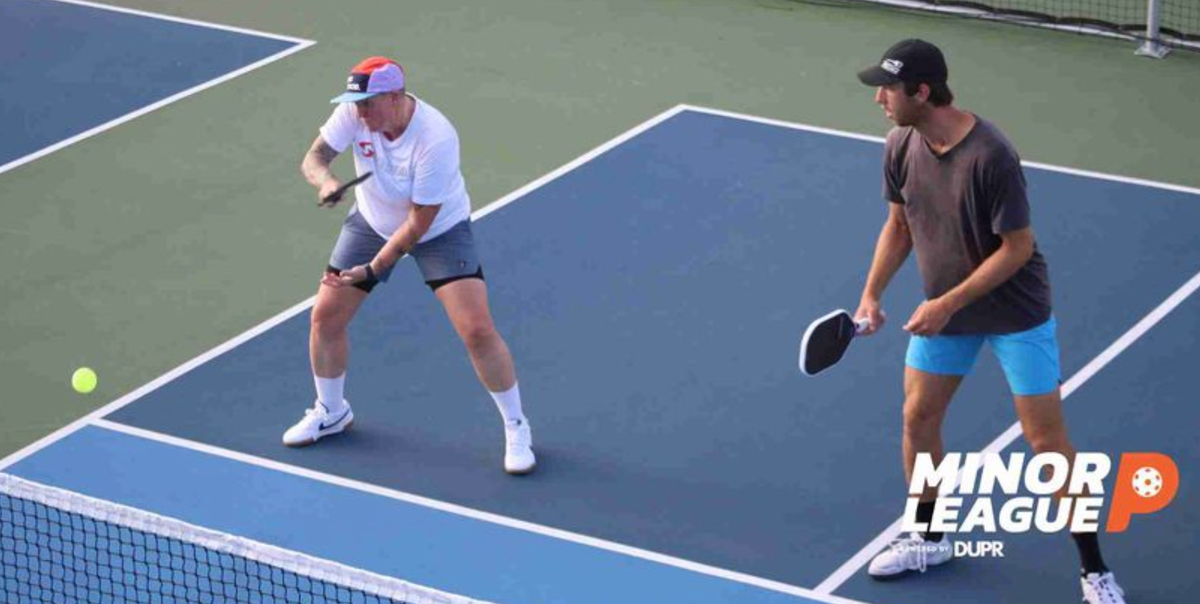
At the kitchen line, the experience advantage for senior pickleball players looks like hands that don't flinch. Veterans reset. Newer players panic-counter.
The tell is the ball at your hip. A younger player sees a chance and swings.
You see a ball below net height and know that attacking it is a low-percentage decision, so you reset it and wait for the next one.
That one habit, built from six kitchen line skills, is most of what separates a 3.5 from a 4.0.Having a clear decision matrix for when to attack or reset turns a guess into a rule, and rules hold up when the score is 9-9.
Bangers hate this, which is the fun part.
A seven-step system for beating bangers is really just a system for being patient on purpose while somebody else loses the plot.Pickleball Tips for Seniors: Turn Experience Into an Edge
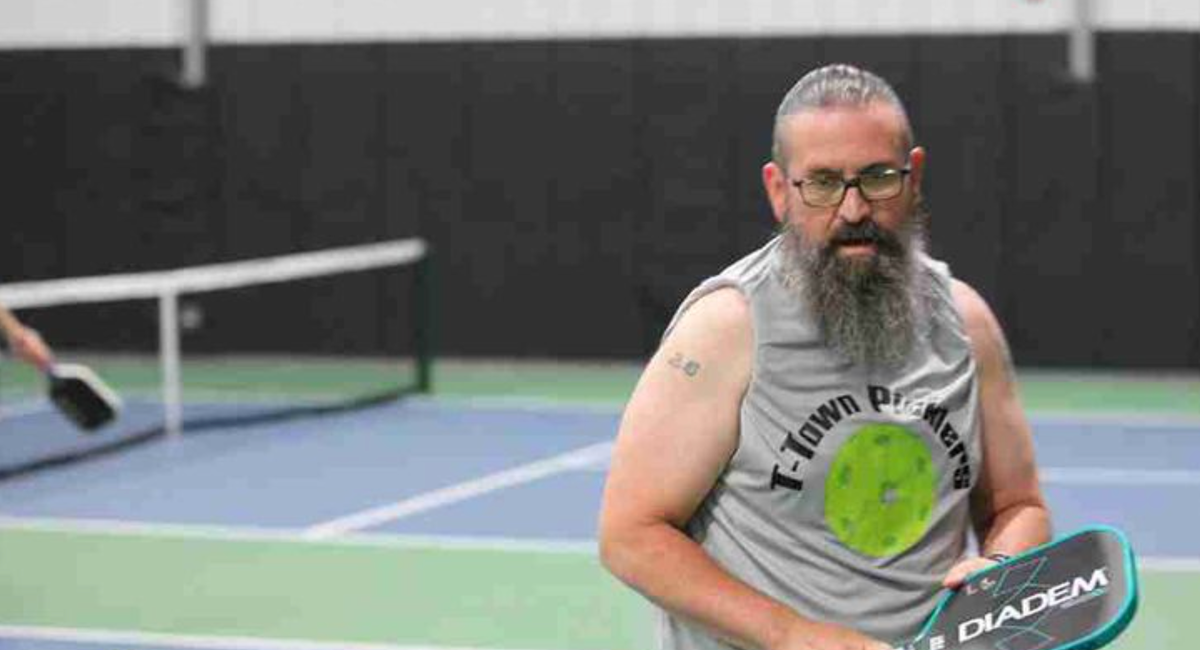
The best pickleball tips for seniors have nothing to do with running faster. Experience, shot selection, and early court position beat raw speed in almost every rec game you’ll play.
 The Dink PickleballThe Dink Media Team
How Do You Build the Experience Advantage for Senior Pickleball Players on Purpose?
You build the experience advantage for senior pickleball players by converting loose playing time into deliberate reps.
Showing up to open play four times a week builds mileage. It doesn't necessarily build skill.
There's a difference, and it's the difference between a player who's been 3.5 for six years and one who got to 4.0 in eighteen months by chasing consistency over highlights.💡
Need some new pickleball gear? Get 20% off select paddles, shoes, and more with code THEDINK at
Midwest Racquet SportsFour habits that actually move it:
- Keep a two-line pattern journal. After each session, write down the shot that lost you the most points and the pattern that won you the most. Six weeks of this and you'll see your own tendencies clearer than any coach could describe them.
- Drill at the edge, not in the comfort zone. The 70% rule says you want to be succeeding roughly seven times out of ten. Easier than that and you're not learning. Harder and you're just missing.
- Use the wall. Wall drills and solo drills build hands and consistency without needing a partner, a court reservation, or a single minute of waiting on the sideline.
- Fix the ratio. One top pro did the math on drilling versus playing, and most rec players are wildly skewed toward playing. Flip even 20% of your court time toward structured reps.
Pair that with a training approach that respects your body.
Training safe to play better is not a soft recommendation; it's what keeps you on the court long enough for the experience advantage to keep accruing.
Pickleball Dink Rallies: When to Change Direction for Tactical Advantage
If you’re stuck in a crosscourt dink exchange and things aren’t going your way, it might be time to redirect that ball to the middle of the court and reset the rally in your favor.
 The Dink PickleballThe Dink Media Team
What Experienced Players Keep Working On
Veteran players don't stop improving, they just improve in quieter places.
A qualitative study of older pickleball players found that the more advanced ones described their ongoing challenges as strategy, partner coordination, and difficult techniques (research), rather than fitness or basic mechanics.
That tracks with what you see at any 4.0 senior court.
The work moves to partner chemistry and teamwork, to who covers the middle, to staying unattackable for one more rally than the other team. It also moves to the ears.A champion mindset is the piece most players skip, and pickleball confidence built on evidence holds up at 10-10 in a way that borrowed swagger never does.
The best pickleball strategy for seniors isn't a secret shot.
It's a safe, simple three-part scoring system executed without drama, backed by ten tips that transform your game and a willingness to be the most boring player on the court.
Pickleball Tips for Seniors: Master Court Positioning
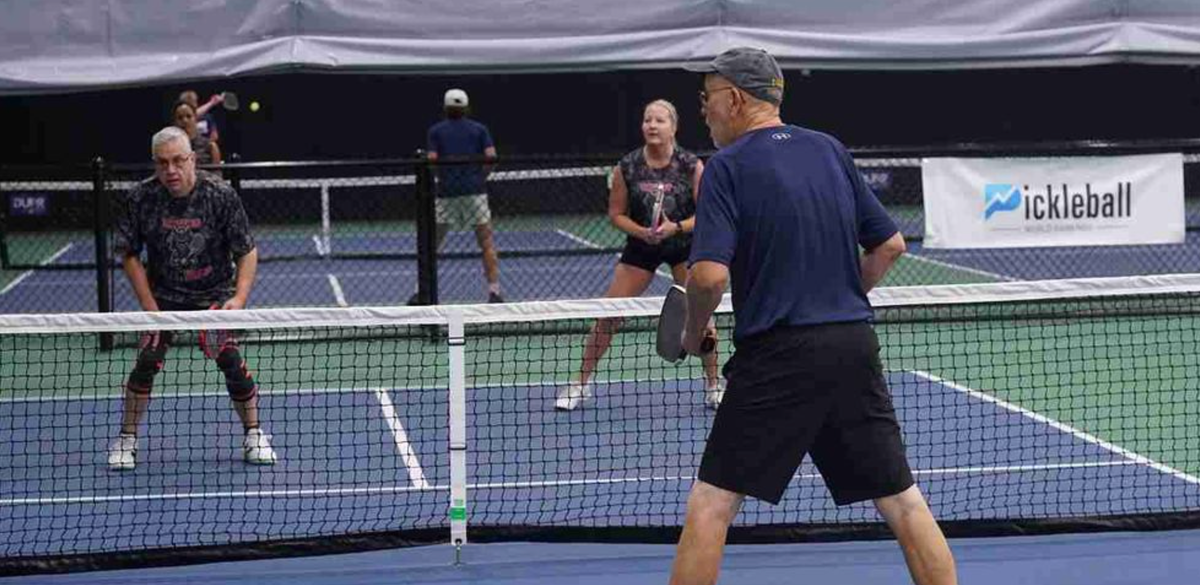
These pickleball tips for seniors focus on one thing: where you stand before the ball arrives. Better court positioning beats faster feet every single time.
 The Dink PickleballThe Dink Media Team
Key Takeaways
- The experience advantage for senior pickleball players is anticipation and shot selection, not raw athleticism.
- Deep returns and patient resets convert experience into points faster than any power shot.
- Structured drilling at roughly 70% success beats unstructured open play for improvement.
- Advanced older players report that strategy and partner coordination, not fitness, are their ongoing challenges.
💡
Heads up: hundreds of thousands of pickleballers read our free newsletter.
Subscribe herefor cutting edge strategy, insider news, pro analysis, the latest product innovations and more.
Frequently Asked Questions
What age counts as a senior pickleball player?
Most tournaments set senior brackets at 50 and up, with age-group divisions climbing in five-year increments from there. Super senior typically starts at 60 or 65 depending on the event. Recreationally, nobody's checking IDs.
Does experience really beat athleticism in pickleball?
It can, especially in doubles on a small court where positioning matters more than foot speed. Experienced players win by taking away options and forcing errors rather than hitting winners. Against a significantly faster opponent, the margin comes from shot selection and patience, not from matching their pace.
What are the best pickleball tips for older players who've plateaued?
Change the ratio of drilling to playing, and pick one specific weakness to work on for a month instead of ten at once. Most plateaus come from repeating the same rec games, not from age, and the transition zone traps are a common hidden leak. Tracking your point-losing patterns usually reveals the fix faster than new gear will.
How do you build confidence on the pickleball court?
Confidence that holds up under pressure usually comes from reps you can point to, not from positive self-talk. Drill a shot until you've hit it successfully hundreds of times, then trust it in a game. Research on older adults has linked regular activity participation with stronger perceived competence, which suggests that staying in the game is part of how that belief gets built.
Is it too late to improve at pickleball after 60?
No. Skill gains in pickleball come largely from decision-making, anticipation, and technique, all of which can improve at any age with deliberate practice. Many players reach their highest ratings well into their 60s and 70s.
💡
Need some new pickleball gear? Get 20% off select paddles, shoes, and more with code THEDINK at
Midwest Racquet SportsAnuncie Aqui / Advertise Here
Sua marca para o mundo Pickleball! / Your brand for the Pickleball world!




 English (US) ·
  Portuguese (BR) ·