
 English
  Spanish
  Portuguese
  German
  Italian
  Japanese
  French
  Polish
  Russian
  Netherlands
  Hungarian
  Turkish
  Videos
  PPA Tour

How CRBN’s California workshop and match-speed testing revolutionized performance paddle design.
In a small machine shop in Southern California, a new pickleball paddle takes shape. An engineer cuts a prototype by hand, and by the same afternoon players in Newport Beach are testing it under match-speed conditions, driving the ball from the baseline and dialing in touch at the kitchen line. Notes are taken. Adjustments are made. By the end of the week, a new version is already in play. That constant loop of build, test, repeat is the heartbeat of CRBN, a paddle company that grew out of competitive play and has become one of the most influential performance brands in the sport.
The story began in 2020 during the pandemic when Garrett Gosselin, a sommelier whose restaurant shut down, found himself suddenly out of work and looking for an outlet. He started playing pickleball daily. Within a year, he was competing at a 5.0+ level, the highest tier of amateur play and a gateway to the professional scene. The more he competed, the more dissatisfied he became with the equipment in his bag.
“He kept saying the same thing to me,” said CRBN co-founder Kyle Goguen. “These paddles are not built for the way the game is being played now.”
Gosselin began sourcing experimental paddles and refining designs for his own use. The version that finally stuck looked nothing like what players were used to seeing on tournament courts. It was matte black, laser engraved and built with a carbon fiber face that created more surface grit and dramatically more spin. At a time when brightly colored paddles dominated the pickleball scene, the understated look drew immediate attention.
“It was a showstopper in its simplicity,” Goguen said. “This paddle matched the aesthetic of where the sport was heading.”
Players at tournaments began stopping Gosselin to ask where they could buy one. He had only ordered forty. The demand surprised him. By late 2021, he called Goguen, his childhood friend and engineer, for advice. Goguen had already built and scaled a successful product-based business and immediately recognized what was unfolding.
“I looked at the growth of pickleball and I looked at the paddle,” Goguen said. “And it was obvious. This was not a hobby anymore.”
The early months were defined by momentum and pressure in equal measure. CRBN sold out repeatedly without any paid advertising, driven largely by what players were telling each other on the courts. The operation itself remained painfully small. Orders were packed in Gosselin’s garage. Gosselin’s mother took over warehouse management. Goguen’s wife handled operations. Inventory shortages became routine. Customer emails were answered by the four at night.
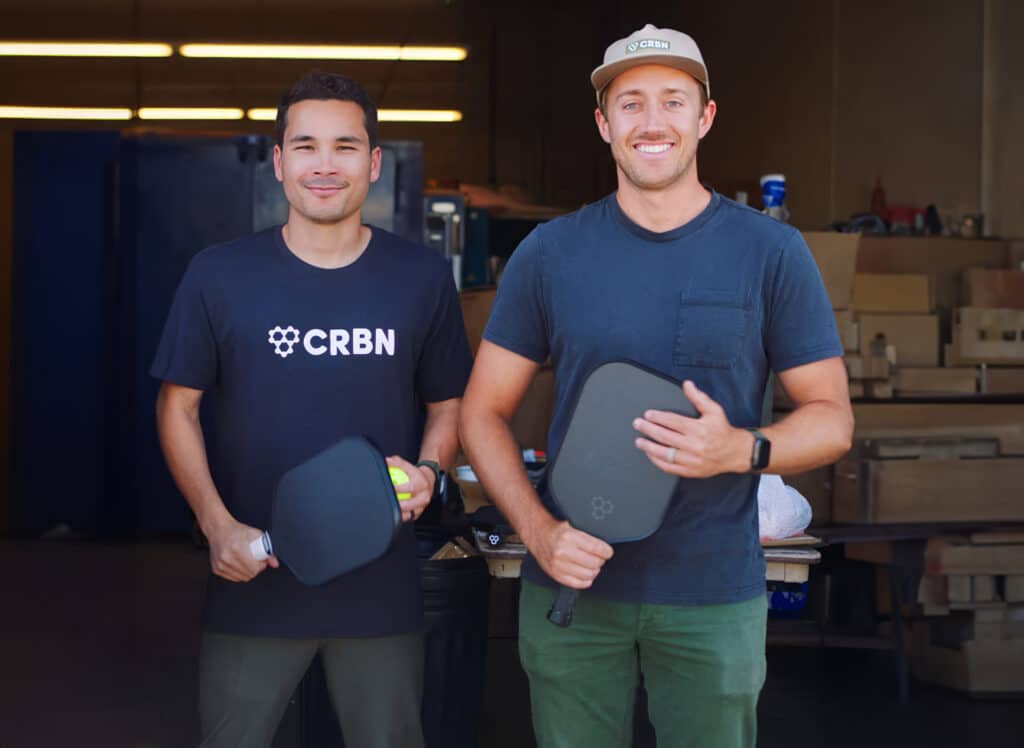
“It was exciting and chaotic at the same time,” Goguen said. “We had demand we could not fully serve yet.”
For months, that tension defined the business. Every new batch sold out almost immediately. Each restock confirmed what the founders were beginning to understand. This was not a short-term surge. The market was choosing them.
“We were learning fast,” Goguen said. “But the way we were building early on made it hard to move as fast as the game itself was moving.”
That realization changed the company’s direction. The garage operation gave way to a formal development roadmap. CRBN hired full-time engineers and moved into a hands-on Southern California workflow where paddles could be built, tested, and refined at match speed. Earlier this year, the company released the first tournament approved paddle with an entirely foam core, a design shift now spreading across the sport.
“Pickleball as a sport is booming,” Goguen said. “Now the technology is finally catching up.”
The next phase of growth arrived when CRBN finally had enough inventory to think bigger. That same year the company scaled well past early eight figures in annual revenue, it launched in the Amazon store.
“For a long time, we simply could not support another major retail channel,” Goguen said. “Once our supply chain caught up, Amazon became a place where we could meet players where they already were shopping.”
Amazon quickly became one of CRBN’s fastest growing retail partners, helping introduce the brand to new customers while supporting national scale through Fulfillment by Amazon (FBA), a service that allows independent sellers to have Amazon take on providing the storage, picking, packing, fulfillment, and customer service for their orders.
“It allowed us to grow without having to build massive new infrastructure,” Goguen said. “We could handle peak demand and stay focused on product innovation.”
Today, CRBN has more than twenty employees across the United States and over one thousand brand ambassadors worldwide, most of which are active tournament players. Growth has also fueled the company’s CRBN Cares program, which donates paddles to programs that bring the sport into schools and underserved communities.
“What I am most proud of at this point isn’t just the paddles,” said Goguen. “It’s the people. It’s the jobs we’ve created, the families those jobs support, and the communities we get to invest back into through our Cares program. The business growing means other people get to grow with us, and that’s the part that really stays with you as a founder.”
For the Professional Pickleball Association and the broader competitive ecosystem, CRBN’s story reflects more than the rise of a performance brand. It traces the full arc of pickleball’s recent evolution, from grassroots pandemic pastime to one of the fastest-growing sports in the country.
It also traces the quiet truth that still underpins the sport.
Sometimes the most elite equipment in the game begins not with a business plan, but with one player standing on a court, simply trying to play better.
Learn more and check out Amazon Seller Partners here.
Anuncie Aqui / Advertise Here
Sua marca para o mundo Pickleball! / Your brand for the Pickleball world!




 English (US) ·
  Portuguese (BR) ·