
 English
  Spanish
  Portuguese
  German
  Italian
  Japanese
  French
  Polish
  Russian
  Netherlands
  Hungarian
  Turkish
  Videos
  Thedink Pickleball

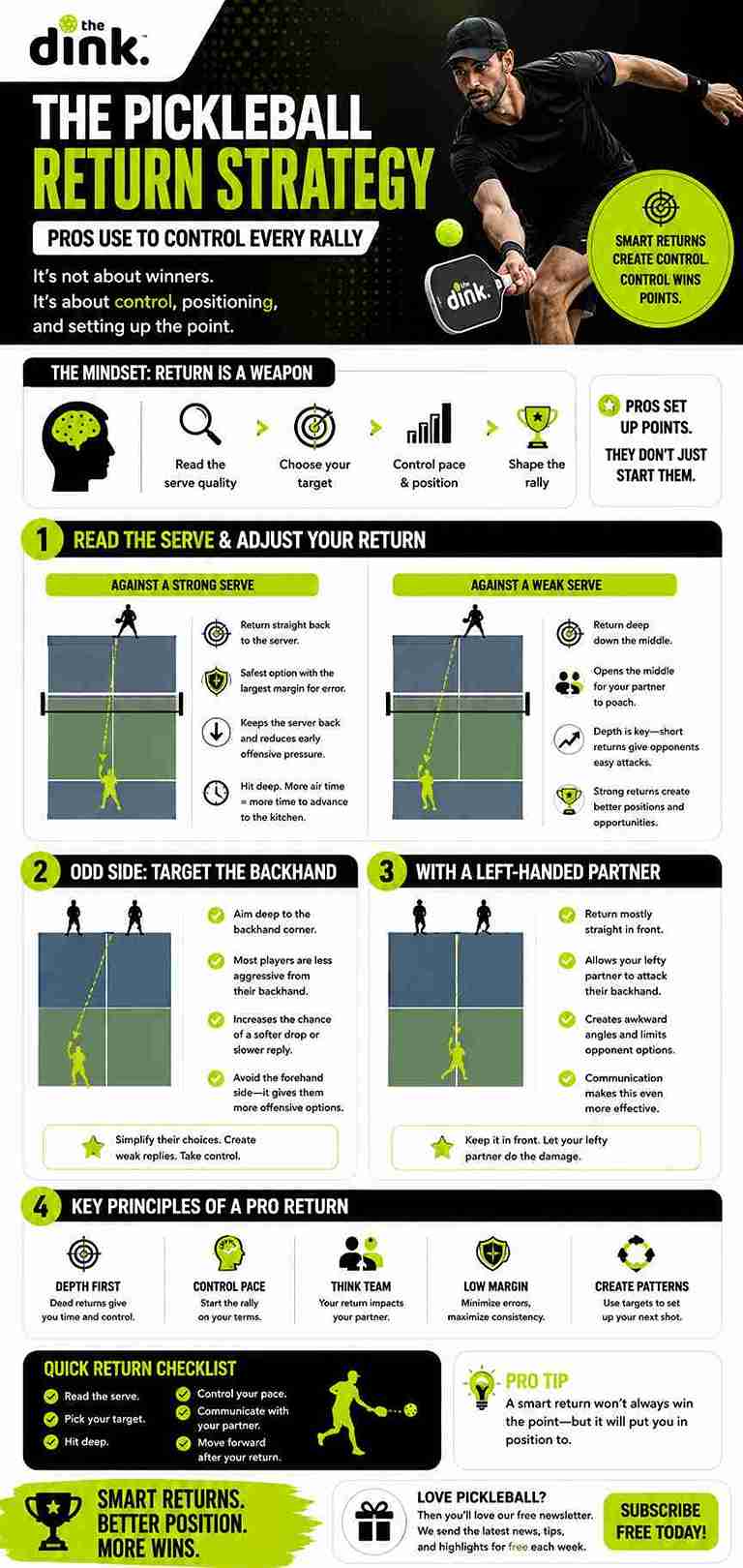
Professional pickleball players treat the return of serve as a strategic weapon, not just a way to get the ball back in play.
Understanding the pickleball return strategy that separates elite players from the rest can transform your game.
Love pickleball? Then you'll love our free newsletter. We send the latest news, tips, and highlights for free each week.
Understanding the Return as a Strategic Weapon
The pickleball return strategy that separates elite players from recreational ones isn't about hitting winners off the serve. It's about control, positioning, and understanding how one shot shapes the entire rally.
According to PADDLIX, a pickleball strategy channel, the return of serve plays a much larger role than simply starting the point. Professional players read the quality of the serve, choose strategic targets, and use placement to dictate pace and structure. This isn't flashy. It's foundational.
Most recreational players treat the return as a defensive shot. Pros treat it as an offensive setup.The difference? Understanding that return placement influences positioning, limits opponent options, and creates opportunities for the next shot.
When you master this mindset, your entire game shifts.
How to Read the Serve and Adjust Your Pickleball Return Strategy
The first decision high-level players make is evaluating the quality of the serve itself.
A heavy, fast, or well-placed serve changes your entire approach to the return.
Against stronger serves, the priority becomes control rather than aggression.
The safest and most effective option is usually returning the ball straight back to the server.This placement creates the largest margin for error because it travels over the lowest part of the net and uses the longest available diagonal on the court.
Here's why this matters: a deep return directly back to the server forces them to remain behind the baseline rather than moving forward aggressively.
By keeping them deep, your team reduces early offensive pressure and slows their ability to take control of the rally.
The return isn't a winner attempt. Its purpose is to establish positioning and create stability at the start of the point.Depth is everything when returning strong serves.
The added air time gives you more time to advance toward the kitchen line, which is where rallies are won in modern pickleball.
Understanding ball height and court positioning before you even swing is what separates reactive players from calculated ones.
💡
Need some new pickleball gear? Get 20% off select paddles, shoes, and more with code THEDINK at
Midwest Racquet SportsWhen the Serve Is Weak: Your Chance to Attack
When the serve is weaker or easier to handle, players gain more freedom in return placement.
At this point, the return of serve becomes a strategic tool rather than simply a neutralizing shot.
From the even side of the court, one of the strongest options is a deep return placed directly in front.
This positioning allows your partner to shift toward the middle and look for poaching opportunities with the forehand.
The effectiveness of this strategy depends heavily on depth.
If the return lands short or floats too high, the opponent can attack aggressively while your team is still moving forward.
A strong return not only improves your position but also gives your partner more freedom to become active in the middle of the court.
This highlights an important aspect of doubles strategy: return placement isn't only about the player hitting the shot.
It also shapes the opportunities available to your partner on the next ball.
For a complete breakdown of how all four opening shots connect, study the shot trifecta of return, drop, and 4th shot volley.
Making smart shot decisions on weaker serves is where rec-level players leave the most points on the table.
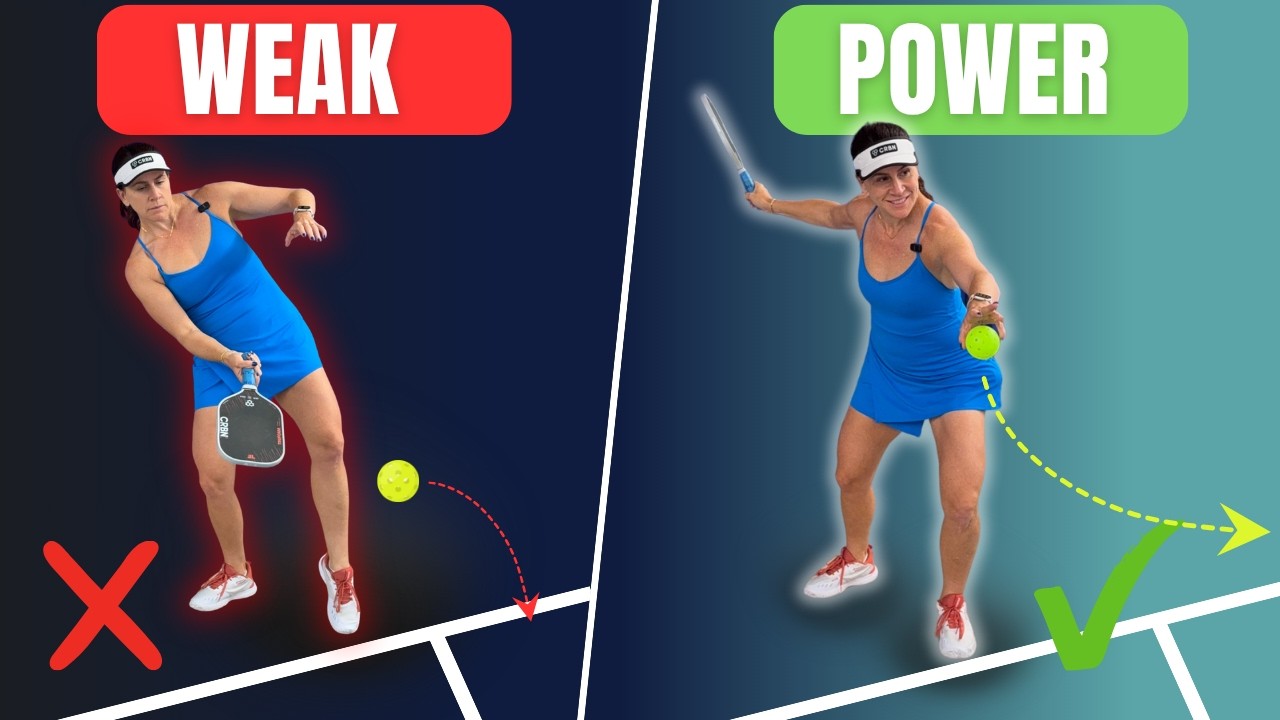
3 Fixes for a Weak Pickleball Serve
Your pickleball serve doesn’t have to feel weak and unreliable. Coach Jess breaks down three simple fixes that transform your pickleball serve in minutes, from toss consistency to proper weight transfer.
 The Dink PickleballThe Dink Media Team
Why Does Targeting the Backhand Matter So Much?
When returning from the odd side, the strategy shifts slightly.
A highly effective option is aiming toward the left-side opponent, particularly toward the backhand corner.
Most players produce a less aggressive response from the backhand side compared to the forehand.
By directing the return into that corner, the likelihood of receiving a softer drop or slower reply increases.
This creates a more favorable opportunity for your team, especially for the left-side player who may now have a chance to attack more aggressively on the next ball.
Returning toward the forehand side carries greater risk because it gives the opponent more offensive options.
From that position, they can drive, flick, or roll the ball with more pace and variation.
Targeting the backhand simplifies the opponent's choices and increases the chance of a weaker response.
This shifts the rally from reactive play into proactive control.
The same concept applies differently when playing with a left-handed partner.
In that situation, keeping the return more directly in front allows the left-handed player to control the middle with the forehand.
These small positioning adjustments have a major impact because they determine who is most likely to receive the next attacking opportunity.
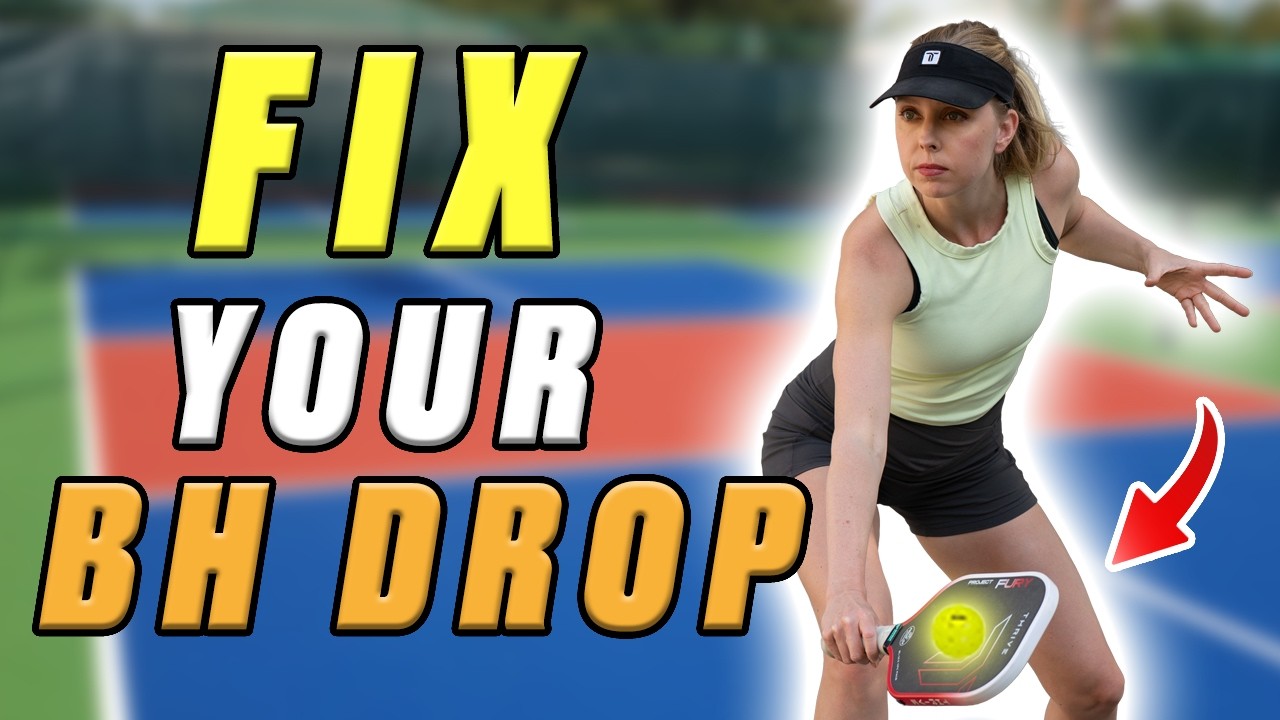
Master the Backhand Drop: A Step-by-Step Guide
The backhand drop is one of the most avoided shots in pickleball, but it doesn’t have to be. With the right progression and focus on fundamentals, you can build a reliable backhand drop that becomes a weapon instead of a weakness.the
The Dink PickleballThe Dink Media Team
The Modern Evolution of Return Technique
Traditionally, players were taught to treat the return as an approach shot.
The focus was on moving through the return smoothly while transitioning toward the kitchen line.
While this approach is still effective, many high-level players are now mixing in a more controlled groundstroke-style return.
Instead of prioritizing immediate forward movement, they focus more on shot quality.
This style allows players to generate more topspin, more depth, and greater placement precision.
The trade-off is slightly reduced forward momentum toward the kitchen. However, the improved quality of contact often creates a less attackable return.
The added spin and depth make it more difficult for opponents to apply immediate pressure.
This reflects a broader evolution in high-level pickleball: shot quality is becoming just as important as speed of transition.
The fact that professional pickleball players abandoned the slice shot in 2025 is a perfect window into how dramatically return technique has shifted at the elite level.
Topspin and precision are no longer optional at 4.5 and above.
The groundstroke return isn't intended to replace the traditional approach-style return completely.
It's an adjustment that can be mixed in selectively depending on the situation and confidence level.
Players still need to move efficiently toward the kitchen whenever possible, but modern returns increasingly prioritize clean, controlled contact.
Pickleball Return of Serve: Why It Matters More
Most pickleball players obsess over their serve, but the truth is your pickleball return of serve might be even more important. Here’s why depth, placement, and consistency matter more than power.
The Dink PickleballThe Dink Media Team
Putting It All Together: The Complete Pickleball Return Strategy
The pickleball return strategy that works at the highest levels combines several elements.
Reading the quality of the serve determines whether control or aggression should guide your return.Smart placement can support your partner, limit offensive responses, and create stronger attacking opportunities.
Targeting weaker backhand positions increases predictability and control.
Modern groundstroke-style returns emphasize spin, depth, and precision.
Together, these adjustments transform the return of serve into a strategic weapon that shapes the entire structure of the rally from the very first shot.
The key is balance.- You're not trying to hit a winner.
- You're trying to set up the next shot, control the court, and put your team in a position to attack.
When you master this mindset, you'll notice your opponents struggling to find rhythm. That's the power of a truly strategic return.
To see how this fits into the bigger picture of your game this season, a simple 4-step system to win more pickleball games in 2026 is worth the read.
💡
Heads up: hundreds of thousands of pickleballers read our free newsletter.
Subscribe herefor cutting edge strategy, insider news, pro analysis, the latest product innovations and more.
Frequently Asked Questions
What's the most important aspect of a pickleball return strategy?
Depth is the most critical element. A deep return gives you time to advance toward the kitchen and forces your opponent to stay back. Without depth, even a well-placed return can be attacked aggressively.
Should I always return straight back to the server?
Not always. Against strong serves, yes. But when the serve is weaker, you have more freedom to target the backhand or place the return strategically. Read the serve quality first, then adjust your placement.
How does the pickleball return strategy change in doubles?
In doubles, your return placement affects your partner's opportunities on the next shot. A return placed directly in front allows your partner to poach in the middle. This coordination is what separates good doubles teams from great ones. For more on doubles strategies nobody talks about, that breakdown goes deep on exactly how positioning shapes every rally.
Can I use a groundstroke-style return every time?
You can mix it in, but it's not a replacement for the traditional approach-style return. Use it selectively when you have confidence and the situation calls for it. The goal is balance and adaptability.
Why is targeting the backhand more effective?
Most players have a weaker backhand than forehand. By targeting that side, you simplify their options and increase the likelihood of a softer response, which gives your team a better chance to attack on the next ball. Pairing this with the 6 essential pickleball shots to master for 2026 gives your full offensive arsenal a serious upgrade.
For everything else we do, visit linktr.ee/dinkfam
Anuncie Aqui / Advertise Here
Sua marca para o mundo Pickleball! / Your brand for the Pickleball world!




 English (US) ·
  Portuguese (BR) ·