
 English
  Spanish
  Portuguese
  German
  Italian
  Japanese
  French
  Polish
  Russian
  Netherlands
  Hungarian
  Turkish
  Videos
  Thedink Pickleball

The pickleball return is the one shot where you start the point on offense, yet most players hand that edge right back. Here is the technique, strategy, and drills to keep it.
The pickleball return is the only shot in the game where you begin the point already on offense, and most players give that advantage away before the ball even crosses the net.
Here is the truth coaches rarely say out loud: the serve is a defensive shot and the return is an offensive one.When you return well, you push your opponent back, buy yourself time to reach the kitchen, and make their third shot miserable.
When you return lazily, you invite them straight into the point.
This breakdown comes from Coach Austin Hardy of Pickleball Playbook, who covered the return top to bottom with his hitting partner Caleb.
Below you get the technique, the strategy, and the three drills that turn your pickleball return into a weapon.
Love pickleball? Then you'll love our free newsletter. We send the latest news, tips, and highlights for free each week.
Why the Pickleball Return Decides the Point Before it Starts
The return is your most important shot because it sets the entire rhythm of the rally.
Get deep and get forward, and your opponent is stuck hitting a third shot from behind their own baseline.
The single biggest mental shift is this: stop treating the return like a rally ball and start treating it like a chance to take control.
You are taking your opponent's pace off their serve and pushing it right back at them.
Everything that follows serves one goal, which is getting you moving forward through contact so you arrive at the net in charge.
What Makes the Pickleball Return Technique Different from a Drive?
A return is a condensed drive where you actually run forward through the ball instead of just leaning into it.
That is the difference that separates the return from every other groundstroke you hit, and it's why the return technique deserves its own practice block.
On a normal drive you load and lean. On a return you load and go.
Anna Leigh Waters, the Soccer Prodigy Who Pickleball Stole
The greatest pickleball player in the world was a soccer prodigy with pro potential. Then another sport came calling, and it was too loud to ignore.
 The Dink PickleballThomas Shields
Your body keeps traveling toward the net after contact, which is why depth and momentum come almost for free.
Here are the five keys to a pickleball return that keeps you on offense:
- Run forward through contact. Do not plant and admire it. Move through the ball toward the net so you cover ground while the ball is traveling.
- Keep the motion out in front and concise. Never reach behind yourself. All the work happens inside your shoulders.
- Draw the "Nike swish." On topspin, go down, out, and up, brushing over the ball and extending toward your target. It is the same shape as the logo.
- Get sideways on the backhand. Turn your shoulders, step out with your dominant leg, and finish before the paddle passes your shoulder.
- Aim for depth, not power. A deep return buys time. A flat, hard return that lands short does not.
💡
Need some new pickleball gear? Get 20% off select paddles, shoes, and more with code THEDINK at
Midwest Racquet SportsTopspin Pickleball Return, One Hand or Two?
The topspin return uses that down, out, and up path whether you hit it with one hand or two.
On a two-handed backhand you can add a trigger finger up the paddle face, which helps you feel where the paddle is in space and make cleaner contact.
Prefer a one-hander? Hold the throat of the paddle with your off hand during the unit turn so you still get a full shoulder and hip rotation, then let both arms spread apart through contact.
If you have wondered whether to commit to a two-handed backhand, the return is a great place to test the extra stability.
Think of it as the same topspin you build on your drives, just shortened and aimed deep.
Topspin Pickleball Technique: Brush Angle & Paddle Path
Topspin pickleball technique is built on two fundamentals: a steep brush angle and a low-to-high paddle path. Nail both, and you’ll hit shots that land deep, kick high, and force your opponents into uncomfortable defensive positions.
 The Dink PickleballThe Dink Media Team
The Slice Return: Still One of the Best Shots in Pickleball
The slice return remains one of the most effective returns in all of pickleball, especially against anyone below the 4.5 level, because it forces your opponent to lift a low ball and most of them dump it into the net.
Caleb, who loves this shot, keeps his shoulders pointed at the fence he is hitting toward, spreads both arms, and cuts underneath the ball.
His feet do a small karaoke step as he approaches the net so his shoulders never pull open too early.
The moment that lead shoulder flies open, the ball sprays.Good footwork is what holds the slice together, which is exactly the point Coach Mary makes in her footwork tip of the week: use a short pivot, push away from the ball, and create space instead of opening up to the net on your return of serve.
Reserve the slice for low balls. On the forehand especially, you mostly want topspin for depth, but keep the slice in your toolbox for those low, awkward serves.
Perfect the Backhand Slice Dink with These 3 Essential Tips
When you’re locked in a tight dinking battle, this shot is your insurance policy
 The Dink PickleballThe Dink Media Team
Topspin or Slice? Read Your Opponent and Do the Opposite
Choose topspin when you want to apply pressure, and choose slice when you want to jam a lower-level opponent, but the real rule is simpler: play the spin your opponent least wants to see.
This is all about spin continuation.
- If you hit topspin, your opponent has to reverse that spin to hit their own topspin third, so their shot loses venom.
- If you slice, you hand them even more of the same underspin they served with, which makes their third harder to lift over the net.
The catch is the 4.5 threshold. Below the 4.5 level, most points are lost by players sailing the third shot drop into the net off your slice.
Above it, players recognize spin continuation and simply aim higher, so a smart serve and a topspin return become the better play.
Not sure where you land? Check your skill level honestly, then pick your spin.Mastering Pickleball Topspin: 5 Common Mistakes and How to Fix Them
By maintaining a stable face and letting the path of the paddle create the spin, you widen your margin for error and maximize consistency
 The Dink PickleballThe Dink Media Team
Three drills that build a pickleball return under pressure
The fastest way to fix your pickleball return is to drill it both cooperatively and competitively, so you groove the reps and then test them under game-like stress.
Here are the three from the video, in order.
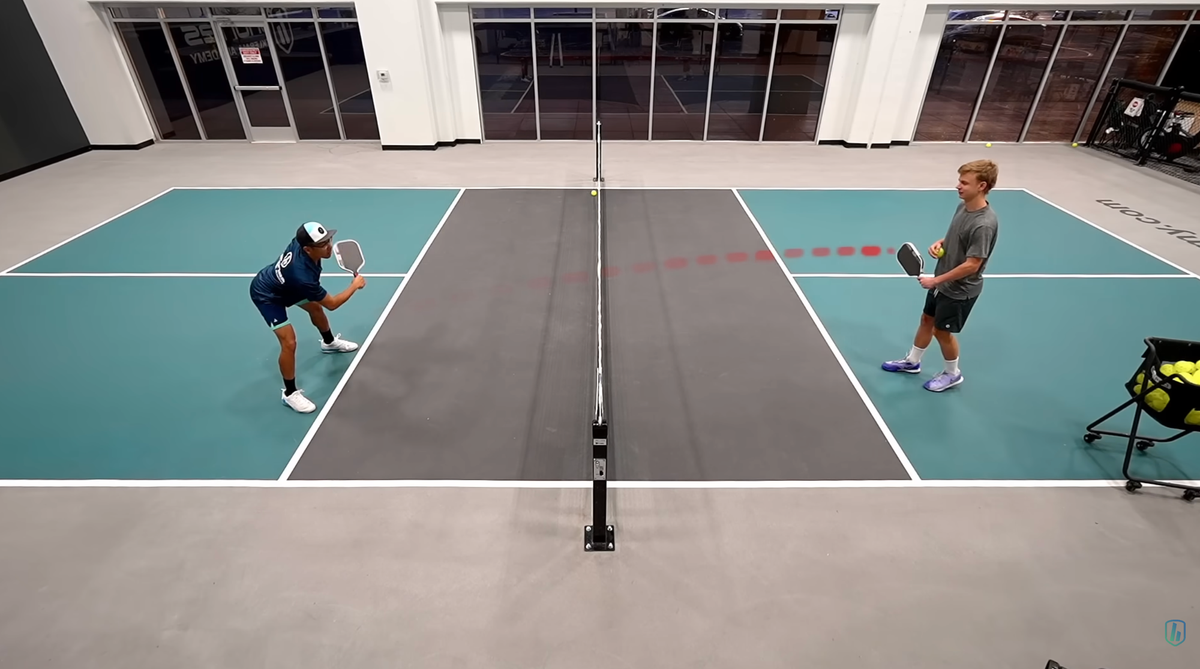
Drill 1, the condensed motion drill (cooperative).
Stand right up on the baseline and have a partner serve to you. Being that close forces a small, concise motion.
If your returns fly long and sporadic, your swing is too big. This is the same close-to-the-line drill Andre Agassi used in tennis, and Agassi, who recently called pickleball a game of patterns, kept his own motion famously compact.
Move forward through every ball, then back up to midcourt and repeat. Go 15 minutes on each side, then switch with your partner.
Drill 2, the return challenge (cooperative-competitive).
The server hits their best serve. If you make the return into the box, you earn 1 point.
If they force a miss, they earn 3. It rewards a big, accurate serve and a pickleball return that holds up against it.
Play both the even and odd sides, and swap roles.
Drill 3, "Call It" (competitive).
As the ball crosses the net, your partner calls "line," "middle," or "wide," and you must hit that target. Miss the call and it is their point.
Make advanced players declare the target by the time the ball bounces, and give newer players the call as the serve leaves the paddle.
Layering these from cooperative into competitive reps is what makes the return hold up when the pressure is real. Reaction speed is trainable, and the faster you react in "Call It," the easier the actual match return feels.
If your pickleball returns keep dying short, it almost always traces back to too much motion or an early shoulder, not a lack of strength. Fix the shape first and you will stop hitting the ball into the net.
💡
Heads up: hundreds of thousands of pickleballers read our free newsletter.
Subscribe herefor cutting edge strategy, insider news, pro analysis, the latest product innovations and more.
Frequently Asked Questions
Is the pickleball return an offensive or defensive shot?
The return is an offensive shot. The server is stuck behind the baseline, so a deep return keeps them pinned back and lets you move forward to the kitchen with the advantage.
Should I hit a topspin or slice return in pickleball?
Use topspin to apply pressure and force your opponent to reverse the spin on their third shot. Use slice against players below 4.5, since the underspin makes it hard for them to lift the ball over the net.
Why do my pickleball returns keep going long?
Your swing is probably too big. Drill standing close to the baseline to shrink the motion, keep everything inside your shoulders, and move forward through contact instead of reaching behind yourself.
Is the slice return dead in pickleball?
Only at the pro level, where players expect spin continuation and simply aim higher. Below 4.5 the slice return is one of the most effective shots you can hit, because most opponents drop the third into the net.
How far forward should I move after my pickleball return?
As far as you can. The return is your chance to take the net, so run through contact and keep advancing until you reach the kitchen line, then set your feet before the next ball.
Anuncie Aqui / Advertise Here
Sua marca para o mundo Pickleball! / Your brand for the Pickleball world!





 English (US) ·
  Portuguese (BR) ·