
 English
  Spanish
  Portuguese
  German
  Italian
  Japanese
  French
  Polish
  Russian
  Netherlands
  Hungarian
  Turkish
  Videos
  Thedink Pickleball

Coach Jess breaks down five pickleball IQ moves designed to give you a strategic edge over your opponents. These aren't just technical skills—they're the mental shifts that separate winning players from the rest.
If you're tired of losing to players who aren't necessarily more talented than you but seem to always know the right shot at the right time, it's time to work on your pickleball IQ.
The difference between intermediate and advanced players often comes down to strategy, court awareness, and pickleball decision-making rather than raw skill alone.
Coach Jess from Athena Pickleball recently broke down five pickleball IQ moves that can immediately elevate your game in tournaments and league matches.
These aren't flashy techniques or power shots.
Instead, they're the kind of strategic shifts that most opponents won't see coming, and they're designed to give you and your partner a competitive advantage.
Love pickleball? Then you'll love our free newsletter. We send the latest news, tips, and highlights for free each week.
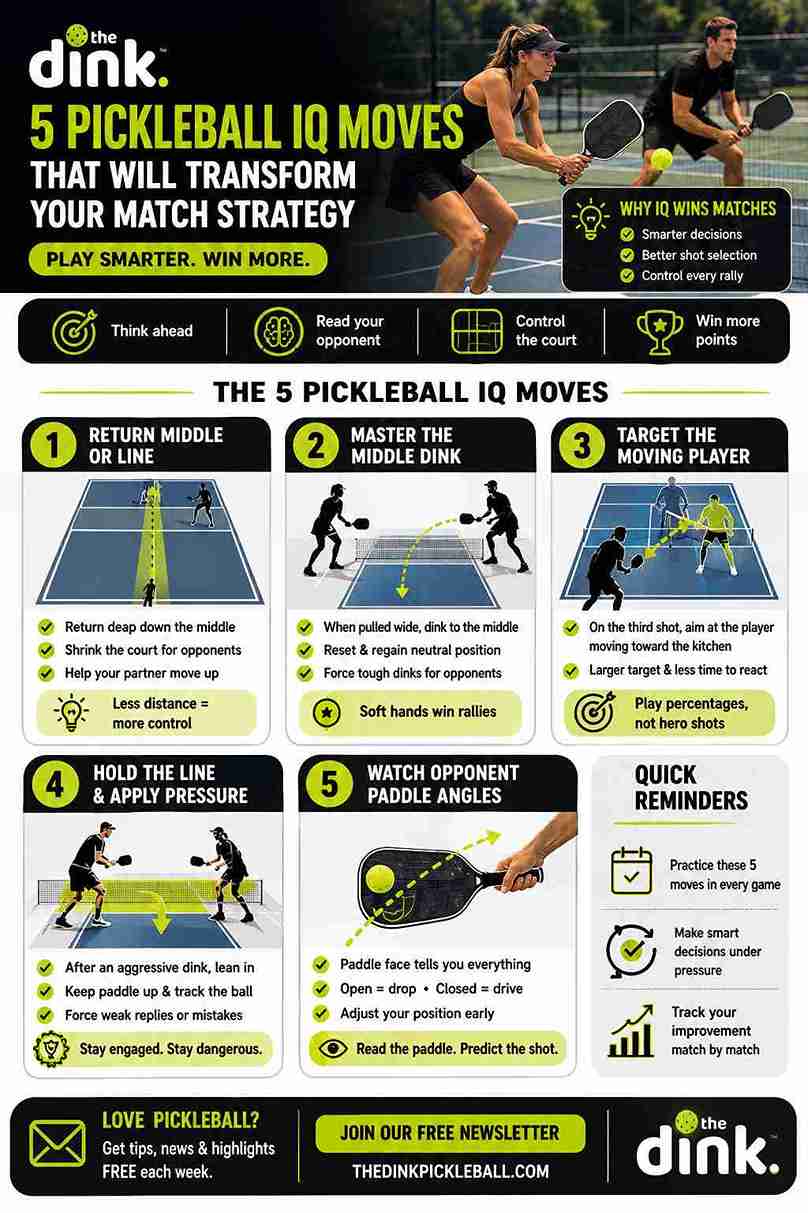
1. The Pickleball IQ Move That Starts Before the Rally
The first pickleball IQ move starts before the rally even begins. Most players return serve without really thinking about where they're hitting it or why.
Coach Jess emphasizes that your return placement should follow a simple rule: middle or line.
Here's why this matters. When you return down the middle or straight ahead, you're doing two things at once.
- First, the court geometry works in your favor, you have less distance to cover, so you don't need to hit as hard.
- Second, and more importantly, you're protecting your partner as they move forward from the baseline to the kitchen line.
How This Pickleball IQ Move Shrinks the Court and Limits Their Options
Think about it this way: if you return crosscourt, your partner has to protect the sideline while also worrying about the middle. That's a lot of court to cover.
But when you return middle or line, your partner can take a big step toward the center and essentially shrink the court for your opponents.
They'll feel the pressure immediately because their options become limited.
The Psychological Edge of a Smart Return
There's also a psychological element here.
A smart return down the middle can create confusion with the serving team.They're expecting angles and aggression, not a controlled, strategic shot that puts them on their heels.
💡
Need some new pickleball gear? Get 20% off select paddles, shoes, and more with code THEDINK at
Midwest Racquet Sports2. The Middle Dink: A Pickleball IQ Move for Defense
When you're getting pushed off the line and your opponent has you on the ropes, the instinct is often to hit harder or try something flashy.
That's exactly when you should do the opposite.
The second pickleball IQ move is mastering the middle dink.
When you're in a defensive position, softening your hand and pushing the ball gently to the middle of the court is your best way back into the point.
This isn't about winning the rally immediately, it's about neutralizing the situation and regaining control.
Coach Jess explains that when you're pulled out wide, a shallow dink to the middle accomplishes two things.
It gets you back to a neutral position so you can transition to offense, and it creates a tougher dink for your opponent because they have to deal with your partner's presence in the middle.
The key is understanding the difference between an offensive dink and a defensive one.
If you're on balance with your weight moving forward, you can be aggressive.
If you're on your heels, focus on getting something soft and shallow back to the middle.
This simple adjustment prevents you from giving your opponent an easy attack ball.
3. Where Should You Actually Hit Your Third Shot?
Here's a question that separates thinking players from everyone else: where are you hitting your third shot?
Most intermediate players don't have a clear answer. They just hit it somewhere.
But the third pickleball IQ move is being intentional about targeting the person who's moving forward.
When your opponent returns serve, they're moving in toward the kitchen line. That's your target. Why? Two reasons.
- First, the space you have to aim for is actually larger because they're on the move. You have more margin for error, especially on a drop shot.
- Second, and this is crucial, a player who's moving forward hasn't had time to split step and stabilize themselves. They're still in motion, which makes it harder for them to handle a good third shot.
Target the Moving Player: The Pickleball IQ Move That Improves Your Percentages
Coach Jess notes that if you're hitting a drive to the person moving in, aim toward the middle of their body rather than trying to pull a fast one by them.
With a drop, you can get a bit more angle, but the principle remains the same: target the moving player with precise shot placement.
This single adjustment can dramatically improve your third shot success rate because you're playing percentages, not hoping for miracles.
4. Holding the Line: The Pressure Play
Once you've hit a solid dink to your opponent's outside foot, what happens next separates good players from great ones.
The fourth pickleball IQ move is about holding the line and applying pressure.
After you hit an aggressive dink, lean forward. Imagine there's a magnet attached to the ball pulling you toward it.
Your paddle should be tracking the ball, ready to attack any ball that comes through the middle.
This is where many players make a critical mistake: they hit a great dink and then step back, essentially telling their opponents, "No pressure, do whatever you want."
The Pickleball IQ Move That Turns Offense Into Sustained Control
When you stay engaged and lean in, something psychological happens. Your opponents feel the pressure of your presence at the net.
They know that if they don't hit a perfect dink back, you're going to attack. This often forces mistakes or weak returns that you can put away.
Coach Jess emphasizes that this isn't about being aggressive for aggression's sake. It's about understanding when you've hit an offensive dink versus a neutral one.
If you're on balance and your weight is moving forward, that's an offensive dink worth attacking. If you're on your heels, neutralize and look for the next opportunity.
5. Stop Speeding Up Crosscourt (And Do This Instead)
The final pickleball IQ move might be the most impactful for intermediate players.
When you're in a dinking rally and you see an opportunity to attack, where do you speed up?
If you said crosscourt, you're like most players. And that's exactly the problem.
Crosscourt speed-ups are longer distance shots, which means your opponent has more time to react.
Meanwhile, your partner has less time to prepare for a counter-attack.
This is why so many speed-ups result in your partner getting crushed.
Instead, think about going straight ahead. When you reach in for an attackable ball, aim for the right hip or right armpit of your opponent.
This gives them less time to react, and it keeps your partner out of harm's way.
You're controlling the aggression through smart shot selection rather than hoping for a winner.
Coach Jess is clear about one thing: that first attack isn't meant to be a putaway.
It's the initiation of the attack.You're looking for the next ball to finish the point, either for yourself or your partner.
By going straight ahead, you're dictating the pace and direction of the rally.
This single shift in thinking can transform how you approach attacking opportunities in doubles matches.
💡
Heads up: hundreds of thousands of pickleballers read our free newsletter.
Subscribe herefor cutting edge strategy, insider news, pro analysis, the latest product innovations and more.
Frequently Asked Questions
What Is a Pickleball IQ Move?
A pickleball IQ move is a strategic decision or shot placement that demonstrates court awareness and smart decision-making rather than raw power or athleticism. These moves are designed to pressure opponents, create confusion, and set up winning opportunities by thinking two or three shots ahead instead of reacting in the moment.
Why Is the Middle Return So Important in Pickleball?
The middle return is critical because it protects your partner as they advance to the kitchen line and immediately limits your opponents' angle options. It also creates confusion with the serving team by leveraging favorable court geometry, giving your side a structural advantage before the dinking rally even begins.
How Do I Know When to Hit an Aggressive Dink Versus a Defensive One?
If your weight is moving forward and you feel balanced, that's your green light to hit offensively and attack the next ball. If you're on your heels or pulled wide, shift into defensive mode with a soft, shallow dink to the middle to reset the point and restore your court position.
Should I Always Speed Up Straight Ahead Instead of Crosscourt?
Straight-ahead speed-ups are generally more effective because they reduce your opponent's reaction time and keep your partner out of harm's way. The key to smart shot selection is reading the court geometry and your partner's position before committing to a direction. Intentional always beats instinct-based.
How Can I Practice These Pickleball IQ Moves in Real Matches?
Start with one pickleball IQ move at a time and track how your opponents respond before adding another. Focus on building a repeatable pattern of court awareness and pickleball decision-making in recreational play, not just drilling in isolation. The goal is for these reads and adjustments to become second nature under real match pressure.
The Bottom Line
Winning more pickleball matches doesn't always require hitting harder or moving faster. Sometimes it's about being smarter. The five pickleball IQ moves Coach Jess outlines are proof that smart shot decisions, court awareness, and intentional shot placement can give you a massive advantage over opponents who rely purely on athleticism.
Start with one or two of these pickleball IQ moves in your next recreational match. Get comfortable with them before adding more to your game. The players who win consistently aren't always the most talented, they're the ones thinking two or three shots ahead.
Anuncie Aqui / Advertise Here
Sua marca para o mundo Pickleball! / Your brand for the Pickleball world!





 English (US) ·
  Portuguese (BR) ·