
 English
  Spanish
  Portuguese
  German
  Italian
  Japanese
  French
  Polish
  Russian
  Netherlands
  Hungarian
  Turkish
  Videos
  Thedink Pickleball

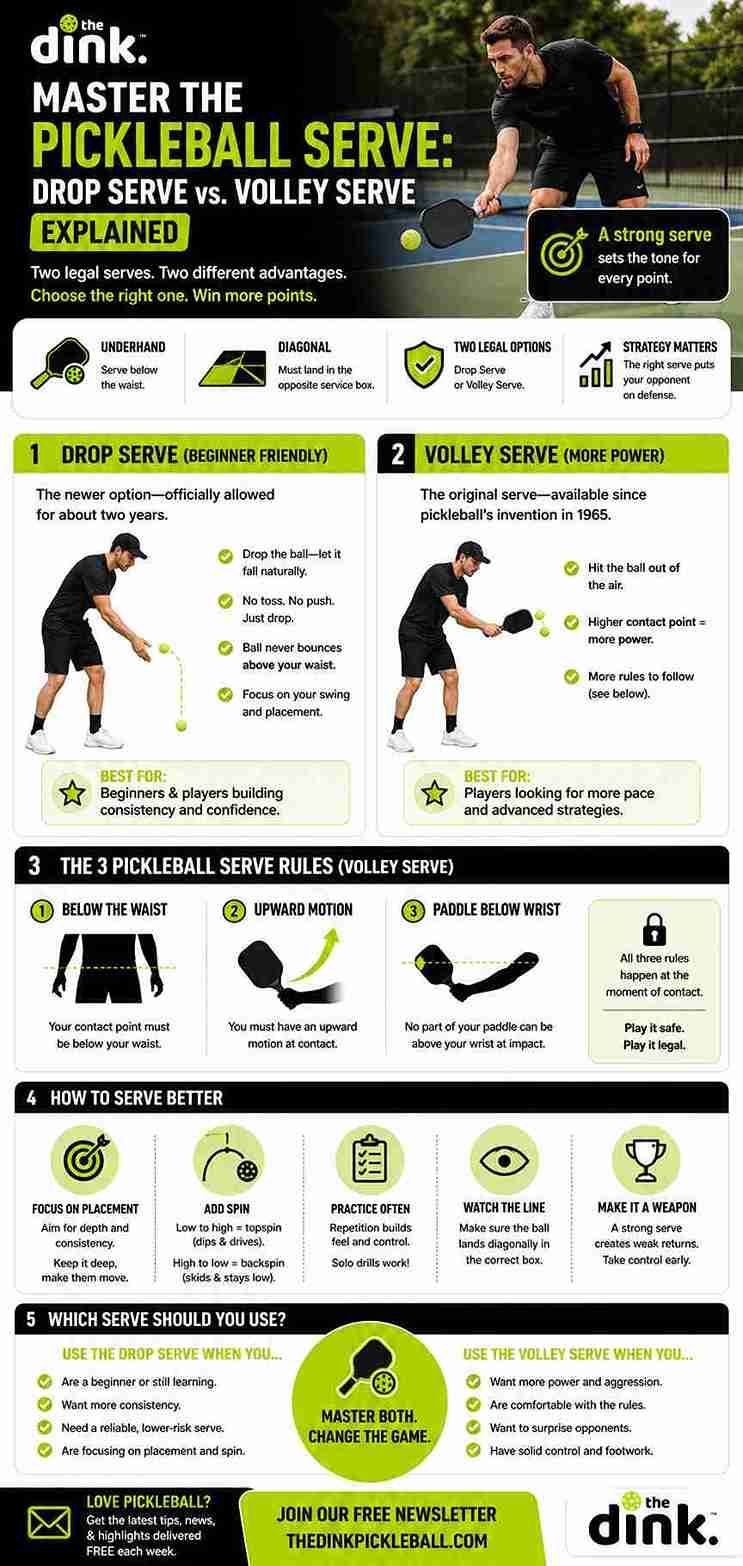
The pickleball serve is the foundation of every point, and mastering it separates beginners from competitive players. Whether you're learning the beginner-friendly drop serve or advancing to the more aggressive volley serve, understanding the rules and mechanics will transform your game.
The pickleball serve is the foundation of every point, and mastering it separates beginners from competitive players.
Whether you're learning the beginner-friendly drop serve or advancing to the more aggressive volley serve, understanding the rules and mechanics will transform your game.
Unlike tennis, where serving requires perfect timing and an overhead motion, pickleball keeps things simple:
You serve underhand, below the waist, and the ball must land in the diagonal service box.But simplicity doesn't mean there's no strategy involved.
Love pickleball? Then you'll love our free newsletter. We send the latest news, tips, and highlights for free each week.
According to Selkirk TV, one of the sport's leading instructional channels, the beauty of pickleball is that you can start playing immediately. The serve contributes directly to that accessibility.
Each pickleball serve comes in two legal forms: the drop serve and the volley serve. Each has its own rules, advantages, and learning curve.
Why the Pickleball Serve Matters More Than You Think
The pickleball serve sets the tone for the entire point.
A weak serve puts you on your heels immediately. A strong serve forces your opponent into a defensive position right from the start.That's why top players spend time perfecting their technique, even though the rules make it easier than other racquet sports.
Here's what makes pickleball serving unique:
There's no toss to time, no overhead motion to master, and no complex footwork required.You simply drop the ball or hit it out of the air, and it has to land in the service box diagonally across the net.
The kitchen line (the no-volley zone) doesn't apply to serves, but the ball must clear it and land beyond it.
💡
Need some new pickleball gear? Get 20% off select paddles, shoes, and more with code THEDINK at
Midwest Racquet SportsThe Drop Serve: The Beginner's Best Friend
The drop serve is the newer of the two legal options, having been officially allowed for only about two years. Before that, all serves had to be hit out of the air.
The drop serve changed the game for beginners because it removes one major variable: the toss.
You cannot create force by pushing it down or tossing it upward.
The beauty here is that no matter how tall you are, the ball will never bounce higher than your waist because of the natural physics of a dropped ball.
This means you're already compliant with the waist-height rule before you even swing.
Selkirk TV's instructors recommend the drop serve for beginners because it's easier to learn and allows you to focus on your swing mechanics rather than ball placement.
Once you've mastered the drop serve, you can layer in spin and power without worrying about breaking the rules.
Drop Serve Placement: Where to Let the Ball Fall
When dropping the ball, placement matters. Drop it in the same location where you'd naturally make contact if you were hitting a forehand.
If you drop it too far behind you, you'll have to reach awkwardly. If you drop it too far in front, the ball will sail wide.
Hold the ball fairly high (but not so high that it crowds your body) so it bounces to a comfortable striking height.
Use code "inf-thedink" on Selkirk to get a free gift card at checkout
How to Add Spin to Your Pickleball Serve
You can add spin to your drop serve just like you would with any other shot.
A low-to-high swing creates topspin, which dips the ball and lets you hit harder. A high-to-low motion creates backspin, which makes the ball skid slightly.
For beginners, though, the priority is simply getting the serve in the service box consistently.The Volley Serve: More Power, More Rules
The volley serve has been around since pickleball's invention in 1965. It's the serve where you hit the ball out of the air before it bounces.
This option gives you more power because your contact point is higher, roughly six inches above the net height compared to a dropped ball.
But with more power comes more restrictions. The volley serve has three critical rules you must follow:
The Three Pickleball Serve Rules You Cannot Break
- Your contact point must be below your waist. This is tricky because the ball is moving through the air, and defining "waist" can be subjective. Is it your belly button? The top of your hip bone? The safest approach is to think conservatively about where your waist is and make sure you're clearly below it.
- You must have an upward motion at contact. You cannot come down on the ball like you might in other shots. This upward requirement prevents players from hitting aggressive downward serves that would be nearly impossible to return.
- No part of your paddle can be above your wrist at impact. This rule works in conjunction with the waist rule to keep serves fair and returnable.
All three of these restrictions happen simultaneously at the moment of contact, which is why Selkirk TV notes that the volley serve is harder to judge and teach.
Many beginners accidentally break one of these rules without realizing it.
The good news? If you've already learned a forehand, you can apply that same motion to a volley serve.
Top professional players like Tyson McGuffin, one of the world's best, use a serve that looks identical to their forehand.
This makes sense mechanically and gives you a familiar motion to build from.
Should You Learn the Drop Serve or Volley Serve First?
Most instructors recommend starting with the drop serve. It's simpler, has fewer rules to break, and lets you build confidence quickly.
Once you're comfortable with the drop serve and can get it in consistently, you can add the volley serve to your arsenal for situations where you want more power.
That said, if you're coming from a tennis background or already have a strong forehand, the volley serve might feel more natural.
The key is not to overthink it. Pick one, practice it until it's reliable, then expand your options.
Adding Variety: The Lob Serve
Once you've mastered the basics, the lob serve becomes a powerful weapon. A lob serve is a soft, high serve that lands deep in your opponent's court.
It looks completely different from a regular serve, which forces your opponent to adjust their positioning and expectations.
The lob pickleball serve is particularly effective because it generates difficulty through variety rather than power.
Your opponent has to generate their own power on the return, and the high bounce can disrupt their rhythm.
Selkirk TV instructors recommend using the drop serve for lob serves because you have more control over the trajectory.
To hit a lob serve, open your paddle face slightly more than you would for a regular serve and focus on lifting through the ball.
The result is a high, deep serve that bounces near the baseline. This gives your opponent less time to attack and forces them to hit a defensive return.
The Pickleball Serve in the Bigger Picture
The pickleball serve is just the beginning of a point, but it's a beginning you control completely.
Unlike the return of serve, where you're reacting to your opponent's shot, the serve is 100% your decision.
You choose the placement, the spin, the pace, and the strategy.
This is why even recreational players benefit from spending time on serve practice.
A consistent serve keeps you in points. A varied serve keeps opponents guessing.A powerful serve puts them on their heels immediately.
The rules of pickleball make serving accessible to everyone, regardless of age or athletic background.
But the strategy and execution separate good players from great ones.
Whether you choose the drop serve or the volley serve, the fundamentals remain the same: keep it in the box, follow the pickleball serve rules, and use it as a tool to set up your point.
💡
Heads up: hundreds of thousands of pickleballers read our free newsletter.
Subscribe herefor cutting edge strategy, insider news, pro analysis, the latest product innovations and more.
Frequently Asked Questions
What Is the Difference Between a Drop Serve and a Volley Serve in Pickleball?
The drop serve involves letting the ball fall naturally and hitting it after the bounce, while the volley serve means hitting the ball out of the air before it bounces. The drop serve is simpler and has fewer rules, making it ideal for beginners. The volley serve allows for a higher contact point and more power but requires strict adherence to three specific pickleball serve rules about waist height, upward motion, and paddle position.
Can I Use a Drop Serve in Competitive Pickleball?
Yes, absolutely. The drop serve has been legal for about two years and is now used at all levels of play, including competitive tournaments. Many advanced players use the drop serve because it's reliable and allows them to focus on placement and spin rather than worrying about breaking serving rules.
What Happens If My Pickleball Serve Hits the Net and Goes In?
According to current pickleball rules, if your pickleball serve hits the net cord and lands in the service box, the serve is good and play continues. This is different from tennis, where a net serve used to be a "let" and you'd serve again. However, if your serve hits the net and lands in the kitchen (no-volley zone), it's a fault.
How Do I Know If My Volley Serve Is Legal?
Your volley serve is legal if three things are true at the moment of contact: your contact point is below your waist, you're swinging upward (not downward), and no part of your paddle is above your wrist. If you're unsure, practice with a coach or experienced player who can watch your form and give feedback.
Why Do Top Players' Serves Look Like Their Forehands?
Top players mimic their forehand motion on the serve because it's mechanically efficient and allows them to use familiar muscle memory. Since pickleball serves are underhand, players can replicate the same swing path, spin, and power generation they use in their regular forehand shots. This consistency makes their serves more reliable and harder to read.
Anuncie Aqui / Advertise Here
Sua marca para o mundo Pickleball! / Your brand for the Pickleball world!




 English (US) ·
  Portuguese (BR) ·