
 English
  Spanish
  Portuguese
  German
  Italian
  Japanese
  French
  Polish
  Russian
  Netherlands
  Hungarian
  Turkish
  Videos
  Thedink Pickleball

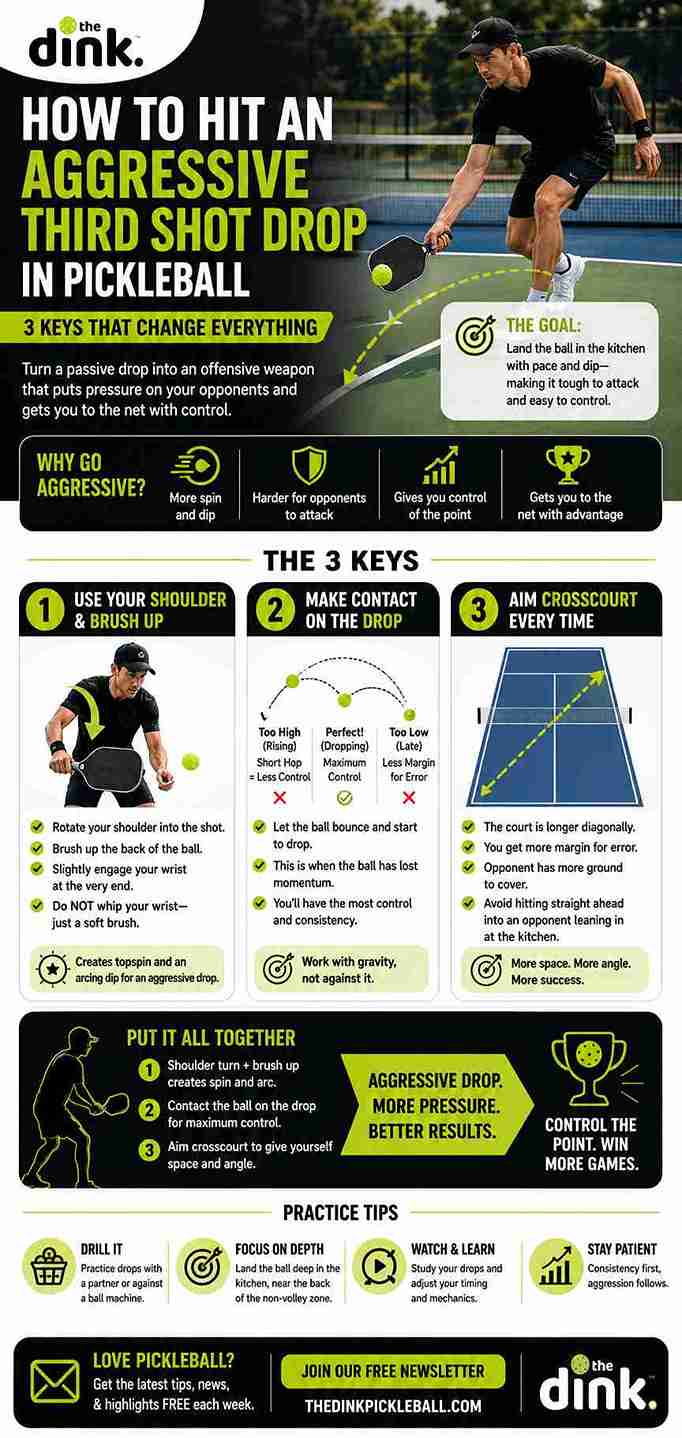
The third shot drop is one of pickleball's most essential shots, and mastering an aggressive version can transform your game. Here are the three keys that separate casual players from competitive ones.
The third shot drop is one of pickleball's most essential shots, and mastering an aggressive version can transform your game.
Here are the three keys that separate casual players from competitive ones.
Most pickleball players treat the third shot drop like a defensive necessity.
They push it softly over the net, hoping it lands in the kitchen and doesn't come back hard.
But what if you could turn that same shot into an offensive weapon?
That's exactly what APP pro Tanner Tomassi breaks down in his latest video.
In under 60 seconds, he reveals three fundamental keys that transform a passive drop into an aggressive, point-winning shot.
Whether you're grinding your way up the competitive ladder or just trying to beat your doubles partner, these principles will change how you approach the third shot drop.
Love pickleball? Then you'll love our free newsletter. We send the latest news, tips, and highlights for free each week.
The Problem With Pushing Your Third Shot Drop
Here's the thing: most players approach the third shot drop with a pushing motion.
They make contact with the ball and guide it over the net with minimal energy. It's safe, sure, but it's also predictable.
When you push your drop, you're not doing much to the opponent. The ball arrives at the kitchen line with little pace, little spin, and little threat.
Your opponent can step in, take it early, and attack you.
You've essentially handed them the initiative.Tanner Tomassi explains that the real magic happens when you change your mechanics entirely.
Instead of pushing, you want to use your shoulder and brush up the back of the ball while slightly engaging your wrist at the very end.
This creates an arcing dip that's fundamentally different from a passive push.
The key distinction: you're not whipping your wrist like a windshield wiper. That's a common mistake.
You're just slightly brushing at the very end of your stroke.
This subtle motion generates the spin and arc that makes an aggressive third shot drop so effective.
Timing Your Third Shot Drop: The Drop, Not the Rise
The second key to hitting an aggressive third shot drop is understanding when to make contact with the ball. This is where most recreational players go wrong.
As the ball approaches you and bounces, you want to make contact when it starts to drop. Not when it's rising.
That rising contact point is called a short hop, and it's the enemy of an aggressive drop.
Why does this matter? When the ball is dropping, it's lost all of its momentum. It's moving at its slowest point. That's your window of opportunity.
When you make contact with a dropping ball, you have maximum control and maximum ability to manipulate it exactly where you want it to go.
Think of it this way: a rising ball is still carrying energy from the bounce. You're fighting against that energy.
A dropping ball is surrendering that energy.
You're working with gravity instead of against it.This timing adjustment alone will improve your consistency dramatically.
💡
Need some new pickleball gear? Get 20% off select paddles, shoes, and more with code THEDINK at
Midwest Racquet SportsCourt Positioning: Why Crosscourt Wins
The third key is perhaps the most strategic: court positioning and shot selection.
If you're going to be aggressive with any shot in pickleball, it's always better to aim crosscourt.
Here's the logic:
The court is longer diagonally. You're giving yourself more margin for error.When you hit crosscourt, you have more space to work with. Your opponent also has to cover more ground to reach the ball.
Avoid going straight ahead if you're trying to be aggressive. Your opponent is leaning in at the kitchen line, ready to pounce on anything that comes their way.
It's very hard to get the ball to bounce when they're positioned right there.
But when you go crosscourt, you're hitting away from their ready position. You're creating angles they have to react to.
This is the kind of strategic thinking that separates competitive players from casual ones.
It's not just about technique. It's about understanding court geometry and using it to your advantage.
Putting It All Together
So you've got the three keys:
- Shoulder rotation with a slight wrist brush.
- Timing your contact on the drop.
- Aiming crosscourt for maximum margin.
How do you actually practice this?
- Start by drilling the mechanics slowly. Get comfortable with the shoulder-and-brush motion without worrying about placement. Once that feels natural, add the timing element.
- Practice hitting balls at different heights and speeds, focusing on making contact when the ball is dropping.
- Finally, add the strategic layer. Play points where you're specifically working on aggressive third shot drops crosscourt. Notice how your opponents react.
Notice how much harder it is for them to attack when the ball is coming from an unexpected angle.
The beauty of this approach is that it's not complicated.
It's three simple principles that compound into a much more effective shot.You're not learning a new stroke from scratch.
You're refining what you already do and making it more intentional.
Why the Third Shot Drop Matters So Much
The third shot drop is arguably the most important shot in pickleball.
It's the shot that determines whether you can get to the net or whether you're stuck at the baseline.
It's the shot that separates players who can compete at higher levels from those who can't.
When you can hit an aggressive third shot drop, you're not just getting to the net. You're getting there with control and confidence.
You're putting pressure on your opponents instead of just hoping they miss.
That shift in mentality changes everything about how you play.💡
Heads up: hundreds of thousands of pickleballers read our free newsletter.
Subscribe herefor cutting edge strategy, insider news, pro analysis, the latest product innovations and more.
Frequently Asked Questions
What's the difference between a third shot drop and a third shot drive?
A third shot drop is a soft, arcing shot designed to land in the kitchen and prevent your opponents from attacking. A third shot drive is a faster, more aggressive shot aimed at winning the point outright. Most players should master the drop first, then add the drive to their arsenal.
How do I know if I'm making contact on the drop or the rise?
Watch the ball's trajectory after the bounce. If it's still moving upward when you hit it, you're hitting on the rise. If it's clearly moving downward, you're hitting on the drop.
Practice with a partner and ask for feedback on your timing until it becomes second nature.
Should I always aim crosscourt with my third shot drop?
Crosscourt is the safer, higher-percentage option because the court is longer and you have more margin. However, once you're comfortable, mixing in some straight-ahead drops can keep your opponents guessing. The key is understanding when each option makes sense strategically.
Can I use this technique in singles and doubles pickleball?
Absolutely. The mechanics and timing principles apply to both formats of the game. In singles, you might have slightly different court positioning considerations, but the fundamental technique remains the same.
How long does it take to master an aggressive third shot drop?
Most players see improvement within a few weeks of focused practice. Mastery takes longer, but the basic mechanics can feel natural within 10-15 hours of deliberate practice. The key is drilling the motion slowly before adding speed and placement.
Anuncie Aqui / Advertise Here
Sua marca para o mundo Pickleball! / Your brand for the Pickleball world!





 English (US) ·
  Portuguese (BR) ·