
 English
  Spanish
  Portuguese
  German
  Italian
  Japanese
  French
  Polish
  Russian
  Netherlands
  Hungarian
  Turkish
  Videos
  Thedink Pickleball

By softening the pace, controlling trajectory, and stabilizing through transition, players can use the reset to regain the kitchen and compete with stronger opponents
Coach Jess (Athena Trouillot) from Athena Pickleball just dropped something that might fundamentally change how you think about your game.
In a recent YouTube video, she breaks down the technical anatomy of the reset shot, and honestly, if you've been stuck at the 3.5 to 4.0 level wondering why you keep losing to better players despite hitting solid shots, this is probably the missing piece you've been searching for.
Love pickleball? Then you'll love our free newsletter. We send the latest news, tips, and highlights for free each week.
The reset is the difference between getting bullied around the court and actually competing with higher-level players.
Athena spent nine months climbing from 3.5 to 5.0, and she credits one skill above all others for that jump. You guessed it: the reset.
What Actually Makes a Good Reset?
Before we get into the technical weeds, let's establish what we're even talking about. A good reset softens the ball. Ideally, it lands in the kitchen or at your opponent's feet. And here's the nuance that matters: it doesn't have to be perfect. If the ball's coming down on their paddle, that's still a pretty good reset.
The whole point of the reset is neutralization. When you're in a defensive position and you can get that ball into the kitchen, you've just given yourself a second chance. You get to come back up to the kitchen line and regain your footing.
Once you start trusting your resets, Athena says it becomes a superpower. You could be playing against the most aggressive hitter on the court, but if you know how to handle their pace, they can't hurt you anymore.
1. Grip Pressure: Wall vs. Cushion
This is where most people mess up without even realizing it. When you're resetting, you need to be stable enough that the paddle doesn't fall out of your hand, but soft enough that you actually absorb the energy of the ball coming at you.
Think about it like this: if you hit a ball against a wall, it comes right back at you with almost equal force. That's what happens when you grip too tightly on a reset. You create a wall, and the ball ricochets off with nearly as much velocity as it came in. This is why you get pop-ups. You've created too strong of a barrier, and you're not softening the ball back where you want it to go.
Now imagine a ball going into something cushiony, like a pillow or a net. It just drops. That's what you're going for. When the ball's coming at you, you want to think about creating a cushion in your hand, similar to how a baseball player catches a hard drive by letting their hands come in and absorb the energy.
So the first principle is straightforward: grip strength matters. Are you holding a wall in your hand, or are you more cushiony and pillowy with your hands? If you're moving into transition and you're stable but your hands are too tight, you'll pop the ball up too high. Soften up, and suddenly that same shot drops right where you want it.
2. Paddle Face Angle and Trajectory Control
Here's where technique meets intention. Sometimes when people are learning resets, they think about punching the ball back. But that's not what's happening. You're thinking about a ball coming into your paddle, and because of the angle of your paddle face, that ball is going to go up, over, and down into the kitchen.
If your paddle is too flush, the ball just comes straight back at your opponent, or worse, it goes into the net. You want your paddle face to be slightly open. On the forehand, this means you've got your elbow in and you should be able to lay your wrist back comfortably. If you can't lay your wrist back, it's usually a grip issue. You might need to move your grip a little to the right into an Eastern grip so you can comfortably lay that wrist back, keep your elbow in, and give that nice little punch with a soft grip.
The paddle face angle is what controls the trajectory. Get this right, and the ball floats exactly where you want it. Get it wrong, and you're either hitting it too hard or sending it into the net.
Heads up: hundreds of thousands of pickleballers read our free newsletter. Subscribe here for cutting edge strategy, insider news, pro analysis, the latest product innovations and more.
3. Stability and Split Step Timing
This is the third technical key, and it ties everything together. When you're moving through transition, you want to stop your body before you hit that reset. You're looking for that moment right before your opponent makes contact. That's when you split step, get your body behind the ball, and put it all together: open paddle face, soft but stable grip, and absorbing the energy of the ball coming at you.
When you're right up at the kitchen line, you might be very, very soft because you only have about 10 to 14 feet to hit that ball. When you're further back, you might need to be a little stronger and give a bit more. But the same rules apply. If a ball's coming hard at you, you need to absorb that energy with a stable base and by catching the ball as it comes to you.
The split step is crucial here. Every time you're about to hit a reset, you're doing that little split step, getting very stable, keeping your legs soft and bent, and absorbing the energy with the other two technical points. As soon as you recognize that you're dropping it into the kitchen or down on their paddle, you're advancing. That's the rhythm.
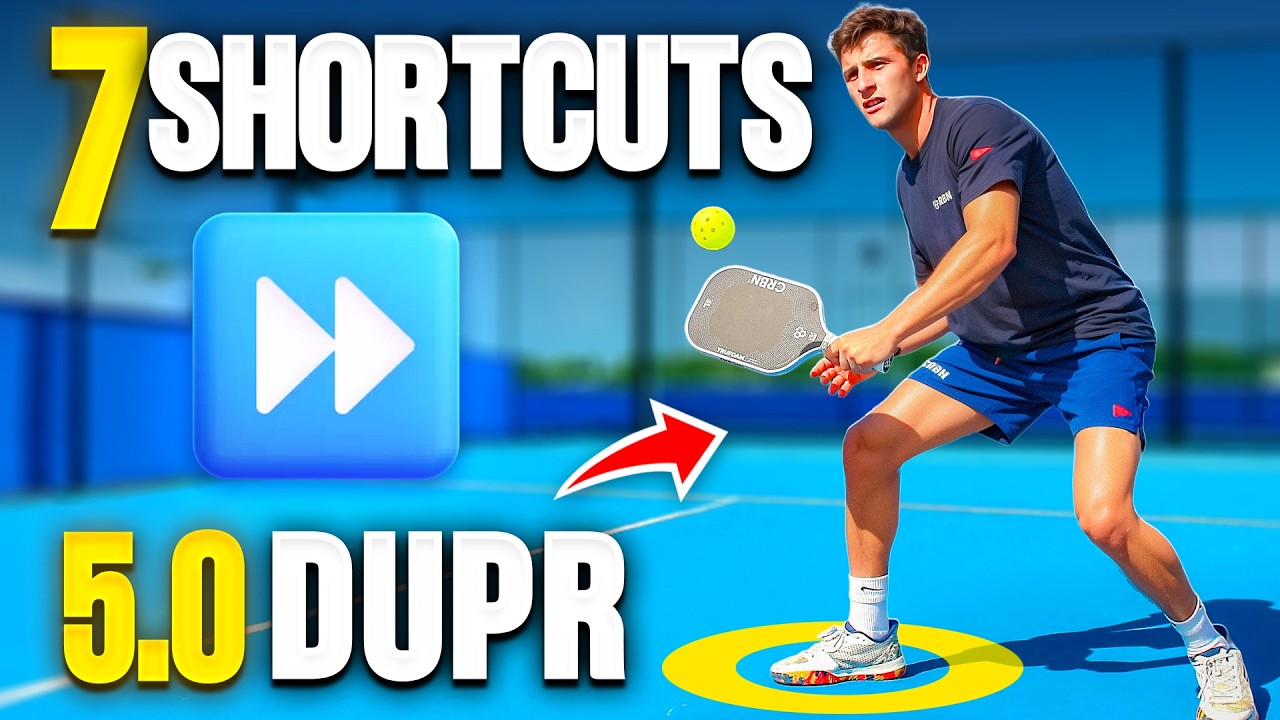
7 Pickleball Shortcuts to Reach 5.0 Faster
None of these shortcuts are revolutionary on their own. But stacked together, they create an entirely different player.
 The Dink PickleballThe Dink Media Team
The Bounce Reset: A Bonus Consideration
There are times in pickleball when you get pushed back and your opponents are on full offensive, paddles going from high to low, and you're just trying to defend for your life. Right off the bounce, the objective stays the same: reset that ball into the kitchen or down on your opponent's paddle so you can move up to the non-volley zone.
What Athena often sees is players keeping their paddle way too high when they're back at the baseline. When you're that far back, you want your paddle a little lower.
First, you don't want to be hitting out balls by swinging way up there. Second, your opponents are trying to get balls at your feet anyway, so a lower paddle position is how you defend.
The key cue for bounce resets is to keep the wrist stable but soft. Instead of flipping it, which creates another pop-up and keeps you in danger, you're catching it in front and pushing the palm forward. Same rules apply: stable base, split step, nice and stable and stationary. You're catching the ball in front and thinking about pushing forward rather than flipping it up.
💡
Need some new pickleball gear? Get 20% off select paddles, shoes, and more with code THEDINK at Midwest Racquet Sports
Putting It All Together: The Reset Drill
Athena includes a practical drill that puts all three technical keys into action. You start with a feed, pop it up, and the point commences. Your goal is to make it to the kitchen and win the point, but here's the catch: you can only reset your way to the kitchen unless you gain an attackable ball through transition. The goal is to stop and reset through the transition zone until you reach the kitchen line.
You can play this for points or just give yourself a point whenever you make it to the kitchen line. You should focus on being stable, working your way through the transition, neutralizing the ball, and getting out of the transition zone to the kitchen.
Why This Matters for Your Game
A good reset doesn't necessarily win you the point. It gives you a chance to get back into it. Sometimes it takes one, two, three, or more resets to get back into a point.
Don't panic. Just figure out where you need to troubleshoot. Is it your grip strength? Is it your base? Are you swinging too much with a closed paddle face? These are typical reasons why a reset might go awry.
If you understand the components of what makes a good reset, you can adjust as needed and start being more consistent with them. That consistency is what separates the 3.5s from the 5.0s. It's not about hitting winners. It's about surviving, neutralizing, and competing.
Anuncie Aqui / Advertise Here
Sua marca para o mundo Pickleball! / Your brand for the Pickleball world!







 English (US) ·
  Portuguese (BR) ·