
 English
  Spanish
  Portuguese
  German
  Italian
  Japanese
  French
  Polish
  Russian
  Netherlands
  Hungarian
  Turkish
  Videos
  Thedink Pickleball

Your ready position is the foundation of every defensive play in pickleball. Master this fundamental technique and you'll react faster, defend better, and win more points.
If you're struggling to react to the next ball in pickleball, your ready position might be the culprit.
According to Angie and Alex Walker of Walker Sisters Pickleball, most players make the same critical mistake: they finish their shot and leave their paddle hanging instead of returning to a neutral stance.
This small lapse costs them precious milliseconds they can't afford to lose.
The ready position isn't just another fundamental to check off your list.
It's the difference between being caught flat-footed and being prepared for anything your opponent throws at you.
Love pickleball? Then you'll love our free newsletter. We send the latest news, tips, and highlights for free each week.
What Exactly Is a Ready Position?
Let's start with the basics. Your ready position is a neutral stance you return to between shots.
According to the Walker Sisters, it's not complicated, but it does require intention.
Here's what a proper ready position looks like: your paddle comes to the middle of your body, creating a triangle with the tip of your paddle and both elbows.
Your feet should be shoulder-width apart, knees slightly bent, and your weight balanced on the balls of your feet.
The paddle itself should be tilted slightly to favor your backhand side, roughly at the 11 o'clock position if you imagine a clock face in front of you.
This positioning matters because it allows you to cover more court with your backhand than your forehand, which is the stronger side for most players.
Why the 11 O'Clock Angle Changes Everything
You might wonder why the paddle angle matters so much. The answer is simple: coverage.
When your paddle is tilted toward your backhand, you can defend a much larger portion of the court without moving your feet.
From the 11 o'clock position, you can cover the entire left side of your body, straight through the middle, and most of the right side.
Only when the ball reaches the far right do you need to flip your paddle and hit a forehand.
This positioning gives you maximum defensive flexibility with minimal movement.
Angie Walker explains it this way:
"I can cover out here all the way through the middle all the way to this side. Once I get to about here, that's when I can flip and hit a forehand."This isn't just theory. It's the positioning that separates players who get caught off-guard from those who stay in control.
💡
Need some new pickleball gear? Get 20% off select paddles, shoes, and more with code THEDINK at
Midwest Racquet SportsThe Three Shots You Need to Be Ready For
Here's where the ready position becomes tactical. When you're in a proper ready position, you're prepared for exactly three things:
- A dink
- A speed-up
- A lob
That's it. Those are your only options. The Walker Sisters use this as a mental anchor when they're playing.
If they get caught off-guard, they ask each other: "What were you ready for?"
It's a way of refocusing and reminding themselves that there are only three possibilities.
Most of the time, you're dealing with dinks or speed-ups. Lobs come rarely. So really, your ready position is designed to handle dinks and speed-ups effectively.
When you're in the proper stance, a speed-up won't surprise you because you're already prepared for it.
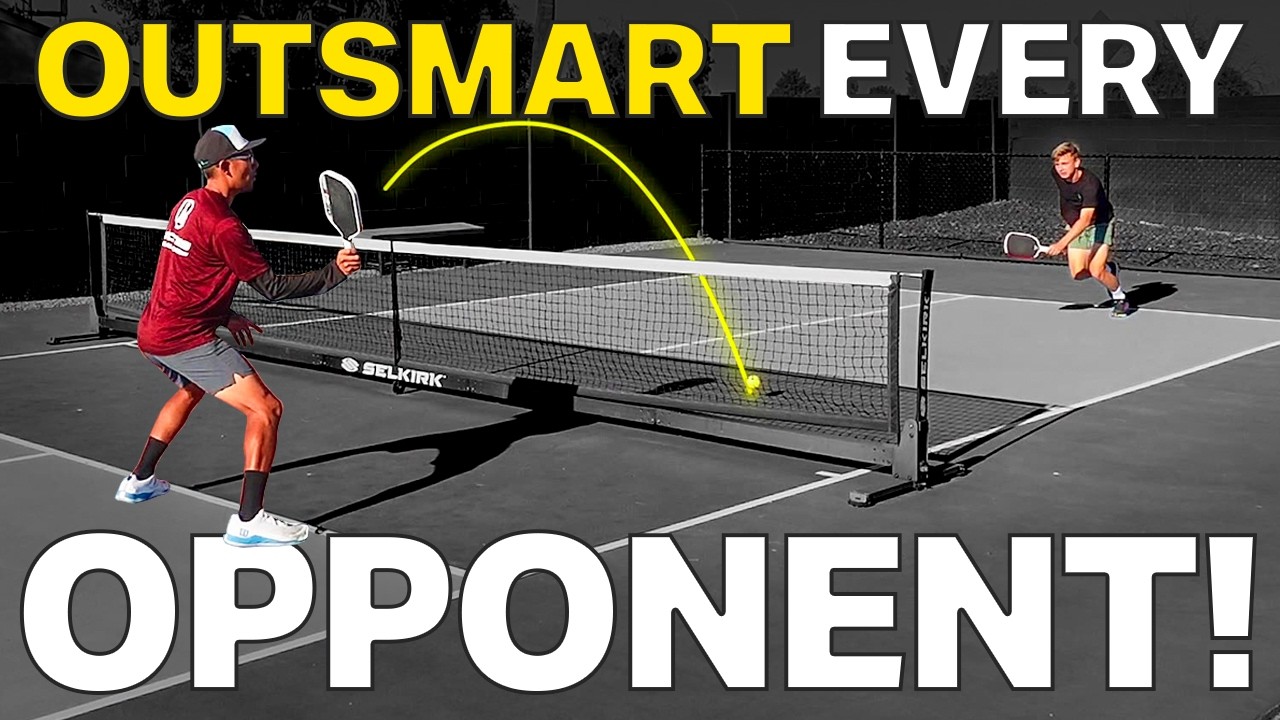
Three Pickleball Shots Every Recreational Player Must Learn
The lob handles defense, the drop volley finishes points with touch, and the ATP gives you an escape route when you’re in trouble.
 The Dink PickleballThe Dink Media Team
What Happens When You Skip the Ready Position
This is where most players go wrong. After hitting a shot, they keep their paddle extended or let it drop to their side.
When the next ball comes back, they're not ready. Their paddle is out of position, their feet are planted, and they're reacting instead of responding.
The difference between reacting and responding is crucial.
Reacting means you're playing catch-up. Responding means you're already in position to handle whatever comes next.A proper ready position turns you into a responder instead of a reactor.
Think about the geometry of the court.
If your opponent has set you up and you're not in your ready position, you're vulnerable to attacks at your shoulder and hip.
These are the spots your opponent will target. But if you're in a proper ready position, you've already closed off those angles.
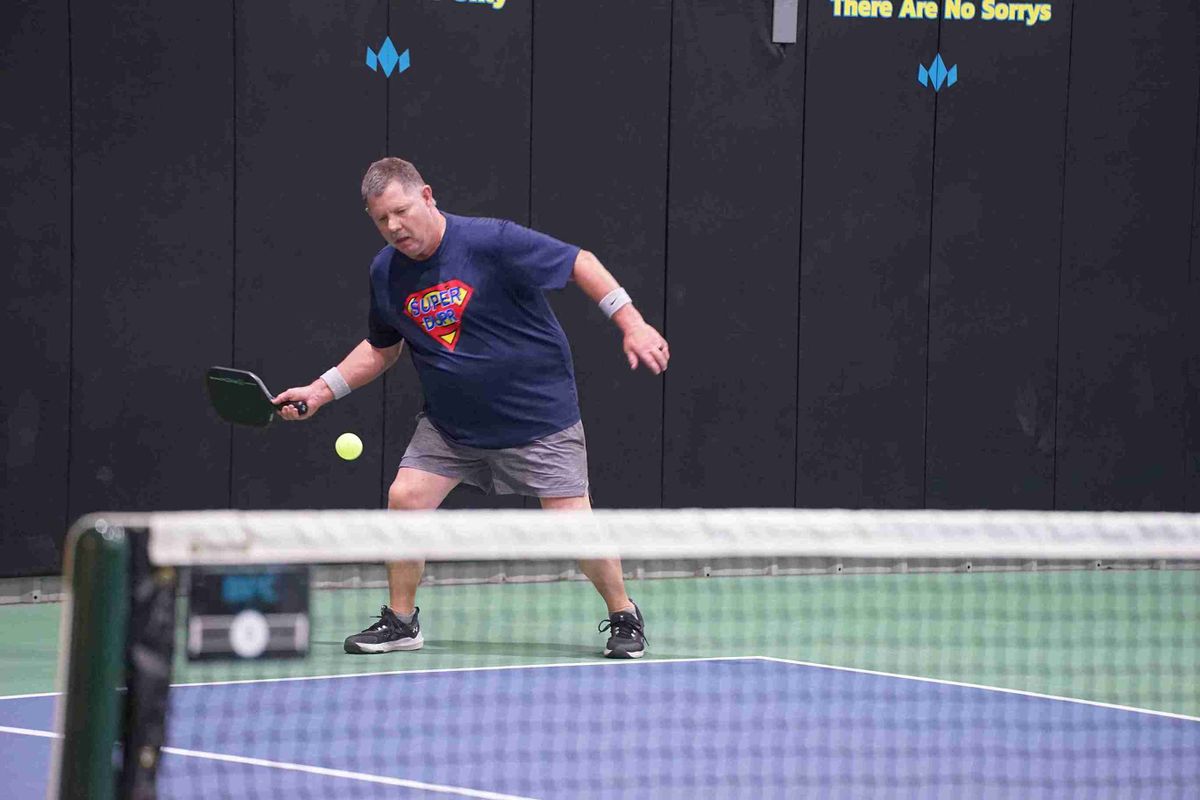
How to Train for Pickleball at Home
You can train for pickleball at home with targeted off-court drills that sharpen footwork, reflexes, and mechanics. Here are 8 drills that actually translate to better play.
The Dink PickleballThe Dink Media Team
The Mental Game Behind the Stance
There's a psychological component to the ready position that often gets overlooked.
When you're in a proper ready position, you feel ready.Your body language communicates confidence to your opponent. You're not scrambling. You're not caught off-guard. You're prepared.
The Walker Sisters joke about this with each other during matches.
When one of them gets caught out of position, the other will ask, "What were you ready for?" It's a gentle reminder to reset and refocus.
But it's also a way of acknowledging that if you're not in your ready position, you're essentially unprepared for the game that's actually happening.
This mental reset is valuable. It brings you back to the fundamentals. It reminds you that pickleball is a game of positioning and anticipation, not just reaction time.
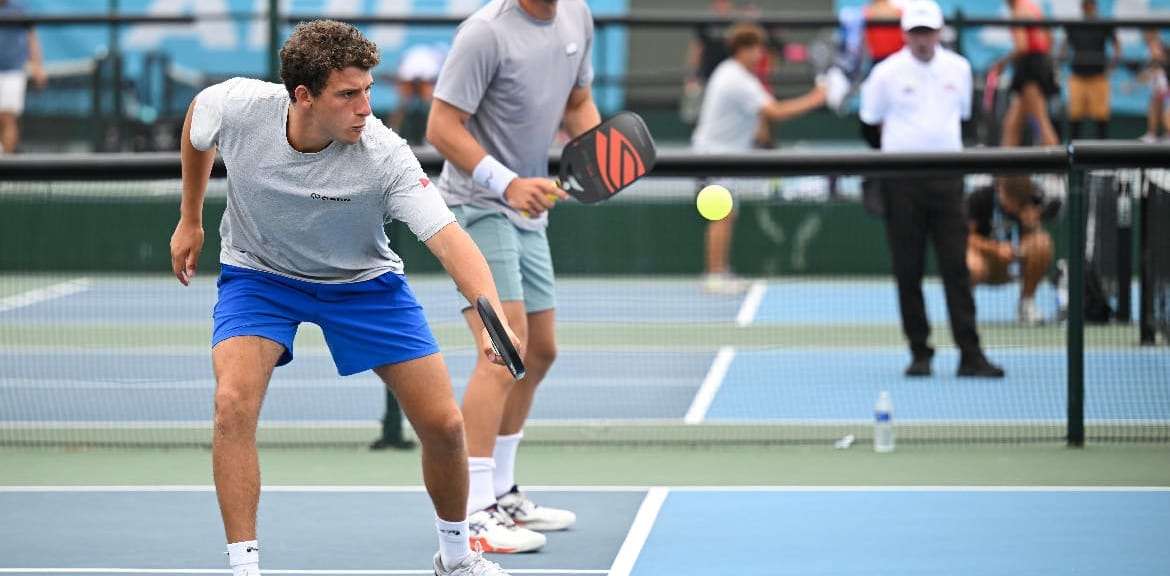
Mental Warfare: What Elite 6.0 Pickleball Players Think During Every Dink
What separates good from great in pickleball is the split-second mental shift that happens the moment the ball leaves the paddle
The Dink PickleballThe Dink Media Team
How to Build the Habit
Building a consistent ready position habit takes practice, but it's worth the effort. Here's what to focus on:
After every shot you hit, consciously return your paddle to the middle of your body.Don't let it drift. Don't keep it extended. Bring it back to center. Make this automatic. The more you practice it, the more natural it becomes.
During drills, focus on the transition. Hit a shot, reset to your ready position, then prepare for the next ball.
This rhythm should become muscle memory. You shouldn't have to think about it during a match.
Watch yourself on video if you can. You'll be surprised how often your paddle drifts out of position. Seeing it visually makes the correction easier to implement.
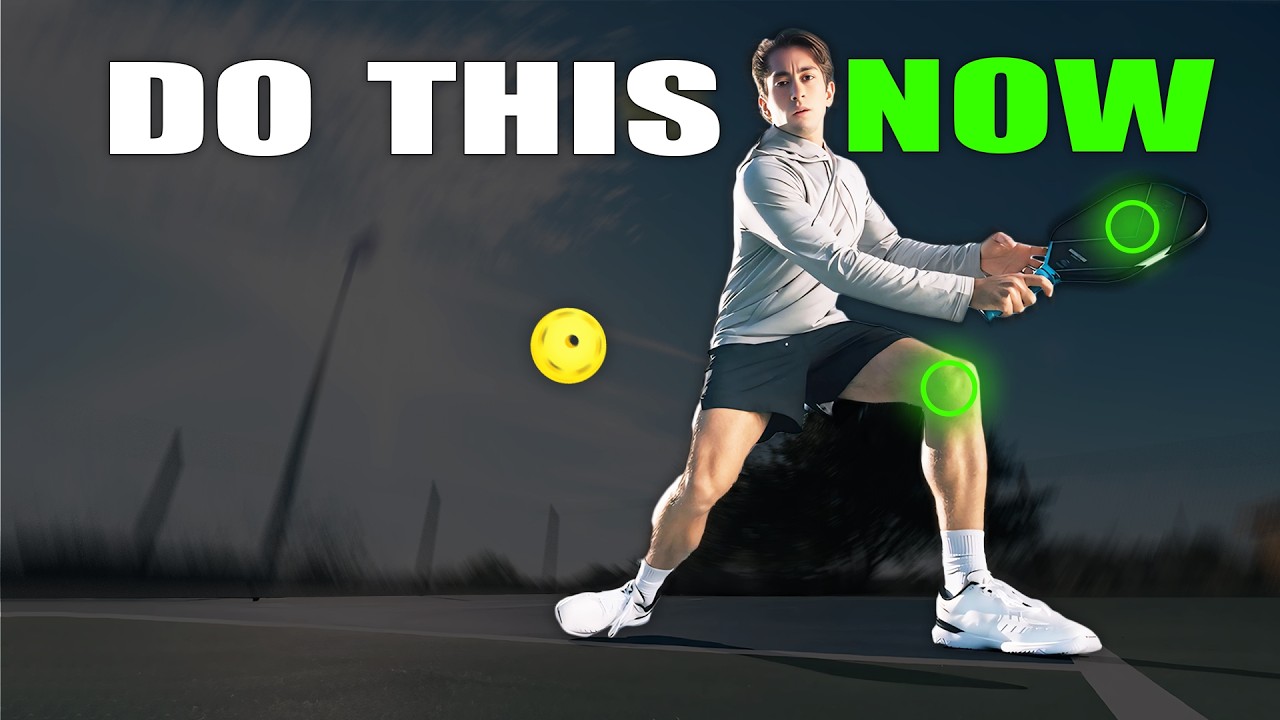
8 Easy Tips to Play More Consistent Pickleball
Maintain complete visual focus on the ball through contact, hit unattackable shots, and always recover back to neutral.
The Dink PickleballThe Dink Media Team
The Bigger Picture: Why Fundamentals Matter
In pickleball, as in most sports, the fundamentals separate good players from great ones.
Your ready position is one of those foundational elements that doesn't get the attention it deserves. It's not flashy. It's not exciting. But it's absolutely essential.
When you master your ready position, everything else improves.Your reaction time gets faster. Your defensive coverage expands. Your confidence grows.
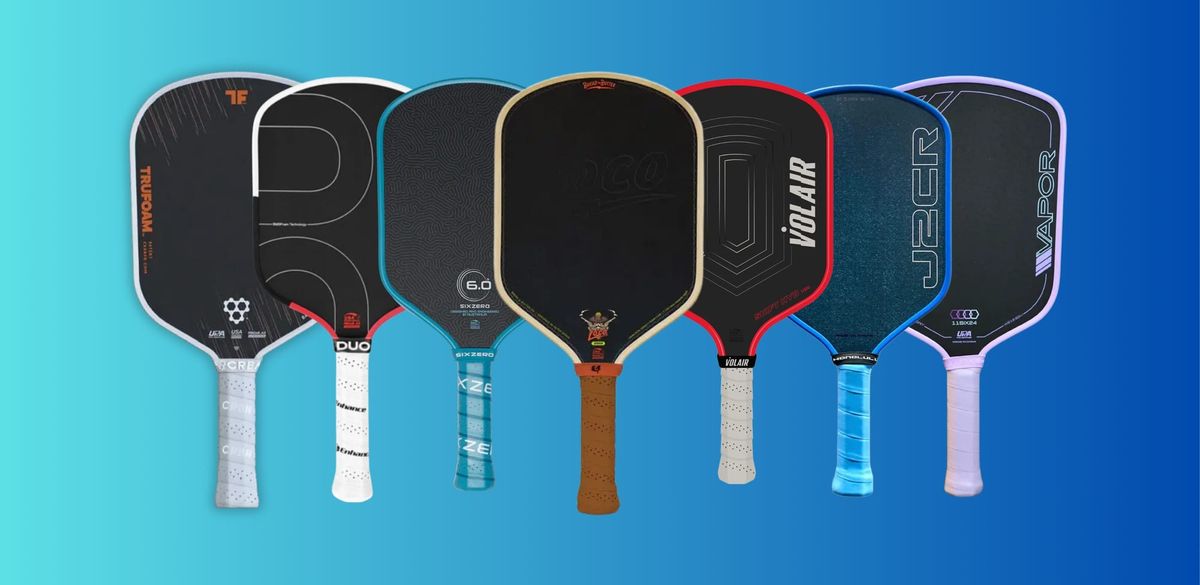
7 Hybrid Pickleball Paddles that Blend Power and Control
None of these are lacking in the oomph department. But their foam cores and hybrid shapes combine to offer more stability, control, and feel when it matters most.
The Dink PickleballAlex E. Weaver
You're no longer scrambling to catch up to the ball. You're already there, waiting for it.
The Walker Sisters have built their teaching around these kinds of fundamental insights.
They understand that most players don't fail because they lack athleticism or hand-eye coordination.
They fail because they're not in the right position when the ball arrives.
💡
Heads up: hundreds of thousands of pickleballers read our free newsletter.
Subscribe herefor cutting edge strategy, insider news, pro analysis, the latest product innovations and more.
Frequently Asked Questions
What's the difference between a ready position and a neutral stance?
In pickleball, these terms are often used interchangeably. Your ready position is the neutral stance you return to between shots. It's the foundation from which you can move in any direction quickly and efficiently.
Can I use a different paddle angle if I'm left-handed?
Absolutely. If you're left-handed, you'd mirror the positioning. Instead of 11 o'clock, you'd aim for 1 o'clock to favor your backhand side. The principle remains the same: position your paddle to maximize court coverage.
How long does it take to develop a consistent ready position habit?
Most players see improvement within 2-3 weeks of focused practice. However, making it truly automatic takes 4-6 weeks of consistent repetition. The key is practicing it during drills and matches, not just thinking about it.
Does my ready position change depending on where I am on the court?
Your basic ready position stays the same, but your distance from the net and your depth on the court will vary. At the net, you'll be closer and more compact. Further back, you might have a slightly wider stance. The paddle angle and body positioning principles remain consistent.
Why do some pros use a different ready position?
While there are minor variations among professional players, the fundamentals remain the same. Most variations come down to personal preference and playing style. The core principle of returning to a neutral, balanced position between shots is universal.
For everything else we do, visit linktr.ee/dinkfam
Anuncie Aqui / Advertise Here
Sua marca para o mundo Pickleball! / Your brand for the Pickleball world!





 English (US) ·
  Portuguese (BR) ·